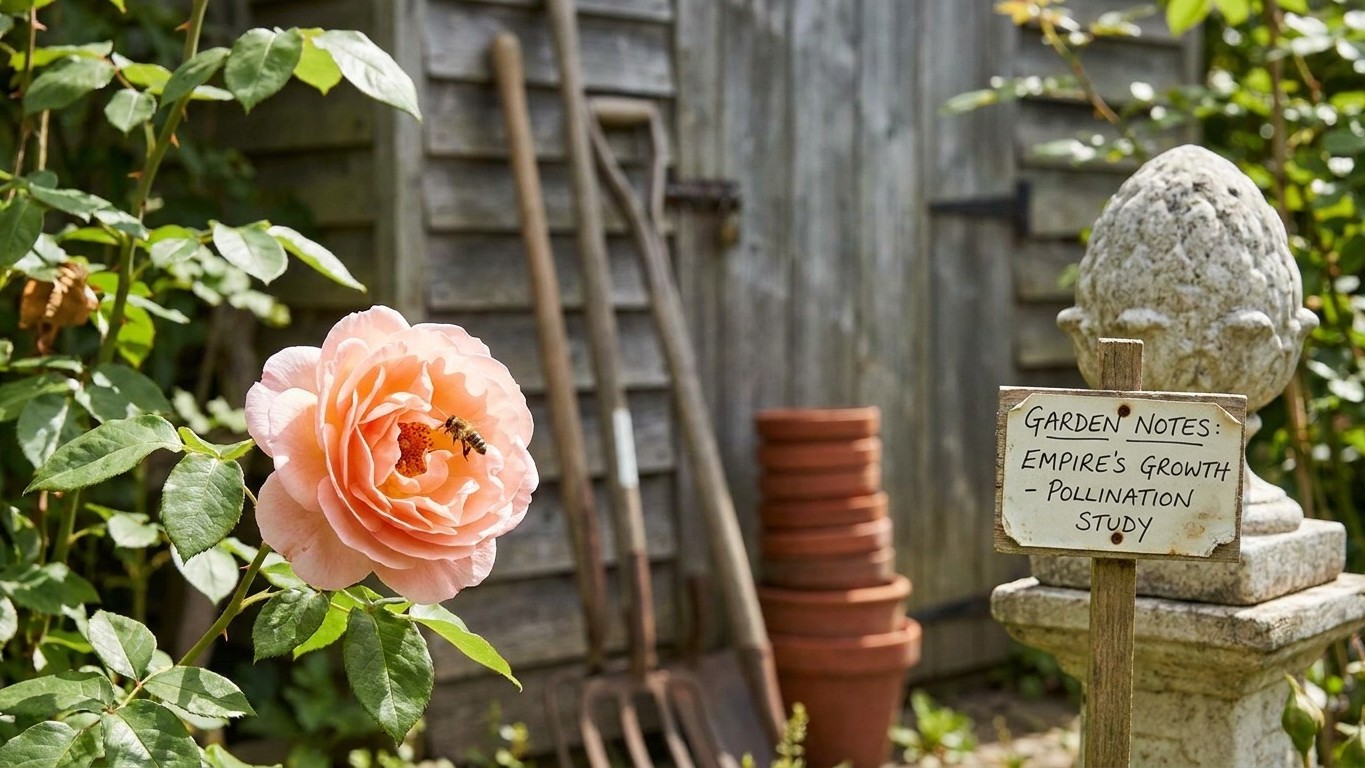

Empire has no named partner variety on record here — that’s the honest answer. What the guide does confirm is a bloom window: Mid season, and that’s the trait any partner has to match, not a specific name pulled from a catalog. Empire is diploid, a McIntosh and Red Delicious cross with fertile pollen, so a standard two-tree pairing works fine once you find a genuine mid-bloom match. Three trees only matter when sterility enters the picture, and Empire isn’t that variety.
The short answer
USU Extension’s guide to apple production for the Utah home garden does not name specific pollination partners for Empire, so no partner variety can be listed with any authority here. What the sheet does confirm is that Empire blooms in the Mid season, and that trait, not any particular cultivar name, is what a partner variety has to share. Any nursery catalog or extension pollination chart listing a variety as mid-season blooming is worth checking against Empire’s own known bloom window before you buy it.
Empire is a diploid apple, a cross of McIntosh and Red Delicious, and diploid varieties carry fertile pollen. That means a standard two-tree planting works for Empire: one Empire, one genuinely compatible mid-bloom partner, each capable of pollinating the other. A third tree only becomes necessary when one variety in the pair is triploid and produces sterile pollen, because a sterile variety accepts pollen and sets fruit but cannot return the favor. Since Empire itself is not one of those varieties, the baseline recommendation stays at two trees, not three, once a genuine mid-season partner has been found.
Other varieties on this site do have documented partner lists, which shows how much this depends on the specific cultivar and the source behind it. Our pages on What Pollinates Fortune, and What Cannot and What Pollinates Sansa, and What Cannot both name partner varieties where the underlying sheets support it. Empire’s own source simply does not, and the honest move is to say so rather than fill the gap with a guess.
Why these varieties and not others

Pollination between two apple varieties depends on timing, not family resemblance or fruit color, and the mechanics apply across the whole crop, as covered in our broader guide to Apple Pollination. Clemson Cooperative Extension explains apple bloom groups as a way of sorting varieties by when their flowers open relative to each other in a given season, running from very early to very late. Two varieties in the same or adjacent bloom group open their flowers close enough together that bees moving between the trees still find open flowers on both, and that overlap is the entire mechanism pollination depends on.
Relative, not calendar-fixed
The important detail in that description is the word relative. A bloom group is not a calendar date. In a cold spring the whole sequence of bloom groups shifts later, and in a warm one it shifts earlier, but a mid-season variety still opens after the early varieties and before the late ones in that same year, wherever it is grown. That is why USU Extension can list Empire’s bloom season as Mid without pinning it to a date, and why that label holds whether the orchard sits in a short, cool season or a long, warm one.
Belonging to the same bloom group is necessary but it is a starting point, not a guarantee. Two varieties can open their flowers in the same week and still fail to pollinate each other for two separate reasons. The first is pollen sterility: some varieties are triploid and their pollen cannot fertilize any other tree’s flowers, even one blooming right beside it. The second is parentage: a variety bred as the deliberate offspring of another cannot be reliably fertilized by that same parent, because the genetics are too close for fruit set to follow. Neither failure shows up on a bloom-group listing, which only tracks timing, not fertility or lineage.
That gap is exactly why a bloom-group match should be treated as the first filter, not the last one. A grower still has to confirm that a candidate partner carries fertile pollen and is not a known parent of the tree it is meant to pollinate before counting on it for a crop.
What cannot pollinate it
USU Extension’s Empire listing does not include a pollination chart, so no specific variety can be ruled out by name here with any authority. What can be explained is the two ways a mid-season partner can still fail Empire even after passing the bloom-timing test, so a grower knows what to check before buying a second tree.
Sterile pollen and parentage
The first failure is sterile pollen. Some apple varieties carry three sets of chromosomes instead of two, a condition called triploidy, and a triploid variety’s pollen cannot fertilize any other apple tree, including one blooming right beside it in the same week. A triploid tree still needs, and benefits from, a pollinator of its own. Planting two triploid varieties together, or a triploid alongside an Empire with nothing else in the garden, produces flowers but no fruit, because neither tree can supply working pollen to the other.
The second failure is parentage. A variety bred as a deliberate cross of two named parents cannot be reliably fertilized by either parent, because the genetic overlap is too close for the cross to set fruit consistently. This rule matters most to growers who assume any two apple trees blooming together will do the job. Pedigree is not printed on a bloom-timing chart, so it has to be checked separately, through the variety’s breeding history rather than its flowering date.
A grower choosing a second variety should confirm both pollen fertility and parentage with the nursery or a local extension office before relying on that tree for a crop.
How close the second tree has to be

Apple pollen moves on bees, not on wind, so distance matters far more for apples than it does for a wind-pollinated crop like corn. The insects doing the work rarely travel far on a single foraging trip, so a partner tree standing in the same yard gets visited by the same bees working the same rounds, while a tree three streets away might as well not exist for pollination purposes even in full bloom.
The tree does not have to be one planted on purpose. Anything blooming at the same time and carrying compatible, fertile pollen can do the job, including:
- A neighbor’s apple tree, if its bloom overlaps Empire’s mid-season window
- An ornamental crabapple flowering nearby at the same time
- A pollinator branch grafted onto an existing tree, carrying a different variety’s flowers
Each of those substitutes still has to clear the same two hurdles as a purpose-planted partner: it has to bloom in the same window, and it has to carry pollen Empire can actually use.
What no partner tree can fix is weather. Bees stay in the hive during cold, wet, or heavily overcast stretches, and if that kind of weather sets in during Empire’s bloom window, the flowers open and close with little or no bee activity between the trees, no matter how close together they stand or how well matched their bloom groups are. No amount of partner planning offsets a bad bloom week. That single fact is why some years produce a light crop even in an orchard with a well-chosen pollinator already in place.
If there is no room for a second tree
A small garden does not rule out pollination, it just changes which route makes sense. Four workarounds let a single-tree garden still get fruit from Empire, each with its own tradeoff.
| Option | What it involves | What it doesn’t solve |
|---|---|---|
| Multi-grafted tree | One trunk carrying several varieties as separate grafted branches | Each grafted variety still has to bloom in Empire’s mid-season window |
| Pollinator branch graft | Grafting a scion of a compatible mid-season variety onto an existing Empire tree | Takes a season or two to grow enough flowers to matter, and needs some grafting skill |
| Columnar variety | A narrow, upright growth habit that fits a second tree into a tight space | Still a whole second tree needing its own root space and a matching bloom time |
| Flowering crabapple | An ornamental tree grown for bloom rather than fruit, chosen to flower with Empire | Produces no apples of its own, and only helps if its bloom truly overlaps Empire’s |
None of these four options changes the underlying requirement. Whatever route a small garden takes, the replacement pollen source still has to bloom during Empire’s Mid season and still has to carry fertile pollen. A columnar tree or a grafted branch that blooms too early or too late helps nothing, however conveniently it fits a tight yard.
Common questions
Can two Empire trees pollinate each other?
No. Two Empire trees are genetically identical, since both were propagated from the same clone, and identical trees do not reliably set fruit off each other’s pollen. You need a genuinely different variety blooming at the same time.
Does Empire ever fruit without a second tree nearby?
Nearly all apple varieties crop better with a compatible partner, and Empire is no exception. A light crop can still occur from a stray pollen source you did not plant on purpose, such as a neighbor’s tree or a wild seedling, but that is not something to plan an orchard around.
My tree bloomed heavily but the crop was tiny, was that a pollination problem?
It might have been, but check the weather during bloom before blaming the variety mix. A cold, wet, or overcast stretch during Empire’s bloom window keeps bees from moving between flowers, and a well-matched partner tree cannot make up for that lost activity.
Does the pollinator tree need to be another Empire?
No, it needs to be a different variety that flowers during the same mid-season window and carries fertile pollen. No such variety is named in USU Extension’s source for Empire, so confirm one with a nursery or local extension office before you plant.
Can a wild or unknown apple tree nearby act as the pollinator?
Possibly, if its bloom genuinely overlaps Empire’s mid-season window, but wild and seedling apples vary widely in bloom timing and are not documented the way named cultivars are. That makes them a gamble rather than something you can plan a crop around.