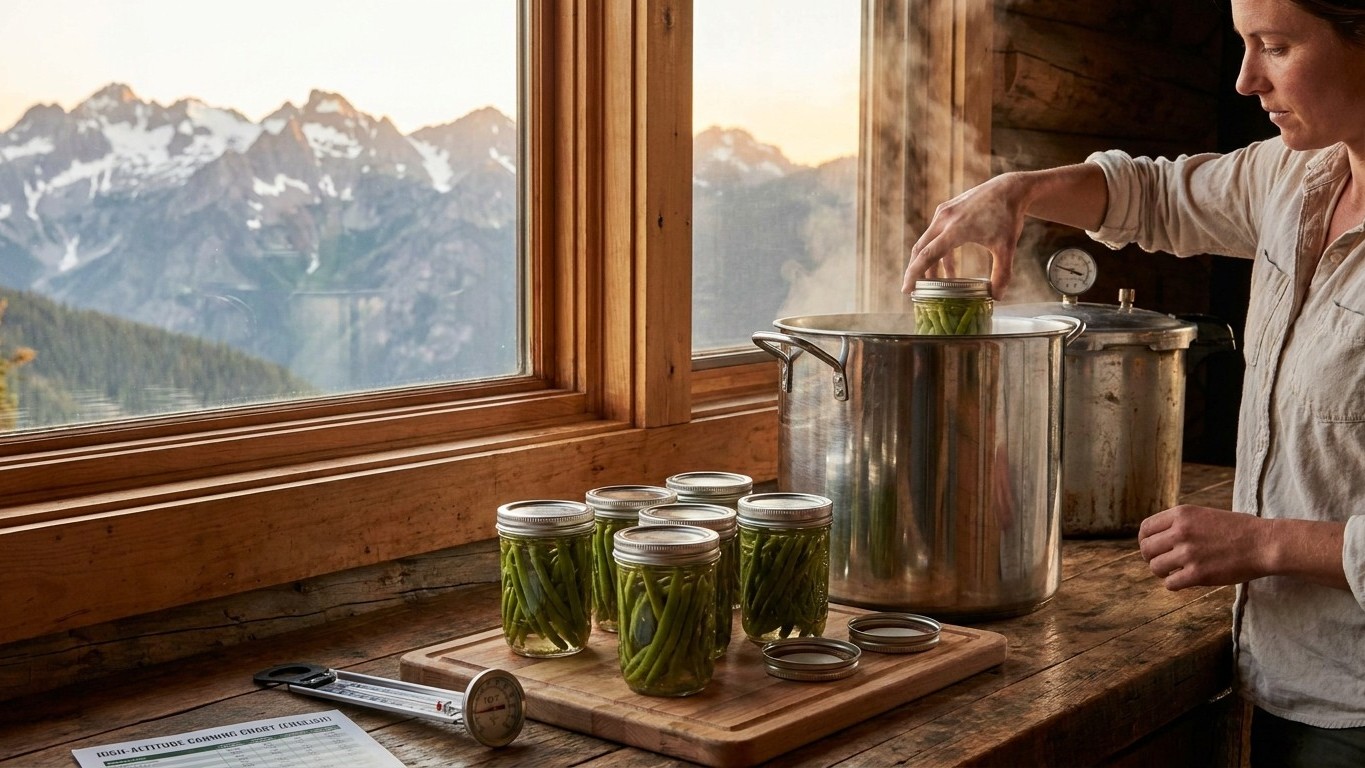

A jar of green beans processed for the same time at 5,000 feet as at sea level can come out under-processed, because water boils at a lower temperature the higher you go. That lower boiling temperature kills fewer bacteria and spores in the same span of minutes, so the fix isn’t a different recipe, it’s a longer processing time or a higher canner pressure for the exact same jar. The National Center for Home Food Preservation, a University of Georgia program, is the reference point for how much longer.
Altitude: Why the Same Jar Needs Longer Up High

The question sounds like a technicality until you look at the numbers. At sea level, water boils at 212 F. That’s the temperature a boiling-water canner reaches, and it’s the number every home-canning time is built around. Climb to 2,000 feet and water boils at 208 F. Keep climbing and it drops further still. The heat doing the work of killing bacteria and inactivating enzymes is simply less intense at the same “boiling” state, so a jar that would be safe after a given number of minutes at sea level may not have reached the same lethal effect at higher elevation in that same window.
This isn’t unique to boiling-water canning, either. Pressure canners are affected too, the pressure needed to reach a safe processing temperature also has to rise with elevation, because the relationship between pressure and temperature shifts along with the drop in boiling point. A dial or weighted-gauge canner set for sea-level pressure at 6,000 feet won’t reach the same internal temperature as that same canner at sea level.
The numbers behind the rule
The USDA Complete Guide to Home Canning, Agriculture Information Bulletin No. 539, lays out exactly how far the boiling point falls as elevation climbs. The National Center for Home Food Preservation adapts these same figures for home canners:
| Elevation | Boiling point of water |
|---|---|
| Sea level | 212 F |
| 2,000 ft | 208 F |
| 4,000 ft | 204 F |
| 6,000 ft | 201 F |
| 8,000 ft | 197 F |
| 10,000 ft | 194 F |
That’s an 18-degree spread between sea level and 10,000 feet. It doesn’t sound dramatic on a thermometer, but in a sealed jar of low-acid food, it’s the difference between a process that reaches the target lethality and one that falls short of it. The remedy is never a change to the recipe itself, it’s an increase in processing time for boiling-water canning, or an increase in pressure for pressure canning, calculated for the elevation where the jar is actually being processed.
What actually decides it
Altitude changes how long or how hard you have to process a jar, but it doesn’t decide whether that jar needs a boiling-water canner or a pressure canner in the first place. That decision comes down to one number: pH 4.6. It’s the dividing line the National Center for Home Food Preservation uses to split every canning recipe into two camps. Foods above pH 4.6 are classified low-acid, red meats, seafood, poultry, milk, and nearly all fresh vegetables — and they require a pressure canner, which reaches 240 to 250 F. Foods at or below pH 4.6 are classified acid, fruits, pickles, sauerkraut, jams, jellies, marmalades, and fruit butters — and those can be safely processed in a boiling-water canner, which tops out at 212 F at sea level.
The reason that line matters so much comes down to a single organism: Clostridium botulinum. Its spores are common in soil and can be present on garden vegetables no matter how carefully they’re washed. Left alone in the open air, they’re harmless. Sealed inside a jar, they can become the source of one of the most dangerous toxins known, and the toxin it produces has no taste and no smell, a jar can look, smell, and taste completely normal and still be unsafe. That’s why the classification of a food, not how it looks or tastes, is what determines the method.
Some foods sit right on that boundary and cause the most confusion. Certain tomato varieties and figs are now known to test slightly above pH 4.6, which is why both are routinely acidified with lemon juice or citric acid before canning rather than treated as automatically safe for a boiling-water bath. When in doubt about where a food falls, the National Center for Home Food Preservation’s tested recipes already reflect the correct classification, which is a safer starting point than guessing.
Clostridium botulinum needs three things at once to grow and produce toxin. Take away any one of them and the risk collapses:
- A moist, low-acid environment — this is removed by acidifying the food or confirming it’s naturally acid, which the pH 4.6 line identifies.
- A temperature between 40 and 120 F — this is removed by heat during processing hot enough to destroy spores, or by refrigeration that keeps food below 40 F.
- Less than 2 percent oxygen — this is exactly what a sealed jar creates, which is why the other two conditions matter so much once a lid seals.
A sealed jar of unprocessed low-acid vegetables checks every one of those three boxes on its own. That’s the entire reason pressure canning exists as a separate, hotter method: it’s the only home process that reliably removes the “moist low-acid” condition for foods that can’t be acidified without changing what they are.
How to do it
The mechanics of canning at any elevation follow the same order every time. What changes with elevation is never the order, it’s the numbers plugged into a couple of these steps, and those numbers come from a tested recipe, not from memory or estimation.
- Select a tested recipe from a source like the National Center for Home Food Preservation that matches the specific food, and confirm whether it calls for a boiling-water canner or a pressure canner.
- Find your elevation using a reliable source rather than guessing from your state or town, since elevation can vary by thousands of feet within a single county.
- Prepare the food and jars exactly as the recipe specifies, including any acidification step for borderline foods like tomatoes or figs.
- Fill the jars, leaving the headspace the recipe specifies, and remove air bubbles as directed.
- Wipe jar rims, apply lids, and load the jars into the canner.
- Process for the length of time and, for pressure canning, at the pressure the recipe specifies for your food and your elevation, the recipe itself will list an adjustment for elevation ranges, and that adjustment is what you follow, not a number you calculate yourself.
- Turn off the heat, allow the canner to depressurize or cool as instructed, then remove the jars and let them cool undisturbed.
- Check each seal once jars are fully cool, and label and store only the jars that sealed properly.
What goes wrong
- You realize partway through that you used the sea-level time at a higher elevation. Stop and don’t count that batch as safely processed. If the jars already cooled and sealed, the safest choice is to discard the contents rather than eat food that may not have reached a lethal temperature for spores, since there’s no way to test doneness after the fact.
- A jar doesn’t seal. Refrigerate it and eat the contents within a few days, or reprocess it promptly with a new lid using the full time from the original recipe, adjusted for your elevation.
- You’re not sure whether your elevation qualifies for an adjustment. Look it up rather than estimate, elevation changes are gradual, and a location that feels “basically at sea level” can already be a few hundred feet up, which is enough to matter depending on the recipe’s adjustment brackets.
- A tomato or fig recipe doesn’t mention acidification. Treat that as a red flag rather than an oversight. Both foods can sit close to pH 4.6, and a tested recipe from the National Center for Home Food Preservation will always include an acidification step for them.
- A jar looks and smells fine months later, but you’re unsure it was processed correctly. Appearance and smell tell you nothing about botulinum toxin, which has no taste and no smell. If there’s real doubt about the process used, the jar should be discarded, not tasted to check.
Where the exact times come from
A tested time belongs to a tested recipe for a specific food, a specific jar preparation, and a specific elevation range, pull any one of those pieces out of context and the number no longer means what it did in testing. The National Center for Home Food Preservation publishes recipe-specific pages for exactly this reason, along with a “Find Your Elevation” page, because elevation isn’t something a state-level guess can answer reliably.
The stakes are why this matters more than most kitchen details. Botulinum toxin has no taste and no smell, so a jar that was processed for the wrong length of time at the wrong elevation gives no warning sign before it’s opened and eaten. The safe path is always the same: match the food to a tested recipe, find the correct elevation, and follow the adjustment that recipe specifies.
Common questions
Does altitude affect acid foods the same way it affects low-acid foods?
Yes. Boiling-water processing times for acid foods like fruits and pickles also need to increase with elevation, because the boiling point drop applies regardless of what’s in the jar. The adjustment is built into tested recipes for both canning methods.
Can I just add extra time “to be safe” instead of looking up my elevation?
Guessing at extra time isn’t a reliable substitute for the specific adjustment a tested recipe calls for at your actual elevation, since the relationship between elevation, boiling point, and required time isn’t linear or intuitive.
Does elevation change which canning method a food needs?
No. Elevation changes the time or pressure within whichever method the food’s pH already requires. A low-acid food still needs a pressure canner at any elevation, and an acid food can still use a boiling-water canner at any elevation.
How often does my elevation actually change enough to matter?
It doesn’t change, but your assumption about it might be wrong. Many home canners have never checked their exact elevation and assume “close to sea level” when they’re actually high enough to need an adjustment, which is exactly why the National Center for Home Food Preservation offers a dedicated way to look it up rather than estimate it.