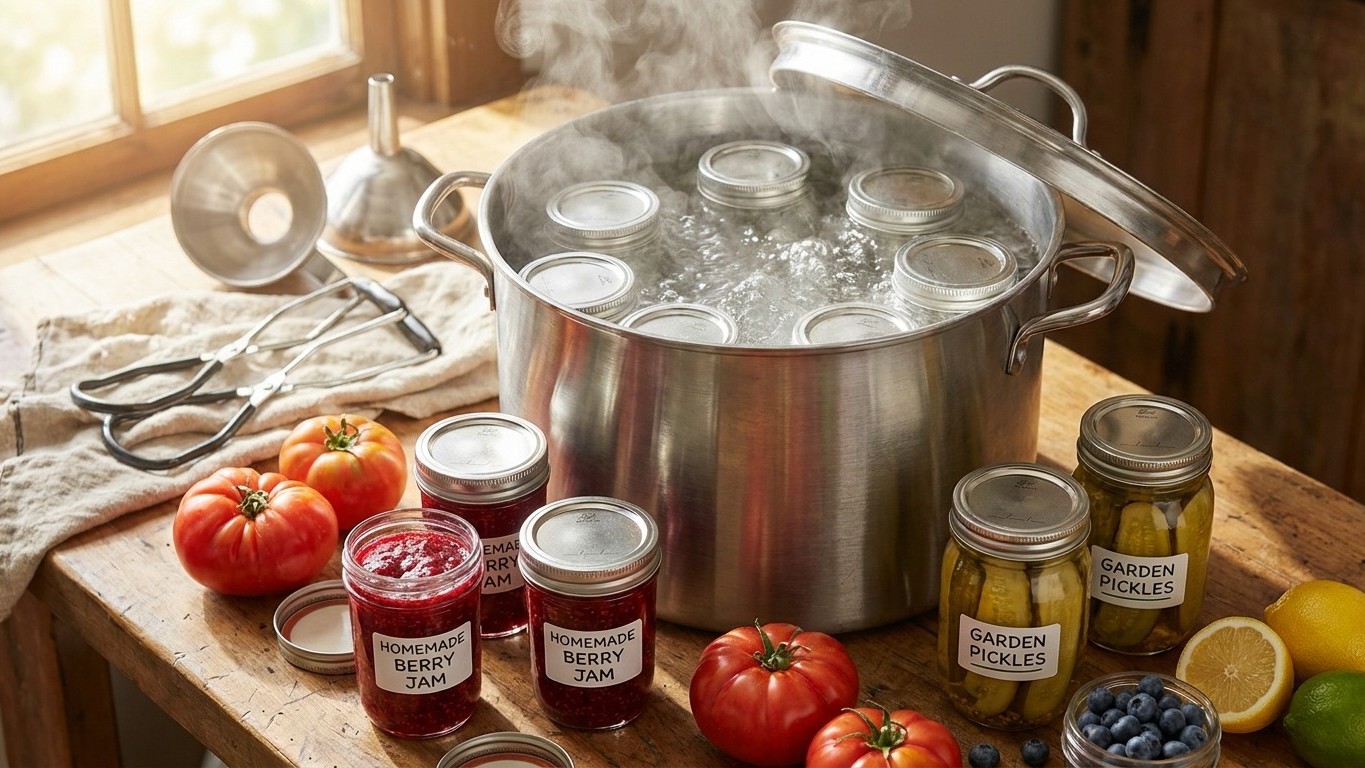

A boiling-water canner processes only foods with a pH at or below 4.6, the acid foods such as fruits, pickles, jams and tomatoes that have been properly acidified. It cannot safely process low-acid foods like vegetables, meats or poultry, because its water never gets hotter than 212°F at sea level. That single number is why the method has a hard boundary, not a gray zone.
The Boiling-Water Canner: What It Can and Cannot Do

According to the National Center for Home Food Preservation at the University of Georgia, the line that separates what this canner can and cannot handle is pH 4.6. Foods above that number are classified as low-acid; foods at or below it are classified as acid. A boiling-water canner, which brings water to a rolling boil and holds jars at 212°F at sea level, is built for the acid side of that line only. It was never designed to reach the higher temperatures that low-acid foods require for safety.
Acid foods vs. low-acid foods
The acid category covers fruits, pickles, sauerkraut, jams, jellies, marmalades and fruit butters. The low-acid category covers red meats, seafood, poultry, milk and nearly every fresh vegetable. Two exceptions deserve attention: most tomatoes and figs. Both are now known to sit at pH values slightly above 4.6, which puts them at risk of drifting into low-acid territory depending on variety and ripeness. That is exactly why tested recipes call for acidifying them with a measured amount of lemon juice or citric acid before they go in the jar, rather than trusting the fruit alone.
The 212°F ceiling
Water boils at a lower temperature as elevation rises, and a lower boiling temperature kills less. This is documented in the USDA Complete Guide to Home Canning (Agriculture Information Bulletin No. 539), which explains that a boiling-water canner working at altitude needs a longer process time to compensate for the drop in boiling point. What it cannot do is boil harder to make up the difference. Boiling water simply does not get hotter once it reaches its boiling point, no matter how high the burner is turned up. That physical ceiling is the whole reason low-acid foods are pushed to a different method entirely, one that can climb past 212°F.
What actually decides it
The decision about which canner a food needs is not a matter of tradition or taste. It comes down to a specific bacterium, Clostridium botulinum, and the exact conditions it needs to grow and produce toxin. Remove any one of those conditions and the risk collapses. Leave all three in place, and a sealed jar becomes an ideal incubator.
- A moist, low-acid food. Acidifying a food to pH 4.6 or below removes this condition, because the bacterium cannot grow in that environment. This is the entire logic behind adding lemon juice to tomatoes or vinegar to a pickle brine.
- A temperature between 40 and 120°F. Refrigeration below 40°F or a canning process hot enough to destroy spores removes this condition. A boiling-water canner reaches 212°F, which is enough to destroy the microorganisms found in acid foods, but not enough to destroy the more heat-resistant spores that survive in low-acid ones.
- Less than 2 percent oxygen. An open, unsealed container removes this condition by keeping oxygen available. A vacuum-sealed jar does the opposite: it creates exactly the low-oxygen environment the bacterium needs.
A sealed jar of unprocessed vegetables supplies all three conditions at once. It is moist, it sits at room temperature, and the seal keeps oxygen out. That combination is precisely why raw-packed low-acid vegetables cannot simply be sealed in a jar and left on a shelf, and why they require a pressure canner capable of reaching 240 to 250°F rather than a boiling-water bath. Once a reader understands this set of three conditions, classifying any food they have never canned before becomes a matter of asking two questions: is it acid or low-acid, and has it been acidified to pH 4.6 or below? The answer determines the method, not the recipe’s tradition or how a grandmother once did it.
How to do it
The sequence below describes the order of operations for a boiling-water canner. It intentionally leaves out processing times, headspace amounts and jar sizes, because those numbers belong to a tested recipe for a specific food, not to the method in general.
- Wash jars, lids and bands in hot, soapy water and check jar rims for nicks or cracks.
- Prepare the food exactly as a tested recipe directs, including any acidification step for tomatoes or figs.
- Fill the hot jars with the hot food, leaving the headspace the recipe specifies.
- Remove trapped air bubbles by sliding a nonmetallic spatula along the inside of the jar.
- Wipe the jar rim clean so no food residue interferes with the seal.
- Center a lid on the jar and screw the band down to fingertip tightness.
- Lower the filled jars into the canner, using a rack to keep them off the bottom.
- Add enough water to cover the jar tops by the amount the recipe specifies.
- Bring the canner to a full, rolling boil before starting the timer.
- Process for the time given in the tested recipe, adjusting for elevation as instructed.
- Turn off the heat, remove the canner lid, and let the jars sit briefly before lifting them out.
- Set jars upright on a towel or rack, undisturbed, until fully cooled.
- Check each seal, then label and store only the jars that sealed properly.
What goes wrong
- A lid doesn’t seal. Refrigerate that jar and use its contents within a few days, or reprocess it with a new lid within 24 hours following the same tested recipe from the start.
- Liquid siphons out during processing. This usually comes from a rapid pressure change, often from lifting the canner lid too soon or a sudden temperature drop. If the jar still sealed, the lower liquid level does not make it unsafe; just note the seal is intact before storing it.
- The liquid inside turns cloudy. This can signal spoilage bacteria, mineral content in the water used, or starch released from the food itself. If the jar shows any sign of spoilage such as an off odor, spurting liquid, or a bulging lid, it should be discarded without tasting it, since botulinum toxin has no taste and no smell.
- A jar breaks in the canner. This is often caused by a jar with a hidden flaw, extreme temperature differences between the jar and its contents, or overtightened bands. Let the canner cool, then carefully remove glass fragments and discard the contents.
- Food floats to the top of the jar. This is a cosmetic issue caused by air trapped in the food or overpacking, not a safety problem. The jar is still safe to store if the seal is good.
- White sediment settles at the bottom. This is typically minerals from hard water or starch from the food, not a sign of contamination, provided the seal held and no other spoilage signs are present.
Where the exact times come from
A tested time belongs to a tested recipe, matched to a specific food, jar size and altitude. Borrowing a time from a different food, or estimating one, removes the safety margin that testing built in. The reader looking for the number for their specific food should go to the National Center for Home Food Preservation at nchfp.uga.edu, which publishes tested recipes and processing times for individual foods. This matters because an under-processed jar shows no warning sign: botulinum toxin has no taste and no smell, so the jar that looks and smells perfectly normal can be the dangerous one.
Common questions
Can a boiling-water canner be used for vegetables like green beans or carrots?
No. Fresh vegetables are low-acid, and a boiling-water canner cannot reach the temperature needed to destroy the spores that survive in that environment. They require a pressure canner.
Are tomatoes always safe in a boiling-water canner?
Only when acidified. Some tomato varieties sit at pH values slightly above 4.6, so tested recipes call for added lemon juice or citric acid before processing.
Does boiling the water longer make up for a shorter processing time?
No. Boiling water does not exceed 212°F at sea level no matter how long or hard it boils. Adjustments for safety come from processing time and elevation, not from boiling intensity.
How can someone tell if a sealed jar is contaminated?
They generally cannot by taste or smell. Botulinum toxin is undetectable that way, which is why following a tested recipe’s exact process time is the only reliable safeguard.