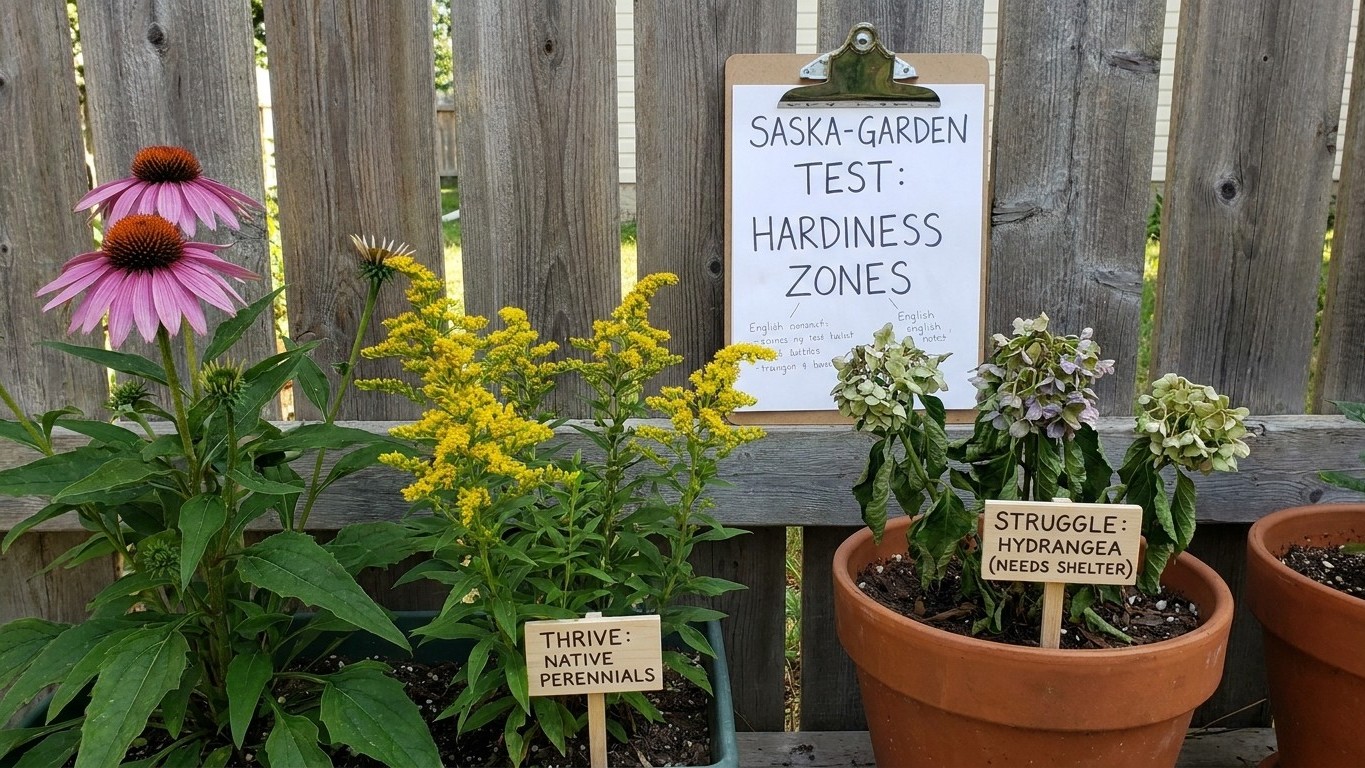

Peonies outlast almost everything else you might put in a Saskatchewan border, and that one fact sets the whole planting strategy. Saskatoon sits in Canadian hardiness zone 3a, cold enough that flowers bred for milder climates either die back hard or don’t come back at all. Build the framework of a bed from perennials rated hardy to zone 3 or colder, things like Siberian iris, daylilies and purple coneflower, and treat anything rated zone 5 or warmer, dahlias, hybrid tea roses, tender hibiscus, as a plant you dig up in fall or simply replace every spring.
Putting a border together
A Saskatchewan border runs on a shorter clock than one in Ontario or the northern United States. Environment and Climate Change Canada’s 1981-2010 climate normals for the Saskatoon SRC station put the average last spring frost at May 18 and the average first fall frost at September 18, which works out to roughly 123 frost-free days in a typical year. That figure is a mean, not a promise. In about half of all years the real frost lands later than May 18, so treat that date as the middle of a window rather than a green light to plant tender stock. Winter, more than any single summer heat wave, is the bigger filter here. The mean daily minimum of the coldest month at Saskatoon, per ECCC’s 1981-2010 normals, sits at -20.7°C, and that number is what actually decides which perennials survive from one year to the next. For frost dates and hardiness detail specific to other parts of the province, our other Saskatchewan guides go deeper region by region.
Layering by height
Start the back row with plants that can take the cold without fuss. Delphiniums push flower spikes several feet tall in a single summer and don’t mind a cool, wet June the way some tropicals do. Peonies, planted once and left alone, build into waist-high clumps that outlive the gardener who planted them, and they need almost nothing once established. In the middle layer, Siberian iris and daylilies hold their own through a prairie winter without lifting, dividing, or covering of any kind. Bring the front of the border down with catmint (Nepeta) and low sedums like ‘Autumn Joy’, both of which shrug off a dry August as easily as a cold April.
Keep the tallest plants out of the prevailing wind’s direct line, or stake them early, because prairie wind snaps a delphinium spike faster than an early frost ever will. Staking after the plant has already started to lean rarely saves it. The stake needs to go in when the plant is a foot tall, not when it’s already six feet and top-heavy.
Succession of bloom across the season
With roughly four months of usable garden time between the average May and September frost dates, gaps in bloom show up fast if everything in the bed is timed for the same three weeks. Open the season with perennials that don’t mind a late cold snap: bergenia and species tulips push through while there’s still a real chance of frost, and they lose nothing if a cold night catches them mid-bloom. Mid-summer is carried by peonies, delphiniums, and the daisy family, black-eyed Susan (Rudbeckia hirta) and purple coneflower (Echinacea purpurea) among them, both rated hardy well into zone 3 and both still blooming through the hottest stretch of the year. Close out the season with sedum and asters, which hold their color right up to the first fall frost and sometimes past a light one.
Annuals fill the gaps a perennial-only bed leaves behind. Cosmos, calendula and marigolds mature fast enough to flower and often reseed within a single Saskatchewan summer. Sweet peas do better here than in a hotter climate, since they actually prefer cool nights to the muggy heat that stalls them further south. None of these need to be started indoors to bloom on time, though a head start under lights in March buys extra weeks of color later.
Repeating color and leaving room at planting
A border reads as designed, not scattered, when the same two or three colors show up in at least three places along its length. Repeat a purple, catmint or delphinium, at intervals rather than clumping all of it in one corner, and let a warm color like the black-eyed Susans echo it from the other end of the bed.
Leave more space between young perennials than looks right in the first year. Peonies and daylilies both spread into their mature width within three or four seasons, and a bed planted tight to look full on day one becomes a crowding problem by year three, not a finished one. A patch of bare soil in May is not a mistake. It’s room the plant is going to need by August of the year after next.
The flowers that struggle here
Some garden-center favorites fight the climate every single year instead of settling into it. Bigleaf hydrangea (Hydrangea macrophylla), the mophead type sold everywhere in spring, is bred for winters far milder than Saskatoon’s and typically dies back to the snowline or worse. Hybrid tea roses survive most winters only with a soil mound or a rose cone over the crown, and even then often lose most of their canes to that -20.7°C mean minimum. Lavender (Lavandula angustifolia) is marginal at best, rated for winters gentler than this one, and a season with thin or late snow cover will often kill it outright rather than just setting it back. Large-flowered clematis varieties that bloom on old wood lose that wood to winterkill most years and simply skip the early flush of flowers.
None of this means skip these plants. It means budget for them as replacements or grow them as annuals rather than long-term investments, the same way you’d treat frost-tender bulbs. Saskatoon’s own weather station, per Environment and Climate Change Canada’s 1981-2010 normals, records only about 5 days a year reaching 32°C and closer to 13 days above 30°C, so a Saskatchewan summer isn’t short on warmth in the moment. It’s short on total days, and a dahlia or canna lily needs more calendar than the frost-free window reliably hands over without an indoor head start.
- Dahlias: dig within a week or two of the first fall frost, dry the tubers, store cool and dark
- Gladiolus corms: same treatment, lift before the ground freezes
- Canna lily rhizomes: lift and store like dahlias, or grow as a potted annual you bring indoors
- Tuberous begonias: lift before frost or grow only in containers you can move under cover
Gardeners further north face this same trade-off in a more extreme form, with an even shorter frost-free window than Saskatoon’s, and our Yukon flower guide covers what that does to bulb choices. A state with a longer, hotter summer, Iowa among them, can leave those same tender bulbs in the ground weeks longer before lifting, a comparison our Iowa flower guide lays out in more detail.
| Flower | Height | Bloom window | How it does in Saskatoon’s zone 3a |
|---|---|---|---|
| Peony | 2-3 ft | Early to mid summer | Thrives, effectively permanent once established |
| Siberian iris | 2-3 ft | Early summer | Thrives, no lifting or winter cover needed |
| Delphinium | 4-6 ft | Mid summer | Thrives, but needs staking against prairie wind |
| Purple coneflower | 2-3 ft | Mid to late summer | Thrives, reliably hardy through zone 3 |
| Dahlia | 2-4 ft | Mid summer to frost | Struggles, tubers must be lifted every fall |
| Lavender | 1-2 ft | Mid summer | Struggles, often winterkilled without heavy protection |
| Bigleaf hydrangea | 3-5 ft | Summer | Struggles, dies back to the snowline most winters |
Local help
The fastest way to get a plant list matched to your actual yard, rather than to Saskatoon’s climate normals in general, is a Master Gardener program run through a local horticultural society. Many hold plant clinics and sales where you can see a mature ‘Autumn Joy’ sedum or a hardy shrub rose in person by August, not just read a catalogue description of one. Saskatchewan’s provincial agriculture and extension service also publishes region-specific growing guidance, useful because a yard two hours north of Saskatoon runs colder and shorter-seasoned than the SRC station figures used throughout this page. Treat every date and temperature here as a Saskatoon-area baseline and adjust colder the further north or higher in elevation your own garden sits.
Common questions
Do peonies need winter mulch in Saskatchewan?
Established peonies rarely need it once they’ve been in the ground two or three winters, since the species is rated hardy well past Saskatoon’s zone 3a. A newly planted peony benefits from a layer of straw or leaf mulch after freeze-up, pulled back again in spring so the crown doesn’t sit wet and rot.
Can I leave dahlia tubers in the ground over winter?
No. Dahlias are frost-tender through and through, and the tubers have no chance against a winter where the coldest month averages a daily minimum near -20.7°C. Dig them within a week or two of the first fall frost, let them air dry, and store them somewhere cool and dark until the frost risk has passed the following spring.
Why did my lavender die over the winter?
Most likely because it’s simply rated for a milder winter than Saskatoon gets. Lavandula angustifolia sits at the edge of what zone 3a can support even under snow cover, and a winter with thin or late snow leaves the roots exposed to temperatures well below what the plant was bred to handle. Grow it as an annual, or in a large pot you can move somewhere sheltered, if you want more than one season out of it.
Is my yard the same hardiness zone as Saskatoon?
Not necessarily. The zone 3a rating from Natural Resources Canada’s Plant Hardiness Site applies to Saskatoon specifically, built from 1991-2020 climate normals, and a yard further north, higher in elevation, or sitting in a low frost pocket can run noticeably colder. Check Natural Resources Canada’s plant hardiness map for your own municipality rather than assuming the Saskatoon figure covers your particular garden.
Related guides
- Flowers That Actually Thrive in Alberta, and the Ones That Struggle
- Flowers That Actually Thrive in Manitoba, and the Ones That Struggle
- Flowers That Actually Thrive in Yukon, and the Ones That Struggle