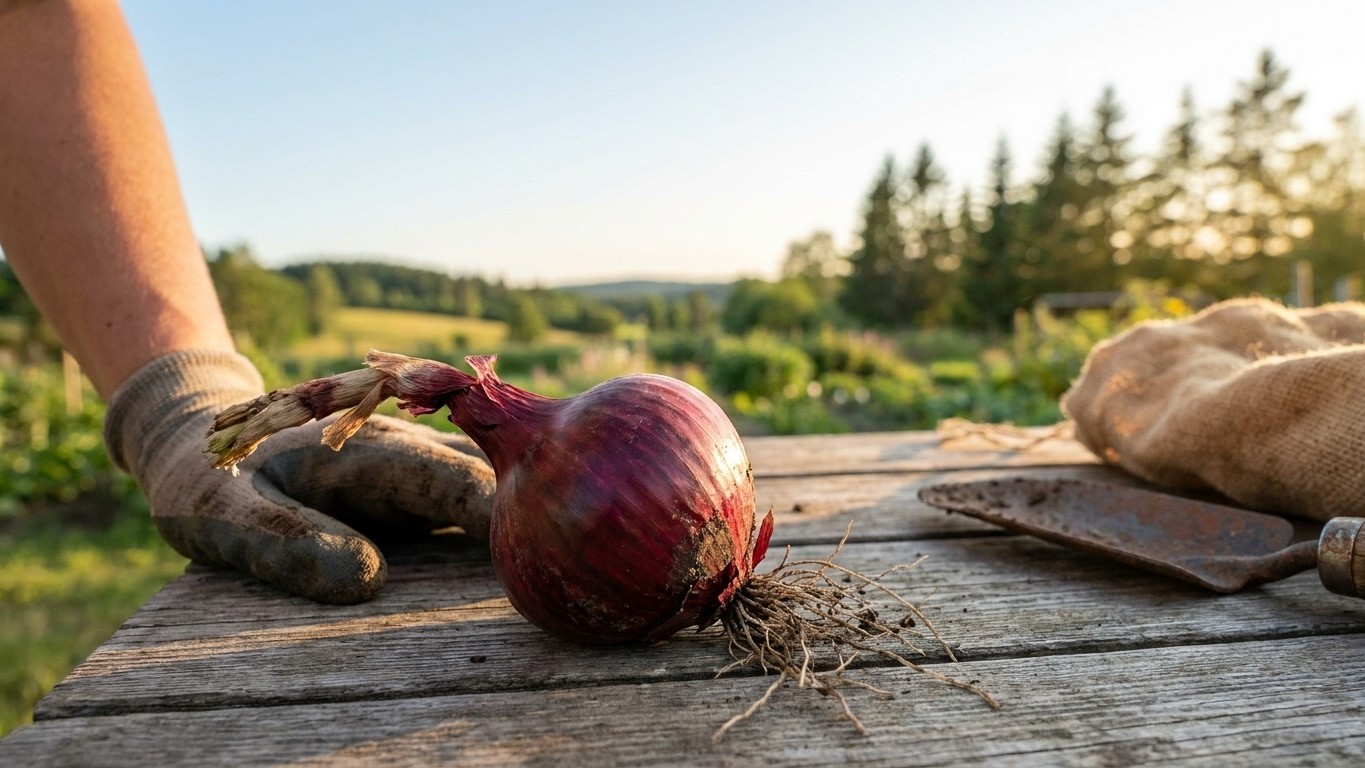

Rossa di Milano is a long-day onion, which means it needs roughly 14 to 16 hours of summer daylight to form a bulb, and that single fact narrows the map to a band between 38 and 50 degrees north latitude. Get the location right and you’re looking at a sharp, red, 100-day storage onion that holds into spring. Get it wrong, and no amount of good soil will save the crop.
Will Rossa di Milano bulb where you are

This is the fact that decides everything else, so it comes first. Rossa di Milano is a long-day onion, and it bulbs correctly between 38 and 50 degrees north latitude. That range covers a wide swath of the northern United States, from roughly the latitude of San Francisco and St. Louis up through the northern tier of states and into southern Canada. South of that line, this variety runs into trouble it can’t solve on its own.
Here’s the mechanism, and it’s counterintuitive enough that most gardeners never think about it: onions don’t bulb because of heat. They bulb because of day length. A long-day variety is genetically wired to wait until the sun is up for 14 to 16 hours before it shifts energy from leaf growth into bulb formation. That’s a summer daylight window that only exists at higher latitudes. The far north actually gets more hours of daylight in June and July than the Gulf Coast does, which is exactly why long-day onions are a northern crop and short-day onions belong down south.
Plant Rossa di Milano well outside its range, in Florida or south Texas, for example, and the days never get long enough to flip that switch. The plant doesn’t respond by making a smaller bulb. It keeps growing leaves all season, and when autumn shortens the days again, whatever swelling started at the base rots in storage rather than curing into a usable onion. There’s no consolation prize here.
If you’re gardening near one of those latitude lines, say around 36 to 38 degrees north, you’re in genuinely blurred territory. The variety may bulb acceptably some years and disappoint in others, depending on how the season unfolds. That’s not a failure of technique. It’s the nature of a boundary that isn’t a hard line but a gradual fade. Anyone in that zone should treat the answer as “maybe, worth trying,” not as a guarantee.
What Rossa di Milano is like
Assuming the daylight math works in your favor, here’s what actually shows up in the garden and later in the kitchen.
- Color: Red
- Days to maturity from transplant: 100
- Day-length group: Long-day
- Keeping time: 6+ months
The flavor is sharp, not sweet, and that’s not an accident or a shortcoming. It’s a direct trade-off worth understanding before you plant. The same sulfur compounds that give an onion its bite and make your eyes water while chopping are the compounds that protect the bulb’s cell structure during long storage. A mild, sweet onion has fewer of those compounds, which is why it tastes pleasant sliced raw on a sandwich and also why it turns soft and unusable within a few weeks of harvest. Rossa di Milano sits at the other end of that spectrum. It’s built to last, not to charm you raw.
That makes it a pantry onion in the truest sense. You won’t reach for it to eat fresh in a salad the way you might a milder variety. You’ll reach for it in November, January, and March, when it’s still firm in storage and doing the quiet work of flavoring soups, braises, and stews. No seed source promises a sweet onion that also keeps for half a year, because that combination doesn’t exist in nature. If a description ever claims both, be skeptical.
Size and shape
Catalogue data on Rossa di Milano generally describes it as producing medium to large bulbs with a rounded to slightly elongated shape, red skin, and firm flesh consistent with a long-keeping storage type. As with any onion, actual bulb size will track closely with how much leaf growth the plant achieved before day length triggered bulbing, a point worth remembering when you get to planting timing.
When to plant it
Planting timing for onions isn’t fixed by the calendar. It’s fixed by day-length group, and that’s why the advice changes depending on where you garden. Short-day onions go into the ground in fall across mild-winter regions and get harvested the following late spring. Long-day onions, Rossa di Milano among them, follow a completely different schedule: they go in during late winter to early spring, once the ground is workable, in northern gardens.
Because Rossa di Milano is a long-day variety, late winter to early spring planting is the right call for anyone gardening within its 38 to 50 degree latitude range. Starting too late creates a real problem, and it’s the one growers run into most often without realizing why their harvest disappointed them.
The test that matters more than any date on a seed packet is size at the moment of bulbing. Onions bulb whenever day length hits that 14-to-16-hour threshold, whether the plant is ready or not. The plant doesn’t wait for you. If the tops are still small and spindly when that trigger hits, the plant simply doesn’t have enough leaf mass and stored energy to build a large bulb, and it forms a small one instead, no matter how good the soil or how consistent the watering has been.
That’s why gardeners who transplant onion sets or seedlings, rather than direct-seeding, often get bigger bulbs from long-day varieties. A transplant already has a head start on leaf growth by the time the days lengthen. If you’re direct-seeding, get it done as early as the soil allows so the plant has maximum weeks to bulk up its tops before the daylight clock starts the countdown to bulbing. Think of it less as “plant by this date” and more as “give the plant every possible week of growth before the trigger fires.”
Growing it well
Onions are shallow-rooted, and that single trait shapes almost everything about how they should be managed in the bed. Their root systems sit close to the surface and don’t reach far or wide for water or nutrients, which makes them poor competitors against weeds. A bed that gets weedy around onions doesn’t just look untidy, it directly steals the moisture and nutrition that would otherwise go into swelling the bulb. The result shows up later as smaller onions, not as an obviously stressed plant, so the damage is easy to miss until harvest.
Keeping the bed weed-free, especially in the first several weeks, protects bulb size more than almost any other single practice. The same logic applies to water: because roots are shallow, onions rely on consistent moisture near the surface rather than the ability to send roots deep in search of it during a dry spell. Letting the soil dry out repeatedly costs bulb size the same way weeds do, quietly and cumulatively.
Bolting is the other issue worth watching for. A plant that bolts, sending up a flower stalk instead of putting all its energy into the bulb, redirects its resources toward seed production. A bulb from a bolted plant will still be edible, but it won’t store well. The core often turns woody or develops a hollow center around the stalk, and that structural change compromises the layers that would otherwise seal the bulb for long storage. If you spot a flower stalk emerging, that’s your signal to pull and use that particular onion soon rather than setting it aside for the pantry shelf. Sort bolted onions out at harvest and eat them first, saving the sound bulbs for the long haul.
Harvesting and keeping it
The signal that Rossa di Milano is ready has nothing to do with a date circled on a calendar. The onion tells you itself: the tops fall over on their own, flopping down at the neck as the plant shifts out of active growth. That’s the cue to stop watering and start the harvest sequence, not a moment before.
Curing is the step that separates onions that make it to spring from onions that rot in the bin by December, and it’s also the step most home gardeners skip or rush. The idea is simple: the neck tissue needs to dry down until it’s papery and tight before the bulb goes into storage. A moist neck is an open door for rot organisms, and no amount of careful storage afterward fixes a bulb that went into the bin before it was properly cured.
- Wait until the tops fall over naturally, without forcing or bending them.
- Lift the bulbs carefully, avoiding cuts or bruises to the skin.
- Cure them in a warm, dry, well-ventilated spot out of direct sun for several weeks, leaving tops attached.
- Check the neck: it should feel dry and papery, not soft or green, before moving on.
- Trim the dried tops and roots, then move the bulbs to cool, dry, dark storage.
Given a proper cure, Rossa di Milano keeps for 6+ months, which in practical terms means a harvest pulled in mid to late summer can still be feeding the household into the following spring. That’s a meaningfully different outcome from a sweeter variety that might only hold for two or three months before softening. If you’re planning meals around a full winter’s worth of stored onions rather than a quick summer supply, that six-month window is the number to build the pantry plan around, and it’s also the reason this variety trades sweetness for staying power in the first place.