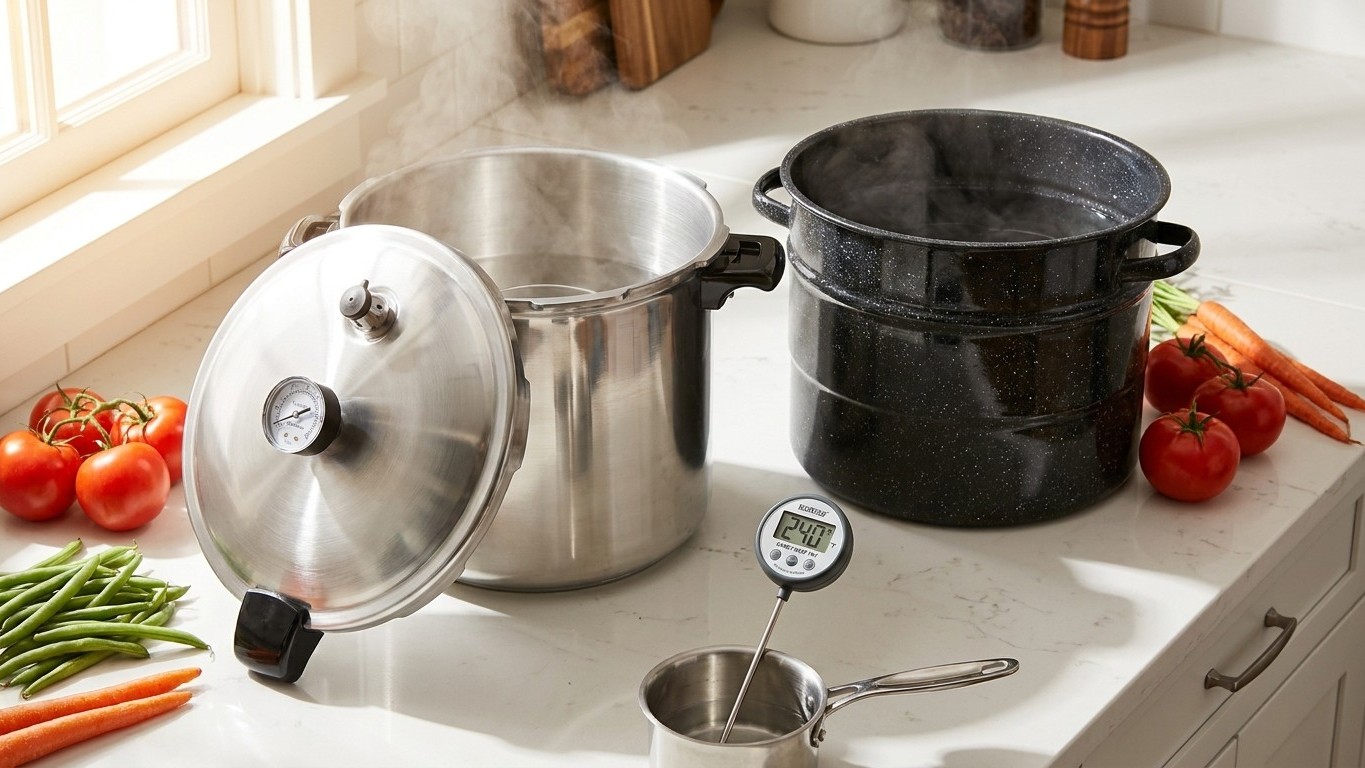

The number that matters is 240°F. A boiling-water bath tops out at 212°F, no matter how long you leave it on the stove. A pressure canner, sealed and vented properly, climbs to 240 to 250°F, and that jump is what makes low-acid food safe to store on a shelf. The National Center for Home Food Preservation at the University of Georgia is the reference point for why that gap exists and what it costs you if you ignore it.
The short answer

Water has a ceiling. At sea level, it boils at 212°F and stays there no matter how hard it rolls or how long you wait. That’s a hard physical limit, not a design flaw in your stove. For pickles, jams, and other high-acid foods, 212°F is plenty. For low-acid foods, meat, poultry, seafood, milk, and almost every fresh vegetable, it isn’t, and no amount of extra time in a boiling-water bath fixes that. The problem isn’t heat exposure duration. It’s the ceiling itself.
A pressure canner solves that by trapping steam inside a sealed vessel. As pressure builds, the boiling point of water inside rises along with it. That’s the entire mechanism, and it’s why the canner has a locking lid and a gauge instead of just a bigger pot. Once the internal pressure reaches the level a recipe specifies, the temperature inside sits at 240 to 250°F. That range is the target, and it’s the only range that reliably destroys the bacterial spores that survive a boiling-water bath untouched.
The organism at the center of this is Clostridium botulinum. Its spores are common in soil and can ride into your kitchen on unwashed vegetables without any visible trace. At 212°F, those spores can survive processing times that would otherwise seem generous. At 240°F and above, they can’t. That’s not a marginal improvement, it’s the line between a jar that’s shelf-stable for a year and a jar that’s a public health risk sitting quietly in your pantry.
This is also why the National Center for Home Food Preservation splits its entire canning guidance around this one number. Every recipe on its site is built around whether a food needs to hit 240°F or can be safely processed at 212°F. There’s no in-between category, no “mostly acidic” designation that gets a pass. A food either clears the threshold or it needs the canner. That single fact reorganizes how you should think about every jar you fill this season, and it’s worth carrying with you before you touch a single vegetable.
What actually decides it
The dividing line for the whole subject is pH 4.6. Foods with a pH above that number are classified as low-acid and require a pressure canner. Foods at or below 4.6 are acid foods and can be processed in a boiling-water canner, the kind that reaches 212°F at sea level and no higher. That single number, not the food’s taste, not its texture, not whether it “seems” acidic, is what the National Center for Home Food Preservation uses to sort every food into one processing method or the other.
Low-acid foods include red meats, seafood, poultry, milk, and nearly all fresh vegetables. Acid foods include fruits, pickles, sauerkraut, jams, jellies, marmalades, and fruit butters. That list feels intuitive until you hit the exceptions. Some tomatoes are now known to carry pH values slightly above 4.6, and so do figs. Both need to Be Acidified Before Canning, regardless of how sharp or mild they taste on the tongue. Taste is not a measurement, and pH doesn’t announce itself to your palate.
The reason this pH line matters so much comes down to what Clostridium botulinum needs to grow and produce toxin. It requires three conditions at the same time, and a sealed jar of unprocessed low-acid food happens to supply all three without anyone intending it to.
- A moist, low-acid food — this is what canning a low-acid vegetable or meat provides by default; acidifying the food below pH 4.6, or processing it at 240°F and above, removes this condition.
- A temperature between 40 and 120°F — this is room temperature storage, exactly where a sealed jar sits on a pantry shelf; a pressure canner’s 240 to 250°F process temperature removes this condition during processing, and refrigeration below 40°F would remove it afterward, though canned goods aren’t meant to depend on refrigeration.
- Less than 2 percent oxygen — this is exactly what a sealed, vacuum-formed jar lid creates; there’s no practical way to remove this condition once a jar is properly sealed, which is why the other two conditions carry the entire safety burden.
Once you can name these three conditions, you can classify almost any food you’ve never canned before just by asking two questions: is it low-acid, and will it end up sealed in an airtight jar at room temperature? If the answer to both is yes, the pressure canner isn’t optional.
How to do it
The order of operations matters as much as the temperature itself, because skipping a step or doing them out of sequence can undercut everything the canner is designed to accomplish.
- Start with a tested recipe specific to the food you’re canning, sourced from the National Center for Home Food Preservation or the USDA Complete Guide to Home Canning, not a general-purpose recipe adapted from memory.
- Prepare the food exactly as the recipe describes, and pack it into clean jars, leaving the headspace the recipe specifies for that particular food and jar size.
- Wipe the jar rims clean of any food residue, since even a small amount can prevent a proper seal.
- Apply lids and bands according to the manufacturer’s instructions for the lids you’re using.
- Load the jars into the canner with the water level the canner’s instructions call for.
- Lock the canner lid in place and allow steam to vent for the period the canner’s instructions specify before closing the vent or adding the weight.
- Bring the canner up to the pressure the recipe specifies for your food and your elevation.
- Process for the time the recipe specifies, adjusting for altitude as the recipe or the USDA guide directs.
- Turn off the heat and let the pressure drop naturally, without forcing it down or opening any valve early.
- Wait until the pressure gauge reads zero and any residual pressure has fully released before unlocking the lid.
- Remove the jars and let them cool undisturbed, then check each lid for a proper seal before storing.
Every specific number, the time, the pressure, the headspace, belongs to the recipe you’re following, not to a general rule you can carry between foods.
What goes wrong
- A jar doesn’t seal. Refrigerate it and use the contents within a few days, or reprocess it with a new lid following the recipe’s timing from the start. Never store an unsealed jar at room temperature.
- Pressure fluctuates during processing. If it drops below the level the recipe specifies, you generally need to bring it back up and restart the timing from zero, because the process depends on sustained temperature, not an average over time. Check the recipe’s specific guidance for how to handle a drop.
- Liquid siphons out of the jars during processing. This is usually caused by pressure changing too quickly, either during buildup or during cooling. The jars are typically still safe if they sealed properly, though the loss of liquid means less of the food is submerged, which can affect quality over time.
- The gauge on a dial canner reads inaccurately. Dial gauges should be checked periodically, and many extension offices offer this service. An inaccurate gauge means you may be processing at a lower pressure, and therefore a lower temperature, than you believe.
- A sealed jar shows cloudiness, spurting liquid when opened, or an off smell. Discard it without tasting, following safe disposal guidance. This is the one situation where the absence of any warning sign in a jar that looks otherwise fine is exactly the danger: spoilage isn’t always visible, and botulinum toxin has no taste and no smell at all.
- You’re unsure whether a jar processed correctly. When in doubt, don’t taste it to check. Discard it. There’s no way to detect contamination by smell, sight, or taste before it’s too late.
Where the exact times come from
A tested processing time belongs to a tested recipe, tied to a specific food, a specific jar size, and a specific altitude. Borrowing a number from one recipe and applying it to a different food, or stretching a fruit’s timing to cover a vegetable, breaks the entire safety chain the number was built on.
Elevation changes this further. Water boils at a lower temperature as altitude rises, and a lower boiling temperature kills less. The USDA Complete Guide to Home Canning addresses this directly, and it requires increasing either the process time or the canner pressure to compensate at higher elevations. That adjustment isn’t optional and isn’t the same for every food.
For your specific food, go to the National Center for Home Food Preservation and look up that food by name. The reason this matters more than it might seem is simple: botulinum toxin has no taste and no smell. A jar that looks, smells, and tastes completely normal can still be dangerous if the processing time or pressure was wrong. There’s no shortcut around a tested source.
Common questions
Can I just process low-acid food longer in a boiling-water bath instead of buying a pressure canner?
No. Extending time in a boiling-water bath keeps the food at 212°F for longer, but it never raises the temperature above that ceiling. Clostridium botulinum spores that survive at 212°F will keep surviving no matter how many extra minutes you add. Only reaching 240°F and above, which requires a sealed, pressurized canner, destroys them reliably.
How do I know if my tomatoes need acidifying?
Some tomato varieties now test slightly above pH 4.6, which puts them outside the safe range for boiling-water processing without help. The National Center for Home Food Preservation recommends acidifying tomatoes before canning regardless of variety, since pH can vary between fruit and even between growing seasons, and there’s no way to judge it by taste or appearance.
Does altitude actually change how I should can food where I live?
Yes. As elevation increases, water boils at a lower temperature, and that lower temperature kills less during processing. The USDA Complete Guide to Home Canning requires compensating for this by increasing either the processing time or the canner pressure, depending on the method and the recipe. Check your specific recipe’s altitude adjustment chart rather than guessing.
Is it safe to taste a jar to check if something went wrong?
No, never. Botulinum toxin has no taste and no smell, so a jar can look, smell, and taste completely normal and still be contaminated. If you have any doubt about whether a jar processed correctly, whether the seal held, or whether the timing or pressure was accurate, discard it without tasting.