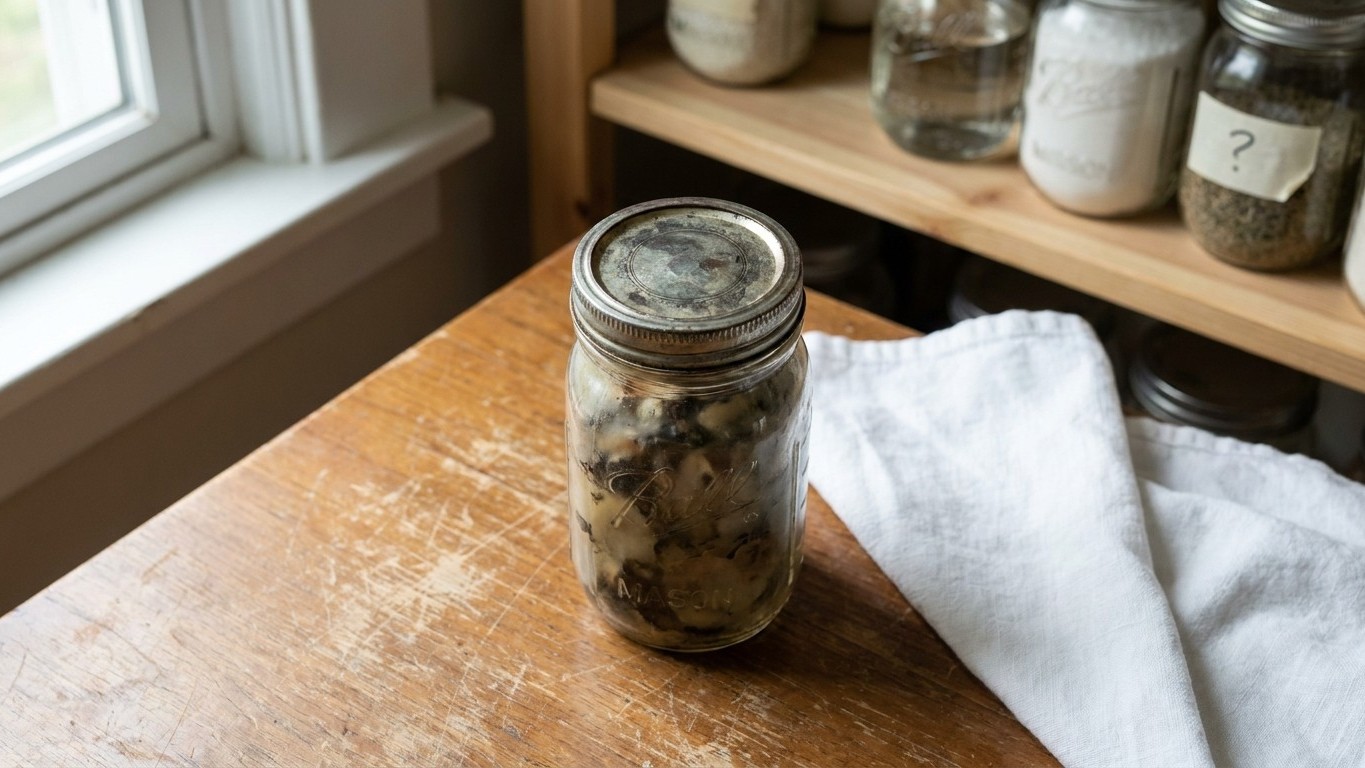

A spoiled jar usually announces itself: a bulging or dished lid, a spurting hiss when you break the seal, liquid that’s gone cloudy or slimy, a smell that’s off the moment the lid lifts. Any one of those signs means the jar goes in the trash unopened and untasted. The harder truth, and the reason the National Center for Home Food Preservation exists at all, is that the most dangerous spoilage gives none of these warnings.
The short answer

Here’s what actually separates a jar you can trust from one that can kill you: acidity. The National Center for Home Food Preservation, based at the University of Georgia, draws the line at a pH of 4.6. Foods above that number are classified low-acid and require a pressure canner, which reaches 240 to 250 F. Foods at or below 4.6 are acid foods and can go through a boiling-water canner, which tops out at 212 F at sea level. That gap between 212 and 240-plus degrees is the entire reason two canning methods exist, and it’s the first thing to check before you decide whether a jar in your pantry is even eligible to be safe in the first place.
Low-acid foods include red meats, seafood, poultry, milk, and nearly every fresh vegetable. Acid foods are fruits, pickles, sauerkraut, jams, jellies, marmalades, and fruit butters. That list looks tidy until you hit the two foods that break it: some tomatoes and figs now test slightly above 4.6, which is exactly why both Must Be Acidified Before they’re processed as though they were simple acid foods. A tomato that tastes plenty tart to your tongue can still sit on the wrong side of that line chemically, and taste is not a lab result.
Spotting a spoiled jar, then, isn’t really one skill. It’s two. The first is visual and practical: swollen lids, weeping seals, mold, foam, or a pop of gas when you open the ring. Discard any jar showing these without a second thought, and without tasting it to confirm your suspicion. The second is invisible, and it’s the one that matters more. A jar that looks perfectly normal, seal intact, liquid clear, can still carry a toxin produced by Clostridium botulinum if the food inside was low-acid and never reached a high enough temperature for long enough to destroy the bacteria’s spores. That toxin has no taste and no smell. It doesn’t announce itself the way mold or a hissing lid does, which is precisely why the pH line, and the processing method it demands, matters more than any visual inspection ever could.
What actually decides it
Clostridium botulinum is a spore-forming bacterium that’s common in soil, which means it can ride into your kitchen on vegetables straight from the garden. On its own it isn’t the threat. The threat arrives when three separate conditions line up at the same time inside a sealed jar, and a jar of unprocessed vegetables happens to supply all three without any help from you.
- A moist low-acid food. Removed by acidifying the food (as with tomatoes and figs) or by processing at pressure-canner temperatures of 240 to 250 F, which are the only heat levels that reliably destroy the bacterium’s heat-resistant spores.
- A temperature between 40 and 120 F. Removed by keeping food either colder than 40 F (refrigeration) or hotter than that range during processing, since the bacterium can’t grow or produce toxin outside that window.
- Less than 2 percent oxygen. This is the one condition a sealed jar creates automatically and can’t undo, since the whole point of canning is an airtight vacuum seal. That’s exactly why the heat step has to do all the work before the jar ever seals shut.
Notice that these three aren’t a sequence you work through one at a time. They’re a set, and the bacterium needs all three present simultaneously. Take away any single one and the danger collapses. A refrigerator removes the temperature condition. Acidifying a tomato removes the low-acid condition. But nothing removes the low-oxygen condition once a lid seals, which is exactly why the heat delivered during processing has to be strong enough to kill the spores before that seal ever forms. There’s no fixing it afterward.
This is also why elevation matters more than people expect. Water boils at a lower temperature as elevation rises, and a lower boiling temperature kills less. A boiling-water canner running at, say, 203 F instead of 212 F isn’t doing the same job, even though the water is still boiling. The USDA Complete Guide to Home Canning addresses this directly: increasing the process time, or the canner pressure for pressure-canned foods, compensates for that altitude drop. Skipping that adjustment because “it’s boiling, so it must be hot enough” is one of the most common and least visible mistakes a home canner can make.
Once you can classify a food this way, low-acid or acid, moist or not, sealed or open, you can look at almost anything in your kitchen and know which risk category it falls into before you ever open a canning book.
How to do it
The order matters as much as the individual steps. Skipping ahead, or reversing two of these, is how a tested recipe stops being safe.
- Choose a tested recipe that matches the food’s acid classification, low-acid or acid, and follow it exactly rather than adapting a recipe written for a different food.
- Prepare and pack the food into clean jars, leaving the headspace the recipe specifies, since that figure varies by food and jar and isn’t a fixed rule you can guess.
- Wipe the jar rims clean of any food residue, then apply the lids and screw bands to the manufacturer’s instructions.
- Load the filled jars into the canner type the food’s acid class requires, boiling-water for acid foods, pressure for low-acid ones.
- Process for the time the recipe specifies, adjusted upward for your elevation as the recipe or the USDA guide directs.
- Once processing ends, remove the jars and let them cool undisturbed for the full time the recipe allows before touching the lids.
- Check each seal once cooling is complete, then label sealed jars with the date and contents.
Every processing time, every pressure, every headspace figure belongs to the specific tested recipe you’re following. None of those numbers transfer from one food to another, even when the foods look similar in the jar.
What goes wrong
- The lid never sealed after cooling. Refrigerate the jar immediately and eat the contents within a few days, or reprocess with a fresh lid the same day if the recipe and your canner allow it. Don’t leave an unsealed jar on the shelf hoping it’ll seal later.
- The lid is bulging or the jar leaks in storage. Discard the jar without opening it to taste or smell the contents. A bulging lid means gas is being produced inside, and that gas can come from the exact bacterium this entire subject exists to prevent.
- The liquid turns cloudy or shows bubbles rising through it. Discard the jar. Cloudiness and gas bubbles both point to microbial activity that a properly processed jar shouldn’t show.
- Mold appears on top of the food. Discard the entire jar and its contents. Scraping mold off and eating what’s underneath doesn’t remove the toxins mold can produce throughout the food.
- Liquid has siphoned out during processing, leaving food partly exposed. If the seal is otherwise intact, the jar can still be safe, though the exposed food may darken. If you’re unsure whether the seal held, treat it as unsealed and refrigerate or discard.
- You’re not sure whether a jar processed at the correct elevation adjustment. If you can’t confirm the time and pressure matched your actual elevation, don’t rely on the seal alone as proof of safety. Discard rather than guess.
Where the exact times come from
No single processing time, pressure, or headspace figure fits every jar. A tested time belongs to a tested recipe, matched to a specific food, jar size, and altitude. Borrowing a time from a similar-sounding recipe, or rounding one up or down because it seems close enough, isn’t a shortcut. It’s a guess, and the bacterium this whole subject centers on produces a toxin with no taste and no smell, so a guess that goes wrong gives you no warning at all.
For the actual time your food needs, go to the National Center for Home Food Preservation’s page for that specific food. The USDA Complete Guide to Home Canning is the other authority worth checking directly for elevation adjustments and general procedure. Neither substitutes for the other, and neither should be substituted with memory or a family recipe passed down before either existed.
Common questions
Can I tell a jar is safe just because the seal is tight?
No. A tight seal tells you the jar is airtight, not that the processing inside was hot enough or long enough to destroy spores. Both conditions have to be true, and only one of them is visible from the outside.
Is it safe to boil a home-canned low-acid food before eating it, just in case?
If you have doubts about a jar, the safest choice remains discarding it rather than attempting to neutralize it yourself.
Why do tomatoes need acidifying if they’re a fruit?
Some tomato varieties test slightly above the 4.6 pH line that separates acid from low-acid foods, which puts them in low-acid territory despite their fruity taste. Acidifying brings them safely under that line before processing.
Does a jar that’s been sealed for years automatically go bad?
Age alone doesn’t spoil a properly processed, sealed jar the way it would fresh food, but quality declines over time regardless. A jar’s safety comes down to whether it was processed correctly in the first place and whether the seal has held, not simply how long it’s sat on a shelf.