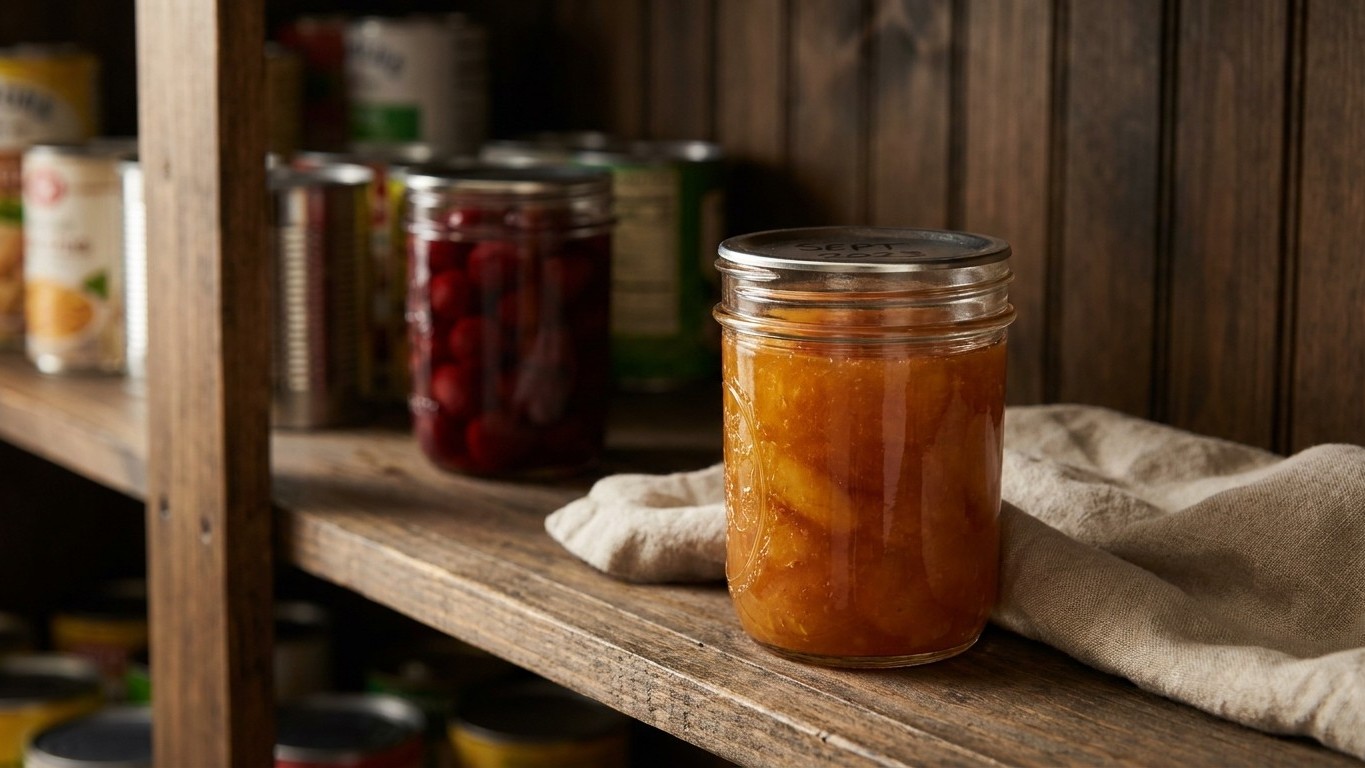

Once a jar has cooled and the lid has sealed, the ring comes off for storage, full stop. It was only ever there to hold the lid down during processing. Where you store the jar matters more than how long a clock has been running: a cool, dark, dry spot with steady temperature keeps a good seal good. Safety itself is set at the moment of processing, not by a countdown on the shelf.
The short answer

Take the ring off within a day of the jar cooling. Wipe the jar and lid, check that the lid is concave and doesn’t flex when you press the center, then store the jar bare, without its ring. The ring’s job ended the moment the lid pulled down and formed a vacuum seal. Leaving it on does nothing useful and creates two problems: it can trap moisture against the metal and rust the lid or the jar threads, and it can hide a lid that never actually sealed, since a loose ring can hold a flat lid in place well enough to fool a glance.
Storage location is the other half of the question, and it’s simpler than people expect. A cool, dark, dry cabinet or pantry works better than a spot near a stove, a window, or an uninsulated garage, because heat and light degrade color, texture, and nutrients faster, and because repeated temperature swings stress the seal over months of expansion and contraction. Basements work well if they stay dry; damp basements invite rust on lids long before anything inside the jar is at risk.
How long a sealed jar stays safe is a different question from how long it stays at its best, and this is where the National Center for Home Food Preservation, the University of Georgia’s research and outreach center for home food preservation, draws the line that matters most for the whole subject: foods with a pH above 4.6 are low-acid, and foods at or below 4.6 are acid. That threshold decided which canning method your jar needed in the first place, pressure canning or boiling-water processing, and a correctly processed, properly sealed jar of either kind doesn’t carry a built-in expiration the way a carton of milk does. What changes with time on the shelf is quality, not the presence or absence of danger: color fades, texture softens, and flavor drifts. The safe move is to date every jar when you store it, use the oldest ones first, and treat a jar that’s been sitting for a long stretch as a candidate for closer inspection before you open it, not for automatic discard on a fixed schedule.
What actually decides it
Everything about how a jar is processed, and by extension how it should be stored and judged later, traces back to one number: pH 4.6. Foods above that threshold are low-acid, and that group includes red meats, seafood, poultry, milk, and nearly every fresh vegetable. Foods at or below 4.6 are acid: most fruits, pickles, sauerkraut, jams, jellies, marmalades, and fruit butters. Low-acid foods need a pressure canner, which reaches 240 to 250 degrees Fahrenheit. Acid foods can be processed in a boiling-water canner, which only reaches 212 degrees Fahrenheit at sea level. That gap in temperature exists because it takes more heat, sustained longer, to destroy the most dangerous organism in home canning inside a low-acid environment.
A wrinkle worth knowing: some tomatoes and figs sit right at or slightly above 4.6, close enough to the line that they’re no longer treated as automatically acid. That’s why tested recipes for both call for added acid, usually lemon juice or citric acid, before processing in a boiling-water canner. Skipping that step turns a food you assumed was safely acid into one that behaves like a low-acid food without the higher heat to match.
The organism behind all of this is Clostridium botulinum, and it needs three conditions together before it becomes a threat inside a jar. Nothing on this list is a maybe; remove any one of the three and the risk collapses.
- A moist, low-acid food. This is removed by acidity: a pH at or below 4.6 doesn’t support the organism’s growth, which is the entire reason acid foods can rely on boiling-water processing instead of pressure.
- A temperature between 40 and 120 Fahrenheit. This is removed by heat during processing, and by refrigeration or freezing for anything that isn’t shelf-stable canned.
- Less than 2 percent oxygen. This is exactly what a sealed jar creates on purpose. A vacuum seal, which is the entire point of canning, also happens to supply the oxygen-poor environment the organism needs, which is why the seal is only safe when the other two conditions have already been handled correctly.
A sealed jar of unprocessed vegetables, checks every box on that list. It’s moist, it’s low-acid, it’s likely stored somewhere in that temperature range, and the seal itself removes the oxygen. That’s the whole reason pressure canning exists as a separate, hotter method for that category of food.
How to do it
The sequence below covers the order storage steps happen in, not the processing details themselves. Anything involving a specific time, pressure, or headspace measurement always comes from a tested recipe for that exact food, never from a general guide.
- Identify whether the food is acid or low-acid, which determines whether the recipe calls for a boiling-water canner or a pressure canner.
- Prepare jars and lids according to the tested recipe’s instructions.
- Fill jars, leaving the headspace the recipe specifies for that particular food and jar size.
- Wipe the jar rim clean before placing the lid, since any residue can prevent a proper seal.
- Apply the lid and screw the ring on fingertip-tight, not fully cranked down.
- Process the jars for the time and, if using a pressure canner, the pressure that the tested recipe specifies for the food, jar size, and your elevation.
- Remove jars from the canner and let them cool undisturbed on a towel or rack for the full cooling period, without pressing on lids or tilting jars.
- Check each seal once cooled by pressing the center of the lid; it should not flex or pop.
- Remove the ring, wipe the jar down, and label it with the food and the date.
- Store the bare jar in a cool, dark, dry location until it’s opened.
What goes wrong
- Lid didn’t seal at all. If the center flexes or pops when pressed after full cooling, refrigerate that jar and use its contents soon, or reprocess it with a new lid within 24 hours if the recipe and your setup allow it. Don’t store an unsealed jar on the shelf.
- Ring rusted onto the lid. This is a storage sign, not a safety verdict on its own; it usually means moisture reached the jar in storage. Check the seal itself carefully before deciding whether the jar is still good, since a stuck ring can mask a failed seal underneath.
- Liquid siphoned out during processing, leaving the jar low. If the seal itself is intact once cooled, the jar is generally still fine to store; the food above the liquid line may discolor slightly but that’s a quality issue, not evidence of contamination.
- Cloudy liquid, spurting liquid when opened, an off odor, or a bulging lid. Any one of these is a sign to not taste the contents and to discard the jar and its contents where nothing else can access them, since botulinum toxin has no taste and no smell and can’t be judged by how a jar looks or smells on the outside.
- Mold visible on top of the food. Discard the entire jar’s contents rather than scooping mold off the surface, since mold can extend into the food and low-acid foods with any sign of spoilage should never be tasted to check.
Where the exact times come from
A processing time only means anything when it’s paired with the exact food, jar size, and preparation method it was tested with; borrowing a time from a similar-sounding recipe, or guessing based on how long something “usually” takes, isn’t a shortcut, it’s a gamble with an organism you can’t detect afterward. Botulinum toxin has no taste and no smell, which is exactly why an untested time is dangerous rather than merely risky: nothing about opening or tasting the jar will warn you if it failed.
For the actual time and pressure your food needs, go to the National Center for Home Food Preservation and look up the specific recipe for what you’re canning. Elevation changes the math too: water boils at a lower temperature as elevation rises, and that lower boiling temperature kills less, which is why both the USDA Complete Guide to Home Canning and tested recipes call for longer times or higher pressure at higher elevations to compensate.
Common questions
Can I reuse the ring on future batches? Yes, rings are reusable as long as they’re not bent, rusted through, or so warped they no longer thread on smoothly. Lids themselves are generally single-use since the sealing compound is designed for one seal.
Does it matter if a jar is stored in complete darkness or just a shaded room? Light exposure over months speeds up fading and nutrient loss in the food, so a closed cabinet or a pantry with the door shut beats an open shelf under a window, even if both count as “indoors.”
Is a jar still safe if the ring is left on for years? The ring itself doesn’t cause spoilage, but it can hide a failed seal and it can trap moisture that rusts the lid, which is why removing it and inspecting the seal directly is the safer habit.
What temperature range counts as “cool” for storage? Avoid spots near heat sources, direct sunlight, or freezing temperatures, and favor a location with minimal swings between hot and cold.