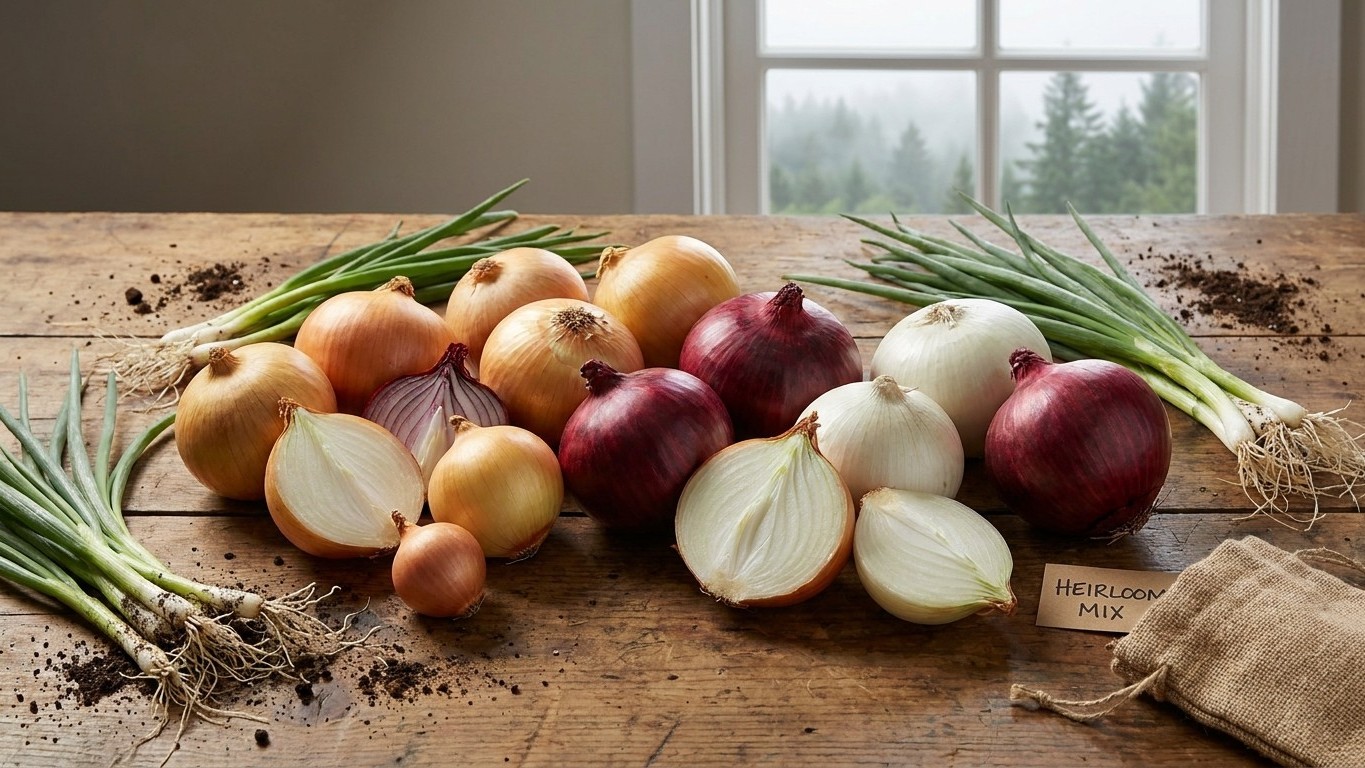

Washington sits at 47.44 degrees north, measured at the reference station for this territory, and the longest day of the year there stretches to 15 hours and 45 minutes of daylight. That number decides everything about which onion belongs in a Washington garden. Long-day varieties, the group built for high-latitude summers, are the answer here, with a handful of intermediate-day types working at the edges. Short-day onions are not part of this conversation at all.
The short answer for Washington

Onions do not care how warm your soil is. They care how many hours of daylight hit their leaves, because day length, not temperature, tells the plant when to stop growing leaves and start building a bulb. At 15 hours 45 minutes on the summer solstice, Washington firmly belongs to the long-day group, the category of onions that wait for 14 to 16 hours of daylight before bulbing starts.
Fourteen of the varieties documented on this site have a published latitude range that covers 47.44N, and most of them are long-day types: Ailsa Craig, Barolo, Blush, Bridger, Frontier, New York Early, Patterson, Redwing, Rossa di Milano, Safrane, Talon, and Walla Walla Sweet. Two intermediate-day varieties also reach this far north on their charts, Red Long of Florence and Red Long of Tropea, though they sit near the upper edge of what intermediate-day onions can do.
A few more sit in what amounts to a blurred boundary rather than a clean yes or no. Monastrell, Powell, and Scout have published ranges that come within a degree and a half of 47.44N, which means they may bulb here, but a gardener growing them is working at the margin of the variety’s documented range, not comfortably inside it.
The practical takeaway: reach for a long-day variety first. If a catalog or seed packet does not say “long-day” or “long day,” or if it lists a southern latitude range, it does not belong in a Washington garden, no matter how good the description sounds. This is the single most consequential decision in growing onions here, more important than soil, fertilizer, or watering schedule combined.
What will not work here
Short-day and most intermediate-day onions are built for a different clock. They start bulbing once day length reaches roughly 12 hours, a threshold Washington’s shorter days hit well before the plant has had time to grow. Plant one of these varieties in a Washington garden and the bulbing signal arrives in early spring, while the onion is still a skinny seedling. The plant obeys the signal anyway. It forms a bulb, but the bulb is whatever size the plant happened to be at that moment: small, sometimes marble-sized, sometimes nothing worth harvesting at all. The leaves may look fine all season. The bulb underneath will not.
Fourteen varieties on this site have published ranges that sit entirely below 47.44 degrees north, which puts them out of range for Washington:
- Cabernet (intermediate-day, 35-45N), range ends two degrees south of Washington
- Calibra (intermediate-day, 35-45N), same shortfall as Cabernet
- Candy (intermediate-day, 33-40N), bulbs far too early at this latitude
- Elsye (intermediate-day, 32-45N), built for a shorter summer day
- Expression (intermediate-day, 32-45N), same ceiling as Elsye
- Gabriella (short-day, 20-35N), a true short-day type, wrong hemisphere latitude entirely
- Madalyn (short-day, 20-35N), bulbs on a Gulf Coast clock, not a Pacific Northwest one
- Red Carpet (long-day, 40-45N), long-day in category but still capped south of Washington
- Red Rock (short-day, 30-36N), will bulb before summer even starts here
- Red Sensation (short-day, 25-35N), southern short-day type
- Sierra Blanca (intermediate-day, 32-45N), two degrees short of Washington’s latitude
- Texas Grano 1015Y (short-day, 25-35N), a Rio Grande Valley variety, not a Pacific Northwest one
- Vidora (short-day, 25-35N), same category mismatch
- White Castle (short-day, 30-38N), bulbs far too early for a Washington summer
None of these are bad onions. They are wrong onions for this latitude, and no amount of extra fertilizer, deeper watering, or a warmer microclimate changes the day length hitting the leaves.
What changes across Washington
The figures above come from a station near Wenatchee, at 47.44 degrees north, in the center of the state. Washington runs from roughly 45.5 degrees at the Oregon border to nearly 49 degrees at the Canadian line, a spread of about 3.5 degrees of latitude. That is enough to shift both day length and frost timing noticeably from one end of the state to the other.
| Location | Approx. latitude | Longest-day daylight | What it changes |
|---|---|---|---|
| Southern WA (Vancouver area) | ~45.6N | Slightly less than 15h45 | Long-day varieties still fit; frost-free season starts a bit earlier |
| Central WA (Wenatchee, reference) | 47.44N | 15h45 | Baseline figures used throughout this page |
| Northern WA (near Canadian border) | ~49N | Slightly more than 15h45 | Even more comfortable margin for long-day types; shorter frost-free window |
A gardener in Vancouver, Washington, or near the border with Idaho and Oregon should not assume the Wenatchee-area figures apply exactly to their yard. The difference across the state is not large enough to flip anyone into the short-day category, but it is large enough to shift transplant timing by a week or two and to change how tight the frost-free window is for getting bulbs to full size before fall. Anyone gardening near either edge of the state should treat 47.44N as a reference point, not a personal measurement.
Sweet now, or onions that last
Every Washington gardener growing long-day onions eventually runs into a trade-off, and it is chemistry, not preference. The compounds that make an onion sharp, the volatile sulfur compounds responsible for tears at the cutting board, are the same compounds that protect the bulb from rot in storage. University of Missouri Extension puts it plainly: sweet onions, as a rule, do not store as well as the more pungent types, because they simply contain less of the sulfur chemistry doing the protective work.
Walla Walla Sweet, a long-day variety that grows well at 47.44N, is the clearest example of the sweet side of that trade. It eats wonderfully in July and August, raw on a sandwich or grilled whole, but it is not built for a root cellar. Varieties like Redwing, Talon, Frontier, and Patterson sit further toward the pungent end, and that sharper bite is exactly what lets them hold up in storage for months rather than weeks.
The practical version of this for a Washington pantry: growing only sweet varieties means eating your onion harvest by early winter, then buying onions at the store from January through the next harvest. Growing at least some pungent, long-keeping varieties alongside the sweet ones means a bin of onions still holding steady in March. Most Washington gardeners with the space end up planting both, sweet for the summer table and something sharper for the months when nothing fresh is coming out of the garden.
Checking this against your own garden
The 47.44N figure and the 15-hour-45-minute daylight number describe one station near Wenatchee, not every yard in the state. A garden near Bellingham, Spokane, or Vancouver sits on a slightly different point of that latitude range, and local frost dates matter just as much as day length when it comes time to decide when transplants go in the ground.
- Look up your own latitude if you garden more than an hour’s drive from central Washington, using any online mapping tool that shows coordinates.
- Check your local average last-frost and first-frost dates, which shift by days to weeks across the state.
- Contact your county’s WSU Extension office for planting windows specific to your area.
- Confirm the day-length category printed on any seed packet or plant tag before buying, rather than trusting the variety name alone.
- Note your garden’s microclimate, since a south-facing slope or a low frost pocket can shift your effective planting date by a week or more even within the same county.