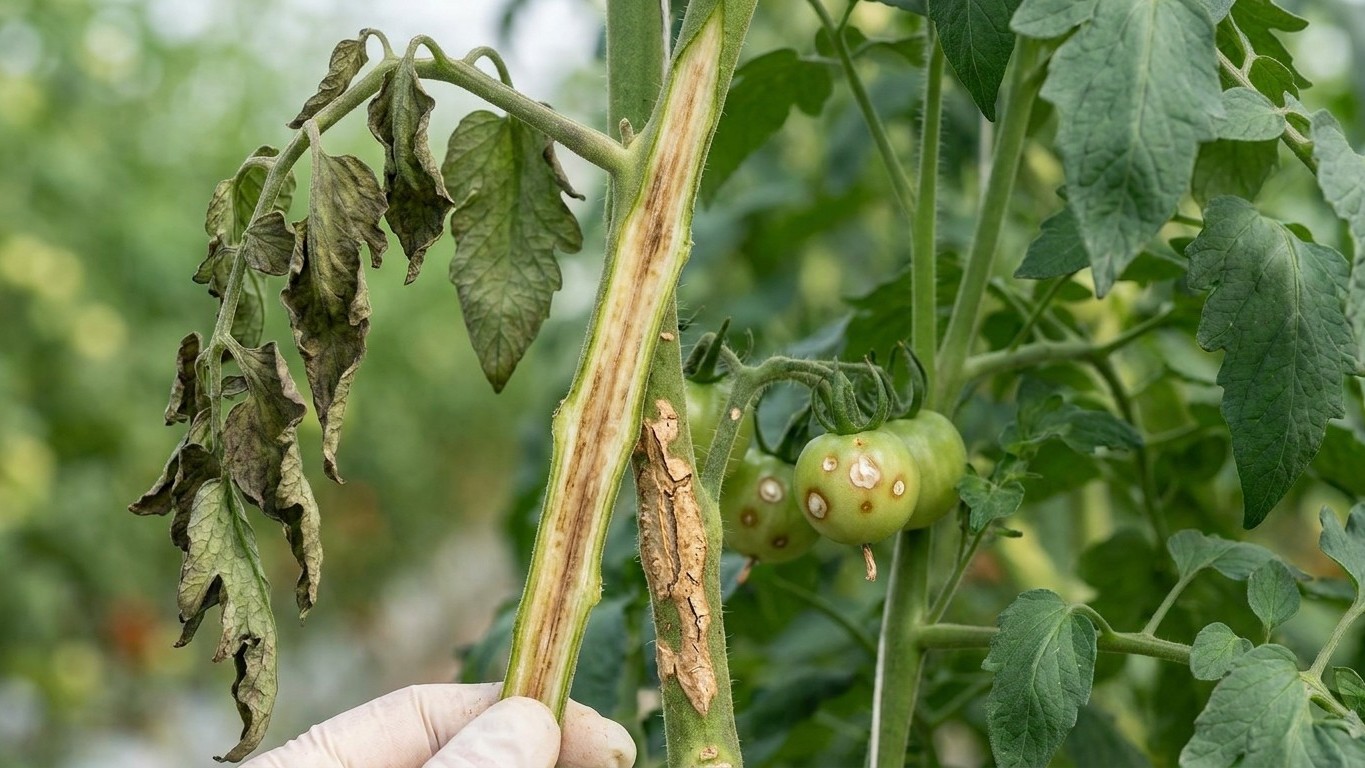

One-sided wilting paired with small tan spots ringed in white on green fruit points to bacterial canker, caused by Clavibacter michiganensis subsp. michiganensis. It is serious: the bacterium moves inside the plant’s plumbing, there is no cure, and a single infected transplant can seed an entire greenhouse before anyone notices a leaf out of place.
What you are looking at

The pattern gives it away before you even check the fruit. Instead of the whole plant sagging at once, one side droops while the other looks fine, sometimes for a week or more before the rest catches up. Leaflet margins on the wilting side brown and curl upward, dry and papery, while the leaf center can still look green. Pull the stem apart lengthwise and you may find a light brown to yellow streak just under the skin, running along the vascular tissue like a hidden bruise.
One-sided leaf wilting and marginal scorch
Look for a leaf, or a whole branch, wilting on just one flank of the plant while its neighbor across the stem stays turgid. The tissue that dies starts at the leaf edge and works inward, leaving a dry, tan-to-brown border around a leaf that can still be partly green at the center. This asymmetry is the single most useful visual clue this disease offers.
Stem cankers and streaking
Given time, raised, rough streaks or actual cracks (the “canker” in the name) can open along the stem, sometimes oozing a sticky residue in humid weather. Cut a stem crosswise near a wilted branch and check for a discolored ring or streak just inside the bark, distinct from healthy white pith.
Bird’s-eye spots on the fruit
Fruit lesions are small, raised, and strikingly uniform: a dark or tan pinpoint center surrounded by a bright white halo, rarely more than an eighth of an inch across. They look stamped on rather than blotchy, which is why growers nicknamed them bird’s-eye spots. They tend to appear on green fruit and stay put rather than spreading into a soft rot.
What it is not
Three other problems get mistaken for bacterial canker often enough that the mix-up is worth untangling, because the fix for one can be useless, or even wasteful, against another.
Bacterial spot and bacterial speck
Both cause small dark leaf lesions, sometimes with a yellow halo, and both can mark fruit with scabby or greasy spots. The difference is the wilting: bacterial spot and speck stay on the surface, leaf and fruit, and never cause the one-sided, whole-branch collapse that canker does. If your plant looks lesioned but structurally sound, and nothing droops asymmetrically, you are almost certainly dealing with spot or speck, not canker.
Fusarium wilt and Verticillium wilt
These are also vascular diseases, and a cut stem can show discoloration in both cases too, which is exactly why they get confused. The tell is in the pattern of the wilt and the fruit. Fusarium and Verticillium tend to move up from the roots and often show as yellowing that climbs the plant fairly evenly, or as a browning ring that circles the entire stem cross-section rather than one streak on one side. Neither one produces bird’s-eye fruit spots. If you see those small white-haloed dots on green fruit, canker is the more likely diagnosis regardless of what the stem cut shows.
Early blight
Early blight produces leaf lesions with visible concentric rings, like a target, usually starting on the oldest, lowest leaves and spreading upward as ordinary yellowing and leaf drop, not a one-sided wilt. Fruit lesions from early blight, when they occur, are larger, sunken, and often show the same ring pattern near the stem end, nothing like the tiny uniform bird’s-eye dots of canker. Treating early blight as bacterial canker means pulling and destroying plants that could have been managed with fungicide and better airflow, a costly overreaction. Treating canker as early blight means spraying for a fungus while a bacterium quietly spreads through your remaining healthy plants via pruning shears and hands.
Where it comes from and when it strikes
Clavibacter michiganensis subsp. michiganensis is a bacterium that survives between seasons mainly in infected seed, in crop debris left in the field or greenhouse, and on stakes, cages, and tools that touched a diseased plant. It does not need soil to persist the way some fungal pathogens do, which is part of why sanitation of hardware matters as much as sanitation of soil here.
Infection typically enters through wounds: pruning cuts, transplant handling, insect damage, or even the natural breaks where lateral roots emerge. Once inside, the bacterium colonizes the vascular system and rides the plant’s own water transport to spread internally, which is why symptoms can show up far from the original point of entry and why one side of a plant can be infected before the other.
Warm, humid conditions with extended periods of leaf and stem wetness favor both infection and secondary spread, since splashing water and wet foliage let the bacterium move from an infected plant to its neighbors during watering, rain, or handling. Crowded plantings with poor airflow, where foliage stays damp longer after each watering or rain event, give the bacterium more opportunity to spread from a low-level infection into a visible outbreak.
What to do about it now
There is no chemical cure for a plant already wilting from bacterial canker; the bacterium is inside the vascular system where sprays cannot reach it. That is the honest starting point, and it changes what “doing something” should mean.
Remove and destroy any plant showing the one-sided wilt and stem streaking described above. Do not compost it; bag it or burn it where local rules allow, since home compost piles rarely get hot enough to kill the bacterium. Pull the whole plant, roots included, rather than just cutting off the affected branch, since the infection is systemic even where symptoms have not yet appeared.
For plants nearby that still look healthy, stop overhead watering immediately and switch to soaking the soil directly, which cuts down on the splash that carries bacteria from plant to plant. Disinfect pruning tools between plants, and avoid working in the garden when foliage is wet, since handling wet, infected leaves is one of the more efficient ways to spread the bacterium on your hands and clothing.
As for the harvest: fruit from a plant with early, mild bird’s-eye spotting is generally still safe to eat once washed, since the lesions are superficial to the fruit surface and the disease is a plant pathogen, not a human one. Discard fruit that is soft, cracked, or visibly rotting, which invites secondary organisms that are a separate food-safety concern.
Keeping it out next season
Rotation helps but needs patience: avoid planting tomatoes, and other solanaceous crops like peppers and eggplant, in the same soil for at least three years, since crop debris can harbor the bacterium that long even without a live host present.
Resistant cultivars are limited for this particular pathogen, and unlike Fusarium (F), Verticillium (V), or nematode (N) resistance, there is no standard letter code marking bacterial canker tolerance on most seed packets. That gap makes prevention through clean sourcing more important here than for many other tomato diseases.
- Buy certified disease-free seed or transplants from a reputable supplier rather than saving seed from a questionable plant.
- Disinfect stakes, cages, and tools at the end of every season, since the bacterium can overwinter on hardware even without soil contact.
- Mulch heavily at planting to create a splash barrier between soil-borne bacteria and the lowest leaves.
- Space plants generously and prune for airflow so foliage dries quickly after rain or watering.
- Avoid handling plants when they are wet, and wash hands between working different sections of the garden.
Common questions
Can bacterial canker survive in the soil without a host plant?
It survives longer in crop debris and on contaminated stakes, cages, and tools than in bare soil alone, which is why cleaning hardware matters as much as rotating the planting bed.
Will one wilted branch recover if I remove it?
No. The bacterium has already moved through the vascular system by the time a branch wilts, so removing that branch does not stop the infection elsewhere in the plant.
Is bacterial canker contagious to peppers or other vegetables?
It primarily affects tomatoes and, to a lesser extent, other solanaceous crops like peppers and eggplant, so rotating those crops out of infected beds together is the safer approach.
Can I save seed from a plant that showed mild bird’s-eye spots?
Saving seed from any plant that showed canker symptoms is not advisable, since the bacterium can be carried inside and on the seed coat, seeding the infection into your next planting.