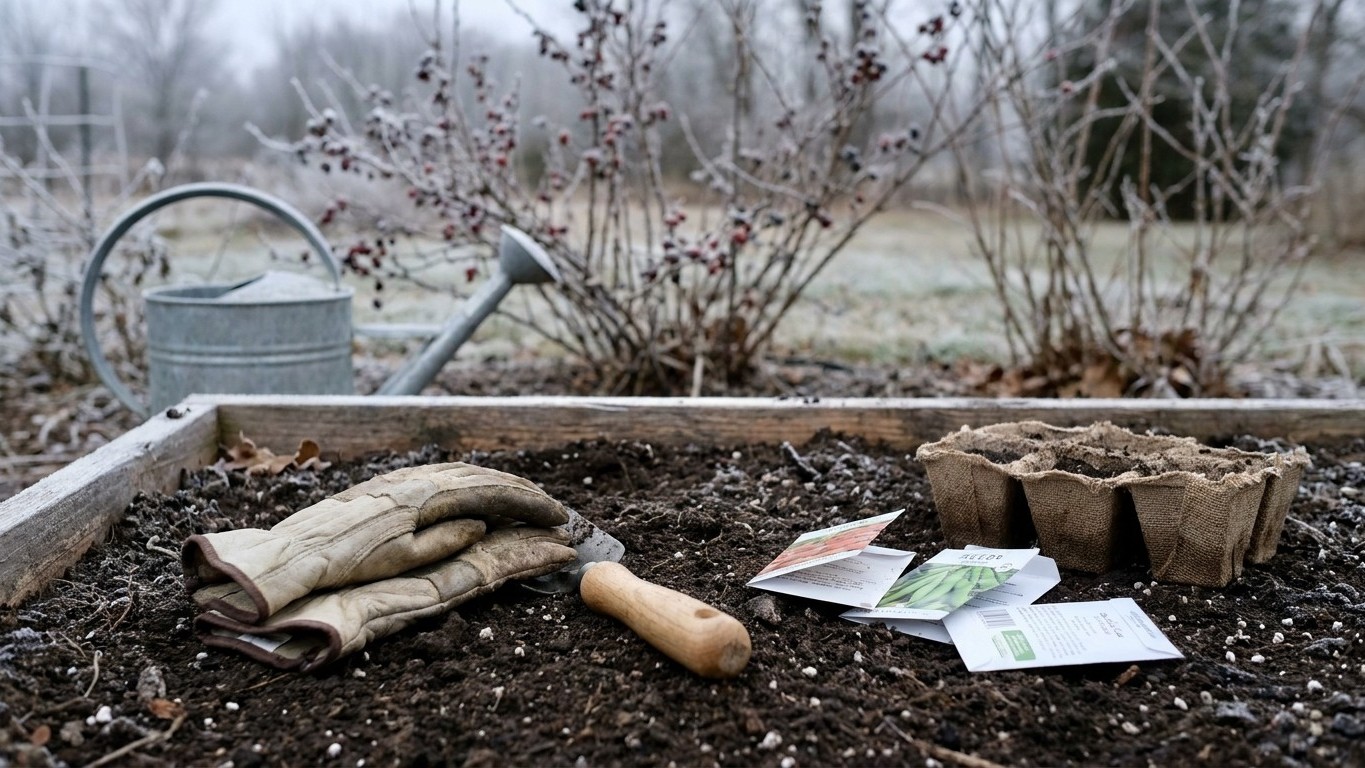

February in Missouri sits weeks before the frost window closes, so open ground stays mostly off-limits this month. The real work happens indoors and under cover: starting onions, peppers, and the earliest tomatoes under lights, forcing rhubarb, tucking in bare-root fruit stock where the soil isn’t frozen solid, and running dormant pruning shears through apple and peach trees. USDA hardiness zone 5b to 7b covers the state under the USDA Plant Hardiness Zone Map, and that spread alone hints at how differently the month plays out between the Bootheel and the northern counties.
What goes in the ground in February

Two things decide whether a seed or a root goes into open soil this month, and neither of them is the date on the calendar. One is soil temperature, since germination and root growth stall below certain thresholds regardless of how warm the air feels on a sunny afternoon. The other is the frost window itself. NOAA NCEI’s 1991-2020 Climate Normals put the last spring freeze for the Kansas City area (station USW00003947) between April 6 and April 20, and that station sits at the airport, well north of the city, so downtown Kansas City runs about five days earlier and southern Missouri milder still. Whatever the exact date in a given county, February falls squarely before that window, sometimes by ten weeks or more.
That makes the honest answer for most of the state: almost nothing goes into open, unprotected ground this month. Tender crops would rot or freeze outright, and even hardy seed sown into frozen or waterlogged soil just sits there. But “almost nothing” isn’t “nothing.”
Where the ground is workable, which usually means the southern third of the state in a mild stretch, garlic and shallots that missed their fall planting can still go in as a late option, though fall planting remains the stronger bet for bulb size. Bare-root fruit trees, brambles, and grapevines can be planted once the soil isn’t frozen and drains freely, since these are dormant and don’t need warm soil to establish roots. Asparagus crowns fall into the same category in the warmer southern counties. Cold frames and low tunnels widen the window further, letting spinach, mache, and other cold-hardy greens germinate weeks ahead of open-ground planting. Indoors, forcing rhubarb crowns or Belgian endive roots in a dark, cool space gives a harvest that has nothing to do with outdoor weather at all.
What to start under cover
Indoor seed starting runs on its own clock, counted backward from the last spring frost rather than forward from any fixed date. Since NOAA NCEI puts that frost window at April 6 to April 20 for the Kansas City reference station, a gardener working from that range can count back the number of weeks a given crop needs and land on a sowing date that fits their own county, adjusting a few days earlier for southern Missouri or later at higher elevation.
Counting backward from the frost window
Onions and leeks grown from seed need the longest lead time, typically ten to twelve weeks before transplanting, which puts their start date in the second half of January for most of the state. Peppers come next, wanting eight to ten weeks under lights before they go outside, which lands squarely in early-to-mid February. Tomatoes need less: six to eight weeks, so the tail end of February through early March is the workable stretch depending on how far south the garden sits. Cole crops like broccoli and cabbage split the difference at six to eight weeks indoors, with transplanting timed for two to four weeks before the last frost since they tolerate a light chill.
| Crop | Weeks before last frost to start indoors |
|---|---|
| Onions, leeks (from seed) | 10-12 weeks |
| Peppers | 8-10 weeks |
| Tomatoes | 6-8 weeks |
| Broccoli, cabbage | 6-8 weeks |
Two mistakes show up every year. Starting too early leaves tomatoes and peppers rootbound and leggy by the time it’s safe to set them out, and a stretched, pale stem rarely recovers into a strong plant. Starting too late does the opposite damage: the transplant goes into the ground too small to take advantage of the full season, and heat-loving crops especially need every week they can get before summer stress sets in.
What is ready to pick
Outdoors, February gives up little. Most beds sit dormant or under snow, and anything still standing has been there since fall. That’s not the same as an empty harvest basket.
Kale, collards, and leeks that overwintered in the garden often taste better after hard cold, since the plant converts starches to sugars as a kind of natural antifreeze. Digging leeks out from under snow cover is entirely workable as long as the ground beneath isn’t frozen solid. Cold frames extend this further, holding spinach, mache, and mixed greens in pickable condition through stretches that would kill the same plants in the open. Indoors, sprouts and microgreens fill the gap on a much shorter cycle, ready in one to two weeks from seed and needing nothing but a windowsill or a shelf under lights.
The other February harvest job is really an inspection. Stored squash, potatoes, onions, and apples should get a hands-on check now, since this is typically when the earliest spoilage shows up. Soft spots on squash, sprouting or greening potatoes, and onions gone soft at the neck all mean pulling that item out before it spreads rot to its neighbors. A five-minute check through the root cellar or pantry shelf now saves a much bigger loss in March.
The jobs that matter this month
The list of outdoor plantings may be short, but the list of jobs with a real deadline is not, and skipping them costs more than a delayed harvest later.
Dormant pruning tops that list. Apple, pear, peach, and cherry trees, along with brambles and grapevines, are cut back while they’re fully dormant and before buds swell, which limits stress on the plant and makes the cuts easier to see and place correctly. Waiting until growth resumes means cutting into live tissue and losing part of the season’s potential fruiting wood.
Seed ordering belongs on the same short deadline. Popular varieties, particularly disease-resistant tomatoes and anything from a small regional seed house, sell out earlier than most gardeners expect, and a February order beats scrambling for substitutes in April.
Soil testing pays off on a delay, since amendments like lime or sulfur need weeks to shift pH before spring planting, so sending a sample to a lab now means the correction has already taken effect by the time seeds go in. Turning the compost pile, even a frozen one, keeps the decomposition process from stalling completely and speeds up finished compost for spring beds. Tools benefit from the same slow season: cleaning rust off pruners and shovels, sharpening blades, and oiling hinges takes an afternoon and prevents ragged cuts that invite disease into live plant tissue later. Raised bed frames, trellises, and fencing are easier to repair now, without a single seedling in the way, than in the scramble of April planting.
What not to do in February
The most common mistake this month is planting by feel rather than by the ground itself. A run of 60-degree afternoons doesn’t mean the soil four inches down has warmed to match, and tomatoes, peppers, beans, or squash set out into that cold, damp soil either rot outright or sit stunted for weeks even if they survive. NOAA NCEI’s climate normals put the last spring freeze at April 6 to April 20 for the Kansas City reference station, and that window holds even through a mild stretch in February.
A related error is uncovering cold frames, row covers, or winter mulch too early after a warm spell. The protection isn’t there for the mild days, it’s there for the freeze that follows them, and pulling it back prematurely exposes tender new growth right when a cold snap returns.
Fertilizing early causes its own trouble. Nitrogen applied to dormant beds or bare soil either leaches away with winter rain and snowmelt before any plant can use it, or it pushes soft, tender growth on anything already active, growth that a hard freeze then kills outright. Soil amendments based on a test result are the better use of this month; nitrogen can wait until plants are actively growing and able to take it up.
Indoors, the same impatience shows up as starting tomatoes and peppers too many weeks ahead of the transplant date. The fix isn’t a shorter growing season, it’s counting backward from the local frost window and holding to that schedule even when the seed packets are sitting right there in January.
Checking this against your own county
Every date and range here comes from a single reference station, and Missouri is too long, north to south, for one number to fit the whole state. Elevation, local cold-air drainage, and the straightforward fact that the Bootheel warms up weeks ahead of the counties along the Iowa line all shift these windows in ways a state-wide page can’t capture. The NOAA NCEI caution on the Kansas City data makes the same point: even within one metro area, downtown runs about five days ahead of the airport station in spring.
The University of Missouri Extension keeps county-level guidance and a planting calendar built for exactly this kind of local adjustment, available at extension.missouri.edu. A quick search there for the local county office is worth doing before locking in a planting date based on a statewide range.
Common questions
Can I plant anything directly outdoors in Missouri in February?
In most of the state, no. The soil is still weeks away from the frost-free window, which NOAA NCEI puts at April 6 to April 20 for the Kansas City reference station. In the milder southern counties, bare-root fruit stock and dormant plantings can go in when the ground isn’t frozen, but seed sowing in open soil is still a gamble.
When should I start tomato seeds indoors for a Missouri garden?
Count back six to eight weeks from the local last frost date. Using the Kansas City reference window of April 6 to April 20, that puts most tomato starts in the second half of February, with southern Missouri gardeners able to start slightly earlier given their typically earlier frost-free date.
Is it too early to prune fruit trees in February?
No, this is close to the ideal window. Dormant pruning done before buds swell reduces stress on the tree and makes the branch structure easier to read. Waiting until active growth resumes risks cutting into live tissue and losing fruiting wood for the coming season.
Why does my county’s frost date differ from what’s listed here?
The published range comes from one NOAA NCEI weather station near Kansas City, and Missouri’s climate shifts meaningfully across its length. Elevation, local terrain, and the north-south spread of the state all move the real frost window earlier or later than the reference figures. County-level data through University of Missouri Extension gives a closer answer for a specific location.