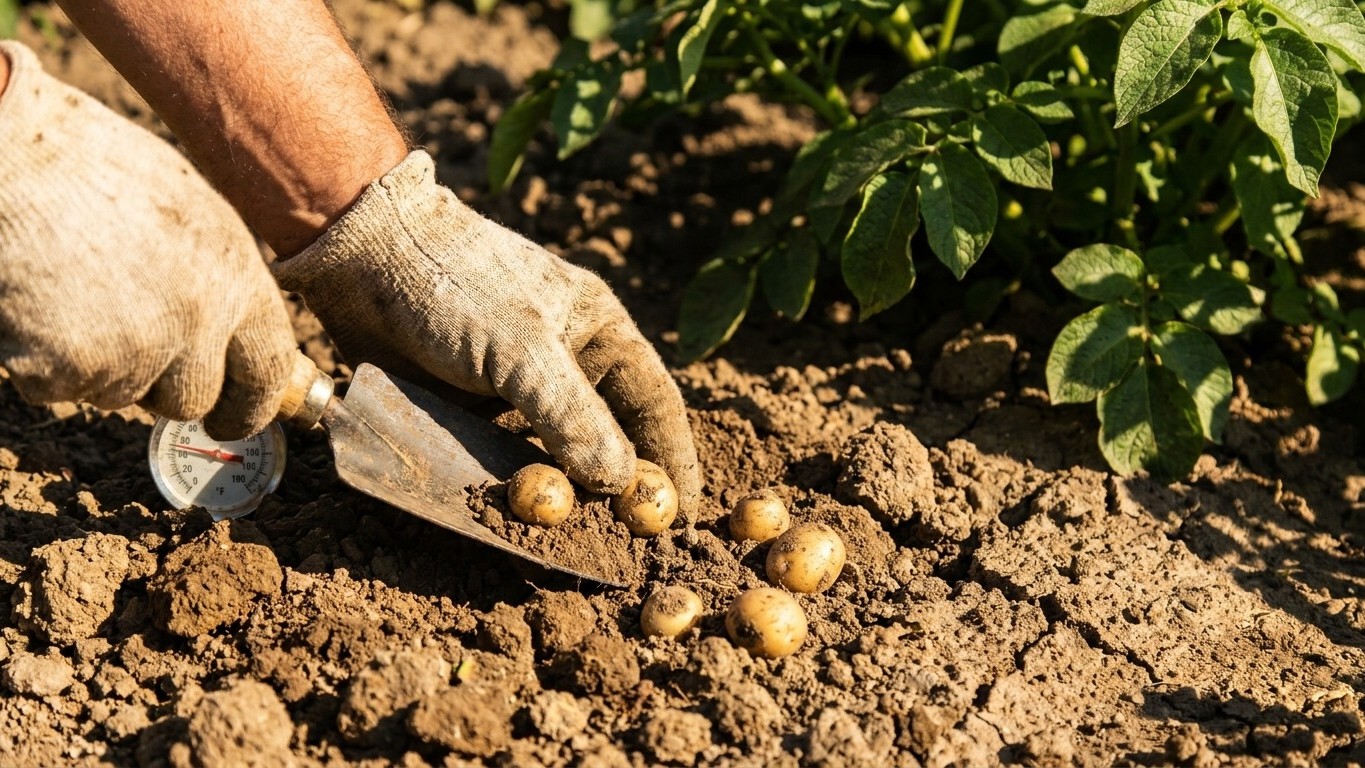

When soil temperatures climb above 90°F, potato tubers stop sizing up, according to Utah State University Extension’s guidance on growing potatoes in the home garden. This isn’t a watering problem. It’s a heat problem, and no amount of extra irrigation reverses it once the soil crosses that line. Gardeners in regions where summer heat lingers need to change their calendar, not their hose habits.
The short answer
Utah State University Extension states it plainly in its “Potatoes in the Garden” guidance: tuber set and fill is inhibited by high temperatures, specifically when soils climb above 90°F. That single threshold explains why a potato patch can look lush and green all July while the tubers underneath stay the size of marbles. The plant hasn’t died. It hasn’t even necessarily wilted. But the underground process that actually builds a potato has hit a wall.
What the threshold actually measures
The 90°F figure refers to soil Temperature, not air temperature. Those two numbers diverge more than most gardeners assume. A 95°F afternoon with a light breeze and some cloud cover might leave soil at a much gentler reading a few inches down, especially under mulch. Conversely, a string of 85°F days with bare, sun-baked soil and no mulch layer can push the root zone past that 90°F mark even though the thermometer on the porch never looked alarming. This is the gap that trips people up: they watch the sky, when they should be watching the ground.
Why more water doesn’t fix it
Extra irrigation cools soil somewhat, but it doesn’t reset the biological signal that heat has already sent to the plant. Once tuber set and fill has been inhibited, the plant’s energy allocation for that stretch of time has already shifted. Watering keeps the plant alive and the foliage green, which is exactly why so many gardeners assume they’re doing everything right. The size just doesn’t follow. In regions where summer runs long and hot, Utah State University Extension’s guidance points to a different fix entirely: plant early enough that tuber bulking happens before the heat arrives, and dig a spring crop rather than fighting the plant through the hottest weeks.
What actually decides it
Tuber sizing isn’t a single event. It’s an ongoing process happening below ground, driven by signals the plant reads from its immediate environment. Once you understand what those signals are, you can reason through situations no article specifically covers.
Soil temperature versus air temperature
The plant’s foliage responds to air conditions: sunlight, humidity, wind. But the tubers themselves respond almost entirely to what’s happening in the root zone, typically the top several inches of soil where they’re forming. A shaded garden bed with reflective mulch can run substantially cooler than an exposed bed even under identical air temperatures. This is why two gardens a few miles apart, planted the same week, can produce wildly different results in a hot stretch. One gardener’s soil crossed 90°F for hours a day; the other’s didn’t.
The stolon-to-tuber signal
Potatoes form on stolons, underground stems that branch from the main plant. Under favorable conditions, the tip of a stolon swells and begins accumulating starch, becoming a tuber. Heat stress interferes with this swelling process. The stolon may keep growing in length instead of swelling, which is part of why heat-stressed plants sometimes produce oddly elongated or knobby tubers rather than round, well-filled ones. The plant isn’t refusing to grow; it’s growing in the wrong direction for a gardener hoping for size.
Depth as a buffer, not a cure
Soil a few inches down runs cooler than the surface, which is why hilling and mulching matter so much for potatoes generally. But depth only buys a buffer, not immunity. During an extended heat wave, even soil eight to ten inches down can eventually climb past a safe range if the surface stays hot for days on end. This is the reasoning that applies beyond any single garden: the longer and more intense the heat, the less any surface treatment can compensate, and the more the actual planting date matters.
How to do it
- Check your region’s typical stretch of hot weather before deciding on a planting date, and aim to have plants established well ahead of the point where soils regularly run hot.
- Plant as early as your local frost risk allows, since earlier planting shifts the tuber-bulking window toward cooler weeks rather than the hottest part of summer.
- Select a season class suited to your region. The University of Maine Cooperative Extension notes that choosing among early, mid-season, and late types lets a grower match the crop’s active bulking period to the cooler part of the local season rather than the hottest.
- Mulch the row once plants are established to buffer soil temperature swings, understanding this reduces heat stress rather than eliminating it entirely.
- Hill soil around the base of the plants as they grow, keeping developing tubers covered and slightly insulated from surface heat.
- Monitor soil conditions directly during hot stretches rather than relying on air temperature alone, since the two numbers can diverge significantly.
- Where summer heat is prolonged and soils are expected to exceed 90°F for extended periods, plan to dig a spring crop before that heat arrives, following Utah State University Extension’s guidance for hot-summer regions.
- Avoid compensating for heat stress with heavier watering alone, since Extension guidance is clear that watering does not reverse inhibited tuber set and fill once soil has run hot.
What goes wrong
- Judging heat stress by air temperature instead of soil temperature. A mild-looking day can still carry hot soil under bare, sun-exposed ground. Check the root zone directly, and lean on mulch and hilling to buffer it rather than trusting the forecast alone.
- Assuming more irrigation will restore sizing. Watering keeps the plant alive but does not reverse tuber set and fill that heat has already inhibited, per Utah State University Extension. The remedy is timing the crop earlier, not adding water later.
- Planting too late for a hot-summer region. If tuber bulking is still underway when soils cross 90°F, sizing stalls regardless of how healthy the foliage looks. The fix is shifting the planting date earlier next season and digging a spring crop ahead of peak heat.
- Skipping mulch on exposed beds. Bare soil absorbs and holds heat far more readily than mulched soil. A simple mulch layer, applied once plants are established, buffers some of that swing and buys the crop extra cooler days.
- Waiting too long to harvest once heat arrives. Leaving tubers in overheated soil longer than necessary doesn’t help them size further and can invite other problems. Once bulking has stalled for an extended hot stretch, digging sooner rather than later protects what size has already been achieved.
Common questions
Does extra watering during a heat wave help potatoes size up?
No. Utah State University Extension’s guidance states that tuber set and fill is inhibited once soils climb above 90°F, and watering does not reverse that inhibition. It keeps the plant alive but doesn’t restore the sizing process on its own.
How do I know if my soil, not just the air, is too hot?
Air temperature and soil temperature aren’t the same measurement. Bare, sun-exposed soil can run hotter than the air above it, while mulched or shaded soil can stay noticeably cooler under identical air conditions. Checking the root zone directly, rather than relying on the forecast, gives a truer picture.
Is it better to plant early or late in a region with long, hot summers?
Earlier is the direction Utah State University Extension’s guidance points toward for hot-summer regions: getting the crop established and bulking before soils regularly exceed 90°F, then digging a spring crop ahead of the hottest stretch.
Does the potato variety change how it handles heat?
Choosing a season class suited to your region, as the University of Maine Cooperative Extension describes for early, mid-season, and late types, helps align the active bulking period with cooler weeks. But the underlying heat threshold for tuber set and fill comes from soil conditions, not from the variety alone.