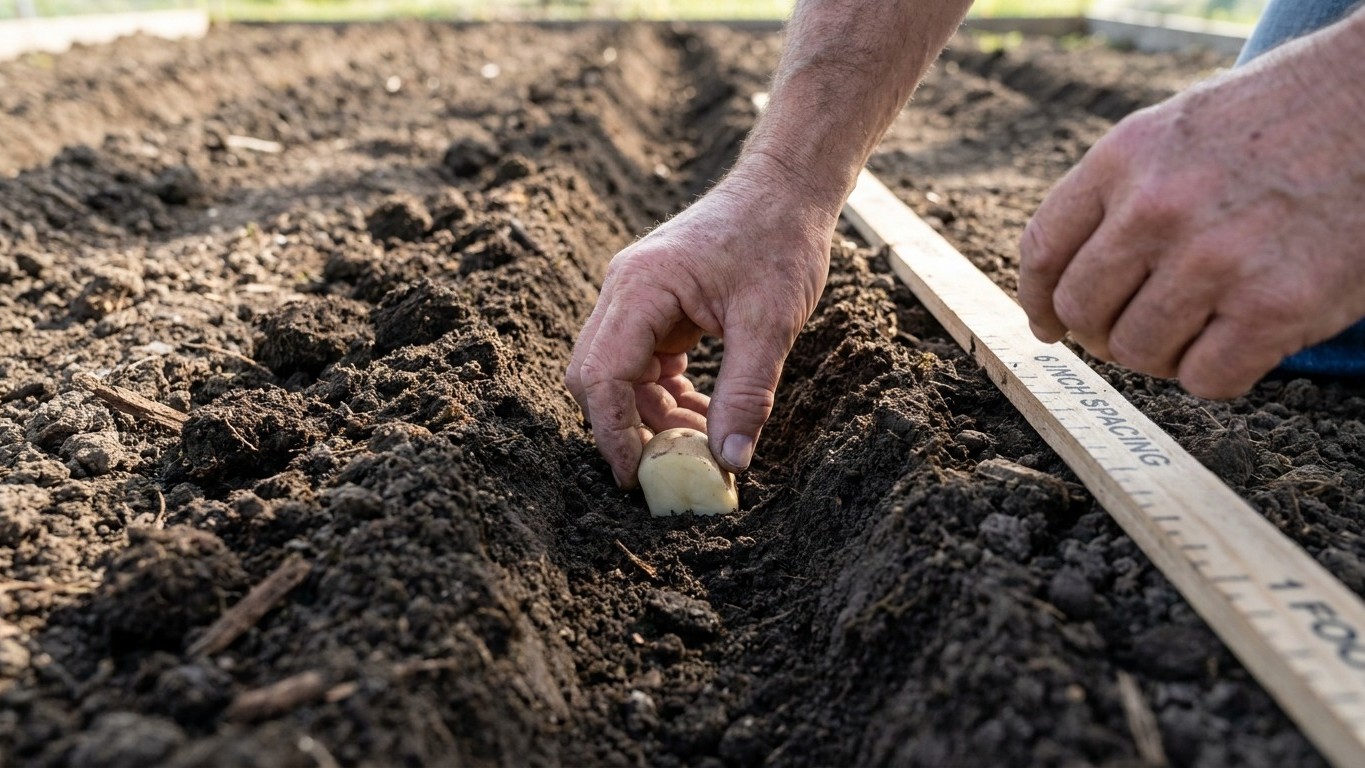

Plant seed potatoes in a furrow 4 to 6 inches deep, then cover them with about 2 inches of soil, according to the University of Maine Cooperative Extension. Space the pieces 8 to 12 inches apart within the row, with 30 to 36 inches between rows. That gap between furrow depth and soil covering matters more than it looks, and it changes as the season moves along.
The short answer
The furrow itself runs 4 to 6 inches deep, but the seed piece doesn’t sit at the bottom exposed to that full depth right away. The University of Maine Cooperative Extension (Bulletin #2077) is specific on this: you cover the seed with about 2 inches of soil at planting, not the full furrow depth. The remaining soil gets pulled in later as the plants grow, a process called hilling, which builds up a mound over the developing tubers rather than burying the seed piece deep from day one.
Spacing follows a similar pattern of two figures working together. Utah State University Extension and the University of Maine Cooperative Extension both put in-row spacing at 8 to 12 inches between seed pieces, with 30 to 36 inches left between rows. The in-row number affects how many potatoes you get from a given bed length. The between-row number affects whether you can actually get a hoe, a hiller, or your own two feet down the aisle without stepping on the crop.
Why the numbers come as ranges
Neither extension service publishes a single fixed figure for either depth or spacing, and that’s not vagueness. It’s an acknowledgment that soil type, seed piece size, and how you plan to manage the bed later all push the number one way or the other within that band. A gardener working heavy clay and a gardener working loose sandy loam are both correct to use different ends of the same range, and the guidance is written to allow that.
Timing sits alongside those two numbers as the third piece of the short answer. Both Utah State University Extension and the University of Maine Cooperative Extension point to soil Temperature, not the calendar, as the trigger: plant once the soil reaches 50 F, which lands 14 to 21 days before the last frost date. Potatoes tolerate cool soil far better than most garden vegetables, which is why the planting window opens while the ground is still cold by the standard of, say, tomatoes or peppers.
What actually decides it
The 4-to-6-inch furrow and the 2-inch soil cover aren’t really two competing figures. They’re describing two separate jobs. The furrow depth sets where the seed piece sits relative to the undisturbed soil surface. The 2-inch cover is just enough to hold moisture around the cut piece and get it in contact with soil while it sprouts. The rest of that furrow’s depth stays open, or gets filled in gradually, because it becomes storage space for the hilling soil you’ll pull up around the stems later in the season.
Depth is a function of what happens after planting, not just at planting
This is the mechanism a lot of gardeners miss: tubers form above the seed piece, along the buried stem, not below it. If you bury a seed piece 6 inches deep and never hill afterward, you’ve used up your working depth before the plant even has a chance to set tubers in loose, dark soil. Hilling adds soil against the stem in stages, which extends the zone where tubers can develop without pushing up into sunlight and turning green. So the shallow initial cover isn’t a shortcut, it’s what leaves room for that hilling soil to go somewhere useful later.
Spacing is a function of tuber count per plant, not plant survival
Potato plants aren’t crowding each other out of light the way lettuce or spinach might at tight spacing. The reason 8 to 12 inches in the row and 30 to 36 inches between rows shows up in both university guides is that each plant needs enough undisturbed soil volume around its root zone to grow multiple tubers to a useful size. Crowd the in-row spacing tighter than 8 inches and you generally trade tuber size for tuber count, not survival. Widen the between-row spacing and you’re mostly buying room for hilling equipment and foot traffic, not additional yield per plant.
Apply that reasoning to a case neither source covers directly, say a raised bed only 24 inches wide. The between-row figure of 30 to 36 inches assumes an open garden row layout. In a narrow raised bed, the mechanism that matters is still root volume and hilling access, so the practical move is to keep the 8-to-12-inch in-row spacing and adapt row count to the bed width, rather than trying to force a 30-inch aisle into a space that doesn’t have it.
How to do it
- Check soil temperature with a soil thermometer rather than going by the calendar or the air temperature; wait until it reads 50 F.
- Confirm that this 50 F reading falls 14 to 21 days before your area’s last frost date, which is the window both extension services describe as the start of the planting season for potatoes.
- Open a furrow 4 to 6 inches deep along the row.
- Place seed pieces in the furrow at 8 to 12 inches apart.
- Space additional rows 30 to 36 inches from the first.
- Cover the seed pieces with about 2 inches of soil, leaving the rest of the furrow’s depth unfilled for now.
- As the plants grow, pull soil up around the stems in stages (hilling), gradually using up the remaining furrow depth and building a mound over the row.
What goes wrong
- Planting before the soil is actually warm enough. Going by the calendar instead of a soil thermometer reading is the most common miss. Wait for the 50 F soil temperature both extension services cite, even if that date shifts from what you did last year.
- Burying the seed piece too deep at planting. Filling the entire 4-to-6-inch furrow with soil right away, instead of the roughly 2 inches both sources describe, can slow emergence and leaves no room to hill later without burying the stem too deep overall.
- Skipping the hilling step entirely. If you cover the seed fully at planting and never mound soil around the stems afterward, tubers that form near the surface are more likely to be exposed to light and turn green. The remedy is building up soil around the stems in stages as the plants grow, using the depth left open by the shallow initial cover.
- Rows spaced too close together. Less than 30 inches between rows can make hilling and foot traffic difficult once the foliage fills in, even if the in-row spacing was correct. Stick to the 30-to-36-inch range from the start rather than trying to correct it mid-season.
- Crowding seed pieces closer than 8 inches in the row. This tends to produce more tubers per row length but smaller individual potatoes, since each plant has less root volume to draw from. Widening to the 8-to-12-inch range trades some count for size.
Common questions
Can I plant potatoes deeper than 6 inches to avoid hilling later?
That specific approach isn’t addressed by either the Utah State University Extension or University of Maine Cooperative Extension guidance used here, so no figure beyond the published 4-to-6-inch furrow depth can be given.
What if my last frost date makes the 50 F soil window fall very early?
Both extension services tie planting to the 50 F soil temperature reading itself, occurring 14 to 21 days before the last frost date, rather than to a specific date on the calendar. Use a soil thermometer rather than assuming based on the season.
Does row spacing need to change for baking versus boiling potato types?
The spacing figures from Utah State University Extension and the University of Maine Cooperative Extension aren’t broken out by what the potato is used for, whether baking or boiling. The 8-to-12-inch and 30-to-36-inch figures apply regardless of that distinction.
How does spacing change for early versus late season potatoes?
The sourced spacing figures aren’t split out by season class either. Both early, mid-season, and late types follow the same 8-to-12-inch in-row and 30-to-36-inch between-row guidance published by these two extension services.