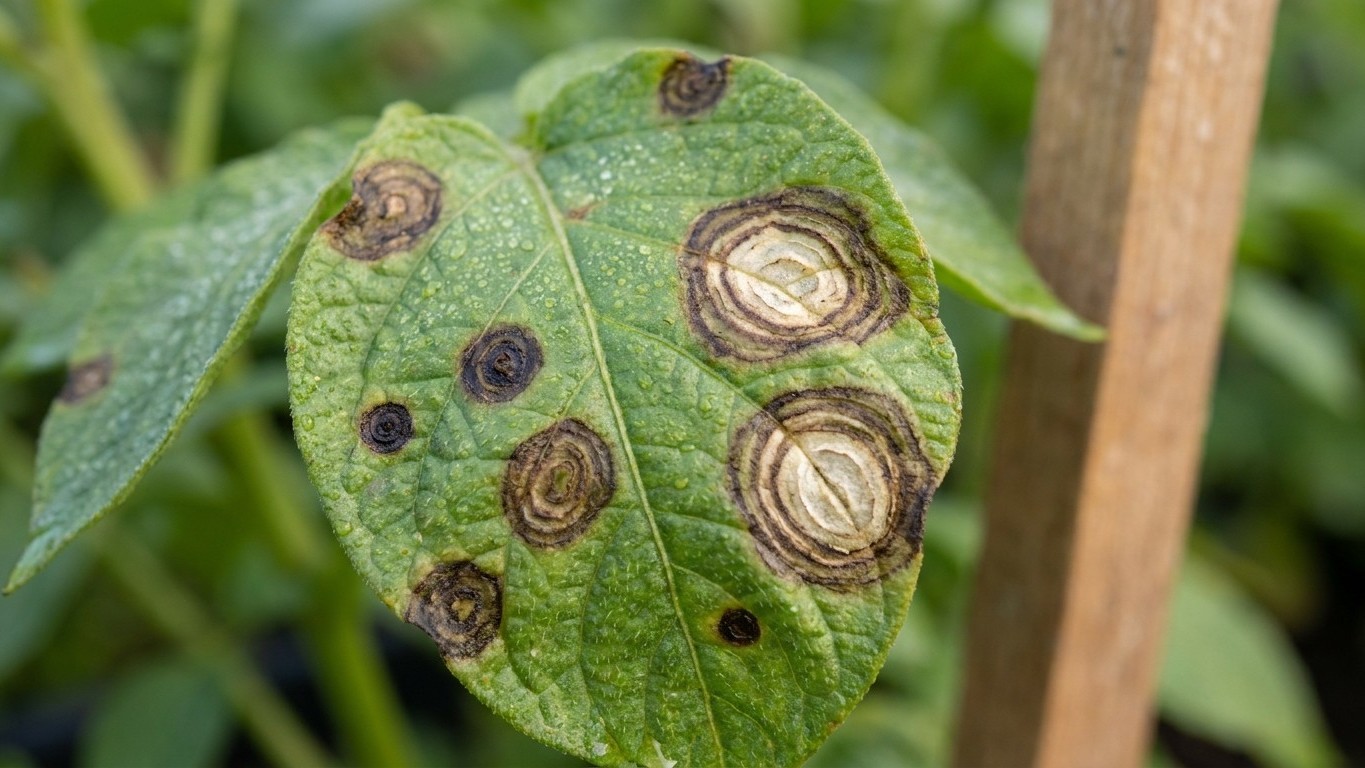

Those brown-to-black rings on your potato leaves, each one growing a darker outer edge and a paler center, aren’t random rot. Utah State University Extension describes early blight in its Potatoes in the Garden guidance as producing “brown to black ‘target’ spots on leaves… giving it a bull’s eye look.” That pattern is the identifying feature, and it shows up well before the plant looks seriously sick.
The short answer
Early blight on potatoes announces itself with concentric rings on the foliage, spots that start small and dark, then expand outward with alternating bands of tissue, light and dark, until the whole lesion resembles an archery target. Utah State University Extension names this appearance directly: “brown to black ‘target’ spots on leaves… giving it a bull’s eye look.” That single visual cue is what separates this disease from the dozen other things that can blotch a potato leaf during a wet summer.
The spots don’t stay put. They tend to start on the lower, older leaves first, the ones closest to the soil, and work upward as the season goes on. A leaf with a handful of small target spots in July can be carrying a much heavier load by August, especially if the plants sit under overhead watering or get soaked by repeated rain. The rings themselves are the tell. Nothing else common in a home potato patch produces that same layered, banded look on the leaf surface.
What the short answer doesn’t cover, and what actually matters for deciding what to do next, is why those rings form in the first place and what conditions push the disease from a few spots to a real problem. That’s a matter of how the fungus grows through leaf tissue over time, not just what it looks like on a given morning. Recognizing the bull’s-eye pattern is step one. Understanding why it forms in rings, and why timing of moisture and leaf age matter, is what lets a gardener catch it early instead of noticing it only after half the plant has gone brown.
It’s also worth being clear about what Utah State University Extension does and doesn’t say here. The identification is specific: target-shaped, banded spots, brown to black, on the foliage. The source doesn’t attach a percentage of leaf area, a spore count, or a temperature threshold to that description. So treat the bull’s-eye appearance as the diagnostic marker, and don’t assume any numeric severity scale that isn’t published in that guidance. The next sections build on exactly what is documented, without inventing thresholds the source doesn’t give.
What actually decides it
The ringed appearance of an early blight lesion comes from how the fungus advances through leaf tissue in bursts rather than a steady front. As the pathogen grows outward from its starting point, it kills tissue in pulses, and each pulse leaves a slightly different shade behind, some bands drier and darker, others still greenish or tan. Layer enough of those pulses on top of each other and you get the alternating light-dark rings that read, from a few feet away, as a target or bull’s-eye. That growth pattern is what makes the lesion visually distinct rather than just a plain brown blotch.
Leaf age plays into where the rings show up first. Older, lower leaves have had more time exposed to whatever fungal spores are present in the garden, and they tend to be a bit more stressed generally, so lesions often establish there before climbing to younger growth higher on the plant. A gardener scanning only the top of the plant can miss an infection that’s already well underway near the soil line.
Moisture on the leaf surface is the other half of the equation. Standing water or prolonged dampness on foliage, from dew, overhead irrigation, or a run of humid days, gives the fungus the film it needs to spread from spot to spot and leaf to leaf. Dry, well-ventilated foliage slows that spread considerably, which is part of why plant spacing and how you water end up mattering as much as anything sprayed on afterward.
Here’s the part that trips people up: several other leaf problems on potatoes also start as small brown spots, and at a glance, a young lesion of almost anything can look like the early stage of early blight. The distinguishing feature isn’t the color of the spot, it’s whether that spot develops the concentric banding as it enlarges. A spot that grows uniformly brown or black without those internal rings is very likely something else. A spot that visibly develops target-like layers as it expands, that’s the pattern Utah State University Extension is describing. Waiting a few days and watching how a lesion matures, rather than reacting to the first speck of brown, is often the difference between a correct call and a wasted treatment.
What to do about it
- Confirm the pattern before doing anything else. Look for the concentric, banded target spots specifically, brown to black, expanding outward in rings. This step comes first because Utah State University Extension’s published control is explicit: “Apply fungicide after proper disease identification.” A fungicide applied to the wrong disease, or applied because a leaf just looked vaguely spotty, is wasted twice over, once on the product and once on the time lost while the actual problem, whatever it is, keeps spreading unchecked.
- Remove and dispose of visibly affected foliage where practical. Pulling off leaves carrying mature, banded lesions reduces the amount of infected tissue sitting on the plant and can slow how much material is available for the disease to spread from, particularly on the lower leaves where it tends to start.
- Adjust watering habits to keep foliage drier. Since prolonged leaf wetness is part of what lets the disease progress, watering at the soil line instead of overhead, and doing it earlier in the day so any incidental moisture on leaves dries quickly, works against the conditions the disease relies on.
- Apply an appropriate fungicide only once the target-spot identification is confirmed. This is the treatment step Utah State University Extension names, and it’s conditioned on identification for a reason: the guidance doesn’t specify which product, timing interval, or application count, so beyond confirming the disease and applying an appropriate fungicide as directed on its label, no further numeric schedule is published here.
- Monitor the rest of the plant and neighboring plants afterward. Because lower leaves are often affected first, keep checking upward and across the row, since a single treatment addressing visible spots doesn’t guarantee the disease hasn’t already started elsewhere on the same plant or nearby ones.
What goes wrong
- Mistaking early, unbanded brown spots for early blight. A fresh lesion that hasn’t developed rings yet can look like the start of almost any leaf disease. The tell is patience: wait to see whether the spot matures into the concentric, target-like banding before treating it as early blight specifically.
- Treating the whole plant based on a couple of spots on lower leaves. Since older, lower foliage tends to show symptoms first, it’s easy to assume the entire plant is heavily infected when really only the base is affected so far. Check the full plant, top to bottom, rather than extrapolating from a few leaves.
- Confusing environmental leaf damage with disease. Sunscald, mechanical bruising from wind-whipped foliage, or nutrient-related discoloration can all produce brown patches on potato leaves. None of these develop the layered, banded rings described by Utah State University Extension, so a spot without that internal banding pattern is worth reconsidering before calling it early blight.
- Applying fungicide before confirming what’s actually on the leaf. This is the mistake the published guidance most directly warns against by conditioning treatment on identification. Spraying first and diagnosing later wastes the application and can delay recognizing that a different problem, one that wouldn’t respond to that fungicide at all, is actually at work.
- Assuming any spotting means the whole crop is at risk. A few banded lesions on lower leaves is not the same as widespread infection, and the source doesn’t publish a severity percentage or yield-loss figure tied to leaf-spot counts. Judge the situation by what’s visibly there, not by an assumed worst case that isn’t documented.
Common questions
Does early blight on potatoes affect the tubers underground, or just the leaves?
Utah State University Extension’s description in Potatoes in the Garden focuses on the foliage, specifically the brown to black target spots on leaves. No tuber-specific detail is published in that guidance, so that question isn’t answered by the source referenced here.
Can I tell early blight apart from late blight just by looking at the spots?
Based on the source used for this page, the identifying feature of early blight is the concentric, banded “target” pattern on the leaf. Late blight is a separate topic with its own distinct symptoms and its own dedicated coverage, so it isn’t detailed on this page.
Should I remove infected leaves even if I’m planning to apply fungicide anyway?
The published control from Utah State University Extension centers on applying fungicide after proper identification. Removing visibly affected foliage is a reasonable practical step to reduce infected tissue on the plant, but no specific instruction on combining leaf removal with fungicide timing is detailed in the source.
How quickly do the target spots typically spread across a plant?
No spread rate, day count, or leaf-percentage figure for early blight progression is published in the Utah State University Extension guidance referenced here, so that specific timeline isn’t something this page can state as fact.