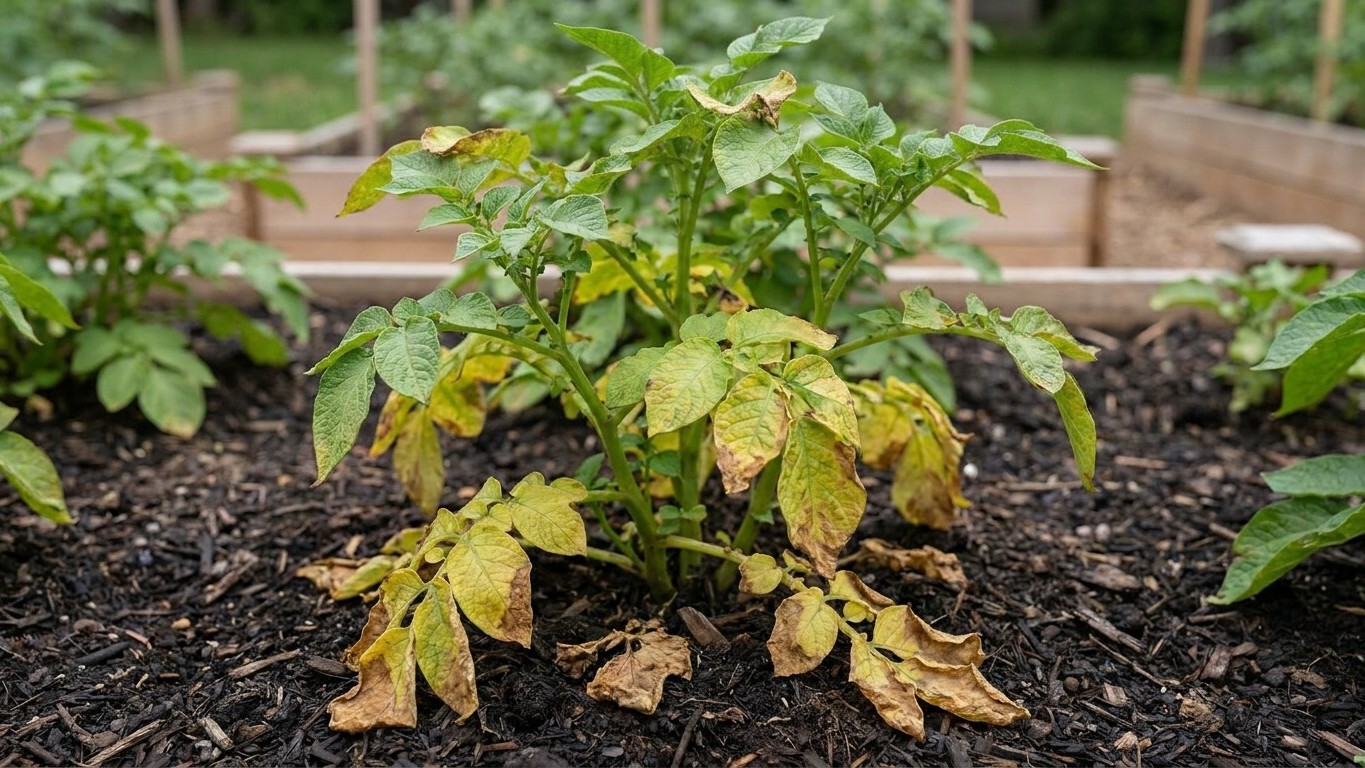

Bottom-up wilting on potato plants, the kind where the lowest leaves droop and yellow first while the plant often ends up dying, is a documented symptom described by Utah State University Extension. It isn’t caused by a single organism. Two different pathogens produce this same bottom-first pattern, which is exactly why the fix isn’t a single spray but a set of cultural practices applied in order.
The short answer
Utah State University Extension, in its Potatoes in the Garden guide, describes the symptom in plain terms: leaves on the bottom of plants wilt first, and plants often die. That’s the diagnostic starting point for any home gardener staring at a potato row where the lower foliage has gone limp while the top of the plant still looks fine, at least for now.
The reason this matters as a distinct entry point, rather than just “the plant is sick,” is the direction of the wilting. Bottom-first wilting points toward a vascular or root-zone problem working its way up the stem, rather than a foliar disease dropping down from the top or a pest chewing leaves at random heights. Utah State University Extension’s description ties this specific pattern to disease, not to drought stress or nutrient deficiency, both of which tend to show up differently across the plant.
The other piece of the short answer is that this pattern isn’t tied to one pathogen. Utah State University Extension notes that these diseases are caused by different pathogens, two of them, both capable of producing the same bottom-up collapse. That single fact reshapes how a gardener should respond. Spraying for one organism when the plant is actually dealing with the other wastes time and money, and by the time the wilting is obvious, the plant may already be past the point where a spray changes the outcome.
What Utah State University Extension does publish as a response isn’t a fungicide name or a specific product. It’s a set of practices: planting resistant varieties where they’re available, rotating crops so the pathogen doesn’t build up in the same soil year after year, and using soil solarization to reduce pathogen load between plantings. None of those three practices require identifying which of the two pathogens is at work, which is part of why they’re listed as the first line of defense rather than a targeted treatment.
For a gardener trying to make sense of a wilting row right now, the short version is this: bottom leaves going first, on potatoes, is a recognized disease symptom according to Utah State University Extension, it can come from more than one pathogen, and the published response starts with resistant varieties and soil management, not a bottle off a shelf.
What actually decides it
The direction of wilting is the detail that separates this from almost everything else that can make a potato plant look unhappy. When water stress or heat is the problem, wilting tends to show up across the whole plant at once, or worse on the leaves getting the most sun exposure, which are usually the upper and outer leaves, not the lowest ones tucked near the soil line. Bottom-first wilting suggests something is interfering with water movement at the base of the plant or in the root zone itself, and the symptom then climbs the stem as the problem worsens.
That’s consistent with vascular-type disease behavior in general: a pathogen established near the roots or lower stem restricts the plant’s ability to move water upward, so the parts of the plant furthest from the roots, ironically, are the last to show stress, while the leaves closest to the compromised tissue wilt first. Utah State University Extension’s description of “leaves on bottom of plants wilt first and plants often die” fits that pattern without requiring a lab test to at least suspect it.
Because two different pathogens can produce this identical visual symptom, the direction of wilting alone isn’t enough to tell a gardener which organism is involved, and Utah State University Extension’s own framing reflects that: the practical response doesn’t hinge on distinguishing between the two. Both are managed the same way at the home garden level, through resistant varieties, rotation, and solarization, rather than through pathogen-specific treatment.
What this section of the diagnosis does rule out is anything that wilts the plant from the top down or all at once. A plant that wilts uniformly during a hot afternoon and recovers by evening is showing ordinary transpiration stress, not disease. A plant where the newest, topmost growth collapses first while lower leaves stay upright is pointing toward a different problem entirely, one not described by this bottom-up pattern. The mechanism that actually decides whether you’re looking at this specific disease symptom is simple to state and harder to act on: the wilting has to start low and move up, and it has to be persistent rather than a one-afternoon slump tied to heat or a skipped watering.
What to do about it
Utah State University Extension lists a specific order of operations for managing this, and the sequence matters because the first steps happen before symptoms ever appear, while the last ones are damage control for the plants and the soil going forward.
- Choose resistant varieties before planting. Utah State University Extension’s guidance opens with planting resistant varieties if available, which puts the most effective control in the gardener’s hands before a single seed potato goes into the ground. Once the plants are in the soil and pathogens are already present, variety choice can’t be undone for that season.
- Rotate the crop out of that soil. Crop rotation is named directly as a control measure. Moving potatoes, and closely related crops, to different ground for a period reduces the chance that a pathogen built up in one season’s soil is waiting for the next planting.
- Use soil solarization between plantings. Utah State University Extension names soil solarization as something that can help. This is a soil treatment approach rather than a chemical one, applied to the ground itself rather than to the plant, and it works on a timeline measured in a full off-season, not overnight.
- Identify what’s actually present before treating anything with a chemical. Because two different pathogens can cause the identical bottom-up wilting symptom, treating without knowing which one is involved risks applying an appropriate insecticide when the actual problem calls for an appropriate fungicide, or the reverse. Identification has to come before chemical control is chosen, since the two pathogen types don’t respond to the same category of product.
- Apply the appropriate insecticide or appropriate fungicide only once the cause is confirmed. Utah State University Extension’s framing keeps this step generic rather than naming a product, and that’s deliberate: the correct choice depends entirely on which pathogen has been confirmed, not on a one-size answer that works regardless of cause.
The order isn’t arbitrary. Resistant varieties and rotation are decisions made before the growing season starts, solarization is a between-season soil treatment, and chemical control, when it’s used at all, comes last and only after the specific cause has been pinned down. A gardener who reverses that order, reaching for a spray before confirming what’s actually in the soil, is working against the sequence Utah State University Extension actually publishes.
What goes wrong
Bottom-up wilting on potatoes gets mistaken for several other issues, mostly because wilting itself is a nonspecific symptom that a lot of different stresses can produce. Here’s where the confusion usually happens, and what actually tells them apart.
- Drought stress: A plant short on water tends to wilt across its whole canopy, often worst on the upper, most sun-exposed leaves, and it typically recovers within a day of watering. Disease-driven bottom wilting doesn’t reverse itself once water is added, because the problem isn’t a lack of moisture in the soil, it’s the plant’s reduced ability to move that moisture upward.
- Heat wilt during the afternoon: Potato leaves can droop temporarily in intense afternoon heat and stand back up by evening. This daily cycle is normal transpiration behavior, not disease, and it doesn’t follow the bottom-first, non-recovering pattern Utah State University Extension describes.
- Overwatering or poor drainage: Waterlogged roots can also cause wilting because saturated soil suffocates the root system, which can produce a similar-looking droop. The distinguishing clue is soil condition: consistently soggy ground points toward a drainage problem rather than the pathogen-driven pattern, though root damage from either cause can look similar above ground.
- Normal late-season decline: As potato plants mature, lower leaves naturally yellow and die back before harvest. The difference is timing and plant death: normal senescence happens gradually as tubers finish sizing, while the disease pattern Utah State University Extension describes often results in the plant dying outright, not just shedding lower leaves on schedule.
The common thread across all of these mix-ups is that wilting by itself, without paying attention to direction, recovery, and whether the whole plant eventually dies, isn’t a reliable diagnosis. The bottom-first pattern paired with plants that often die, rather than recover, is what Utah State University Extension actually flags as the disease indicator worth acting on.
Common questions
Does bottom-up wilting always mean the plant will die?
Utah State University Extension describes plants that “often” die once this pattern sets in, which means death is a common outcome but not stated as certain in every case. That’s part of why early identification and the published control steps matter, rather than waiting to see what happens.
Can I save a plant once the bottom leaves start wilting?
The published control measures, resistant varieties, crop rotation, and soil solarization, are framed as management for the disease going forward rather than a rescue for a plant already showing the symptom. Once wilting is visible, the practical value of these steps is protecting future plantings in that soil.
Do I need to know which pathogen is involved before doing anything?
Not for the first three steps. Resistant varieties, rotation, and solarization work regardless of which of the two pathogens is present. Identification only becomes necessary before choosing between an appropriate insecticide or an appropriate fungicide, since those two categories target different types of organisms.
Is soil solarization something I do every year?
Utah State University Extension names it as something that can help as part of the control approach, without specifying a required frequency here. It’s a between-season soil treatment rather than an in-season fix, so it fits into the gap between one potato crop and the next.