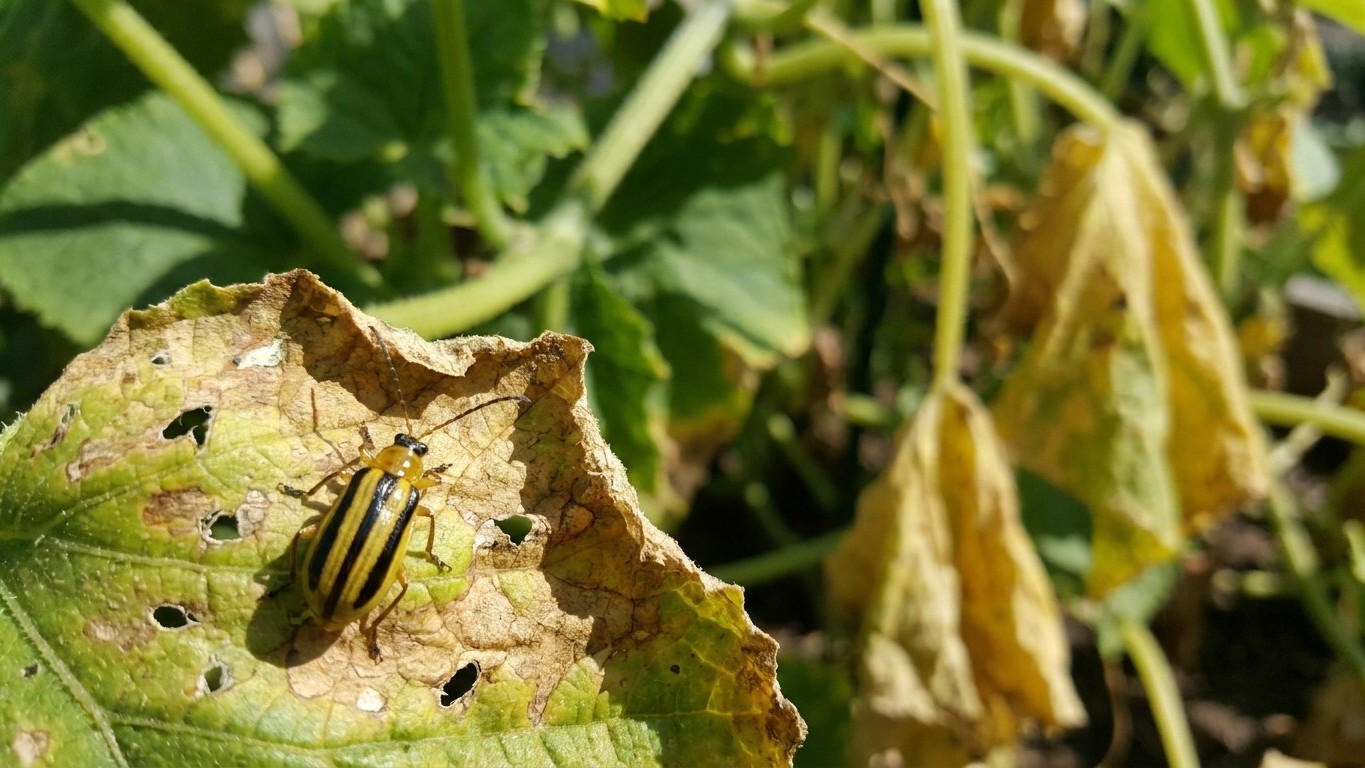

The striped cucumber beetle (Acalymma vittatum) is a small, yellow-and-black striped beetle that feeds on cucumbers, melons, squash and other cucurbits across most of the country. Its bite marks look worse than they are. The real threat is bacterial wilt, a disease the beetle carries in its gut and injects into the plant every time it feeds. A vine that looks fine on Monday can be collapsed by Friday, and that collapse is the reason this insect gets more attention than its size would suggest.
What it is and what it attacks

Adult striped cucumber beetles are about a quarter inch long, with three black stripes running down a yellow back. They target the cucurbit family almost exclusively: cucumbers and muskmelons rank as favorite hosts, squash and pumpkins come next, and watermelon is fed on but less preferred. Seedlings take the worst hits because beetles concentrate on the tender first true leaves, and a heavy infestation can strip a cotyledon bare before a gardener even notices the insects are there.
What separates this species from most garden pests is the transmission mechanism. The bacterium Erwinia tracheiphila, which causes bacterial wilt in cucurbits, overwinters inside the beetle’s digestive tract. When an infected beetle feeds, bacteria pass into the wound and travel into the plant’s vascular system. There’s no cure once a vine is infected. Cucumbers and muskmelons wilt fastest, sometimes within two weeks of exposure, while squash and pumpkin varieties show more tolerance and can carry the infection longer before symptoms show.
This is why the feeding damage itself, ragged holes in leaves, scarred stems, chewed blossoms, matters less than what it represents: an open door for disease. A grower who only counts leaf holes to decide whether to act is measuring the wrong thing. The insect population on a plant is really a proxy for infection risk, and that risk changes with the crop, the plant’s age and the local beetle density.
Because the biology, the damage patterns and the control tactics each raise their own questions, this hub splits them into dedicated pages. If you’re trying to confirm what you’re looking at in the garden right now, the identification details belong on the damage and identification page. If you want to understand why beetles show up when they do and how many generations occur in a season, that’s covered on the life cycle page. And if you’re past the point of curiosity and need a plan, the control page lays out the options in order of effectiveness.
Recognizing it
The clearest tell is the beetle itself: three black longitudinal stripes on a yellow-orange back, distinguishing it from the spotted cucumber beetle, which carries black dots instead of stripes and is a different species with an overlapping but not identical range. Adults cluster on new growth and blossoms, often in groups of several beetles per plant when populations build. Chewed cotyledons, ragged leaf margins, and scarring on the rind of young fruit are the visible signs, along with beetles feeding directly inside open flowers, which can reduce pollination on top of the direct damage.
Growers sometimes confuse early feeding scars with other chewing insects, or mistake a wilting vine for drought stress rather than bacterial infection. The distinction matters because the response is different: watering fixes drought stress, nothing fixes bacterial wilt once it has set in. A quick field test exists for confirming wilt (cutting a stem and looking for the sticky bacterial ooze that strings out when the cut ends are pulled apart), and that test, along with photos comparing beetle look-alikes, side-by-side descriptions of larval versus adult damage, and guidance on how many beetles per plant typically signal elevated risk, is laid out in full on the damage page.
One detail worth flagging here: larvae feed underground on roots and the base of stems, damage a gardener rarely sees directly. A plant that seems to wilt without visible above-ground feeding may be dealing with root-stage larvae rather than adult beetles, which changes both the diagnosis and the timing of any response.
When it appears
Adults overwinter in plant debris, fence rows and wooded edges near the previous season’s cucurbit plantings, then emerge in spring as soil warms and move into gardens right around the time cucurbit seedlings and transplants go in the ground. That overlap between beetle emergence and seedling planting is not a coincidence; the insect has co-evolved with these crops, and its life cycle is essentially timed to intercept the most vulnerable growth stage.
The exact emergence window, the number of generations in a season and the point at which a second generation becomes a practical concern all vary by region, and this is where the general story stops being useful on its own. Soil temperature accumulation, not the calendar, drives emergence, so a warm spring in one state and a cool one in a neighboring state can put beetle activity two or three weeks apart even at similar latitudes. Some regions see a single generation cycle through the season, others see two, and that difference changes how long a grower needs to stay watchful after the first beetles show up.
Because none of these dates hold nationally, the specifics, degree-day accumulation patterns, typical emergence windows, generation counts and how they shift year to year, belong on the life cycle page, where the full seasonal progression from overwintering adult to egg to root-feeding larva to new adult is broken down stage by stage. Local land-grant extension services track this closely for their own state, since it directly informs when protective measures need to go up, and their monitoring is the closest thing to a reliable local calendar that exists for this pest.
What works
Timing beats reaction. Because the highest-risk period is the seedling and early transplant stage, before plants are large enough to tolerate some feeding, protective measures matter most in that first window rather than later in the season when plants have more leaf area to spare. Physical barriers, floating row cover installed at planting and removed once flowering starts (since cucurbits need pollinator access), are one of the more reliable tools for keeping beetles off young plants during that vulnerable stretch.
Biological control has real teeth against this species. The tachinid fly Celatoria setosa is a specialist parasitoid of adult striped cucumber beetles and can meaningfully reduce local populations where it’s present and undisturbed. Generalist predators, including ground beetles and soldier beetles, feed on eggs and young larvae in the soil, and entomopathogenic nematodes naturally present in healthy garden soil attack larvae and pupae underground before they ever reach adulthood. All of these allies share one requirement: they need habitat and they need broad-spectrum insecticide use kept to a minimum, since a spray that kills the pest beetle also kills the fly and beetle predators working on the grower’s behalf for free.
Crop rotation, delayed planting relative to typical local emergence, and resistant or tolerant variety choices round out the toolkit, and each of these tactics is explained in more depth, along with how to sequence them and when a targeted treatment becomes justified, on the control page. Because thresholds, emergence timing and permitted products are set at the state level by extension services rather than nationally, the most useful next step is finding the page on this site for your own state, which links directly to your regional extension service’s current guidance.
Common questions
Does the striped cucumber beetle bite people or pets?
No. It feeds exclusively on cucurbit plant tissue and poses no direct threat to humans or animals. The concern is entirely agricultural, centered on plant damage and disease transmission.
Can a plant recover once it has bacterial wilt?
Generally no, once Erwinia tracheiphila has colonized the vascular system, especially in cucumbers and muskmelons. Squash and pumpkin varieties sometimes tolerate infection longer, but there’s no treatment that clears the bacterium once it has established.
Are all cucurbits equally attractive to this beetle?
No. Cucumbers and muskmelons tend to draw the heaviest feeding, squash and pumpkins are moderately attractive, and watermelon is comparatively less preferred, though still fed on when other hosts aren’t available.
Is the striped cucumber beetle found nationwide?
It’s established across a wide range of the country, though local abundance, emergence timing and generation count differ by state and by season, which is why regional extension guidance matters more than a single national rule.