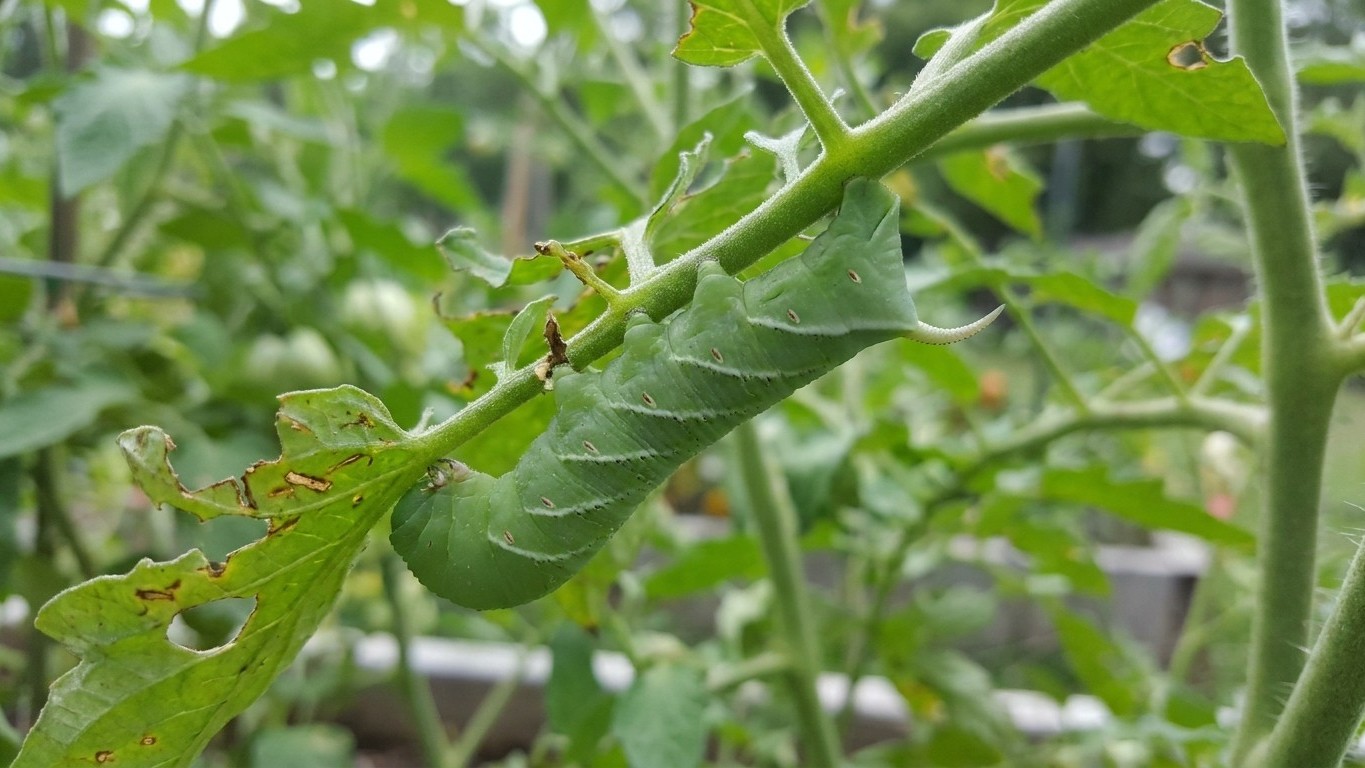

Tomato hornworm (Manduca quinquemaculata) is the thick green caterpillar that strips tomato and pepper foliage down to bare stems almost overnight. It’s the larval stage of a large sphinx moth, and despite its size, it’s built to disappear into the plant it’s eating. Most gardeners find the damage days before they find the culprit.
What it is and what it attacks

The tomato hornworm feeds on plants in the nightshade family: tomato first, but also pepper, eggplant, and potato when those are nearby. A mature larva can reach four inches long, roughly the length of a house key, with a pale horn-like spike near its tail end that gives the whole group of hornworms their name. Its coloring, a bright green that matches tomato foliage almost exactly, plus faint white diagonal stripes down each side, is what makes it so hard to spot even when it’s sitting in plain sight on a stem you’ve looked at twice already.
That camouflage is the whole story here. A caterpillar this size should be easy to find, and yet gardeners routinely miss it until a plant has lost half its leaves. The stripes break up its outline against leaf veins, and it tends to rest along the underside of stems during the day, feeding more actively at dusk and dawn. Add in the fact that it holds still when disturbed rather than fleeing, and you have an insect that’s large, slow, and still remarkably good at not being seen.
There’s also a second player in this story that changes how a lot of infestations actually end. Tiny braconid wasps parasitize hornworm larvae by laying eggs inside them; the wasp larvae later emerge and spin small white cocoons across the caterpillar’s back, which look like grains of rice stuck to the skin. A hornworm carrying those cocoons is already finished as a pest, whether or not you ever touch it. Recognizing that difference matters more than most home gardeners realize, and it’s covered in full on the site’s damage identification page.
The rest of this hub works the same way: each section below answers one part of the question (what the damage looks like, when the moth and caterpillar show up, what actually reduces numbers) and points to a page built around that single question. Timing in particular is not the same from one state to the next, so the practical answer to “when do I need to start looking” lives on this site’s territory pages rather than in a single national date.
Recognizing it
The clearest sign of tomato hornworm activity isn’t the caterpillar itself, at least not at first. It’s defoliation: entire branches stripped of leaves in a way that looks almost surgical, paired with dark green to black droppings (called frass) scattered on leaves and soil below the damaged area. Those pellets are often the first real clue, since they’re easier to spot than the insect that produced them. Fruit damage happens too, usually as gouged, sunken bites on the shoulders of green or ripening tomatoes, though defoliation tends to show up first and worse.
Confusion with other pests is common, and it runs in both directions. The tobacco hornworm (Manduca sexta) is nearly identical in size and habit, distinguished mainly by the shape of its side markings and the color of its rear horn; both species feed on the same host plants and cause the same kind of damage, so the distinction matters more for curiosity than for control. Gardeners sometimes also mistake early, lighter feeding for slug damage or flea beetle injury, which look different up close: slugs leave ragged holes with slime trails, flea beetles leave a fine shotgun-hole pattern, while hornworm feeding removes whole leaf sections and sometimes entire branches.
Age of the caterpillar changes what you’re looking for as well. Young larvae are small, pale green, and easy to overlook against new growth; they do proportionally little damage on their own but grow fast, and a plant can go from lightly nibbled to badly stripped within about a week once larvae reach their final growth stages. That’s why frass on the ground under a healthy-looking plant is worth taking seriously, even before you find visible leaf loss. A full breakdown of what each stage of damage looks like, including photos-style descriptions of frass, bite patterns, and the parasitized versus healthy caterpillar, is on the damage page, which is the right next stop if you’re staring at a stripped plant right now and trying to confirm what did it.
When it appears
Tomato hornworms don’t appear on a fixed calendar date. The adult moth, a large gray-brown sphinx moth sometimes called a hawk moth, overwinters as a pupa in the soil, emerges in spring, and lays eggs on the undersides of leaves once temperatures and host plants are both ready. From there, the insect moves through egg, larval, pupal, and adult stages, with the larval stage doing essentially all the visible damage. Because that whole cycle depends on soil and air temperature, the actual dates when eggs hatch and larvae start feeding shift by weeks depending on where you garden, and can also shift year to year within the same region depending on how warm or cool spring turns out to be.
This is exactly why a single national answer to “when should I start checking my plants” doesn’t hold up well in practice. A garden in a warm southern state may see its first generation of hornworms well before a garden in a cooler northern one even has tomato transplants in the ground, and some regions get a second generation later in the season while others typically only see one. Local university extension services track this with degree-day models and regional emergence data specific to their climate, which is a more reliable guide than any fixed date printed on a seed packet or gardening calendar.
The practical takeaway is that timing is a local question with a local answer. The site’s life cycle page walks through each stage of development in detail, including how long the caterpillar typically stays in its feeding stage and what triggers the shift to pupation. For the actual timing in your area, the state-level pages on this site link out to the relevant extension service, which is the authority that tracks regional emergence and publishes updated guidance each season.
What works
Control that actually holds up starts with timing, not products. Catching larvae while they’re still small, before a plant has lost significant foliage, makes hand removal realistic; once a caterpillar reaches its full size, it can strip remaining leaves within days even after you’ve spotted it. Checking plants in early morning or evening, when hornworms are more active and visible against the foliage they’re feeding on, is more effective than a quick daytime glance. Frass on the ground remains one of the best early triggers to start a closer inspection rather than waiting for obvious leaf loss.
Physical barriers matter more than most gardeners expect. Floating row covers placed over young transplants can block egg-laying moths from reaching the plants in the first place, though covers need to come off once flowering starts so pollinators can reach the blooms. Tilling soil in fall or early spring disturbs overwintering pupae, reducing the population that emerges as moths the following season, which is a low-effort step that pays off before the growing season even starts.
Natural enemies do a lot of the heavy lifting where they’re present. Parasitic braconid wasps are the most important biological control for this species; a hornworm covered in small white cocoons should be left in place rather than removed, since it’s already been neutralized and the wasps that emerge will go on to parasitize other larvae in the garden. Broad-spectrum insecticide use tends to work against this benefit, since it kills the parasitic wasps along with the pest, so gardeners who want the biological control to keep working need to be selective about when and what they spray. Predatory insects and some birds also take a share of hornworm eggs and small larvae, another reason a chemical-first approach can backfire over a full season.
The full control page on this site covers each of these approaches, including how to time inspections around your own region’s emergence window, at tomato hornworm control. Because emergence dates and any recommended treatment thresholds are state-specific, the most useful next step is finding your own territory’s page on this site, which links directly to your state’s extension service for current, region-specific guidance.
Common questions
Are tomato hornworms poisonous or dangerous to touch?
No. Despite the horn-like spike on the tail end, tomato hornworms don’t sting or bite, and they’re safe to pick up by hand, though many gardeners prefer gloves simply because of the size and the mess of handling a large caterpillar.
Will tomato hornworms move to other plants besides tomatoes?
Yes. They also feed on pepper, eggplant, and potato plants, all members of the same nightshade family, so a garden with several of these crops planted close together can see damage spread between them.
Should I kill a hornworm covered in small white cocoons?
No. Those cocoons belong to parasitic wasp larvae that have already killed the hornworm from the inside; leaving it in place lets the wasps emerge and go on to parasitize more hornworms nearby.
Why did my tomato plant lose all its leaves overnight with no hornworm in sight?
A single mature hornworm can strip a large amount of foliage in just a day or two, and its coloring makes it easy to miss even when it’s still on the plant; checking the undersides of stems at dusk or dawn, and looking for frass on the soil, usually turns it up.