
New Brunswick gardeners really have one lever that matters: picking a season class, not a brand name on a seed bag. With the Moncton station’s average last spring frost landing May 23 (Environment and Climate Change Canada, Canadian Climate Normals 1981-2010), the safe planting window is short enough that early and mid-season classes fit most yards better than late ones. Certified seed potatoes, not the variety name on the label, are what actually decides whether that class performs.
The short answer
The number that governs this whole choice is May 23, the average last spring frost date recorded at the Moncton station and published by Environment and Climate Change Canada in the Canadian Climate Normals for 1981-2010. That date is a mean, not a guarantee. In roughly half the years on record, frost at that station arrived later than May 23, which means any planting plan built around it needs slack built in rather than treated as a fixed line on the calendar.
What that frost date tells a gardener, combined with soil temperature, is which season class of potato has time to set and fill its tubers before conditions turn against it. Utah State University Extension and the University of Maine Cooperative Extension both describe the same mechanism from opposite ends: potatoes go in the ground once soil reaches 50 F, typically 14 to 21 days ahead of the last frost date, and tuber set and fill stall once soil climbs above 90 F. Neither source publishes a days-to-maturity figure for any variety, so the honest way to talk about fit is by season class: early, mid-season, or late.
For most of New Brunswick, early and mid-season classes are the better match. They ask for less total time in the ground between that 50 F soil threshold in spring and harvest, which means less exposure to whatever the frost-free window actually does that particular year, and less risk of running into a hot stretch that pushes soil past the 90 F ceiling before the crop finishes filling. Late-season classes aren’t ruled out everywhere in the province, but they need a longer stretch of workable soil than a station reading of May 23 comfortably promises, and they carry more risk in a year when frost runs late.
None of that matters much, though, if the seed itself is compromised. Certified seed potatoes are grown and inspected specifically to keep virus out of the seed stock; uncertified seed can carry it silently, and a virus-carrying tuber will underperform no matter how well the season class matches the local window. The season class question and the certified-seed question aren’t separate decisions. They’re the same decision, made twice.
What actually decides it
The frost date is an average, half your years will be worse
A “last frost date” sounds like a fact. It’s actually a midpoint. The Moncton figure of May 23 comes from thirty years of records averaged together, which means it splits the years roughly down the middle: in about half of them, the last frost fell after that date, sometimes well after. Treating May 23 as a safe planting day is treating a coin flip as a promise.
It also only describes Moncton. New Brunswick isn’t one climate zone stacked under a single number. Northern districts and higher elevations routinely run weeks behind a station reading taken at Moncton, so a gardener in the Restigouche region or on higher ground inland should expect their own local last frost to sit later than the provincial reference point, not the same. Worth flagging too: this Canadian normal covers 1981-2010, a different thirty-year stretch than the 1991-2020 period used for U.S. climate figures, so side-by-side comparisons across the border aren’t measuring quite the same window.
Soil temperature, not the thermometer, decides planting day
The frost date sets the outer edge of risk, but the actual go signal is soil temperature. Utah State University Extension and the University of Maine Cooperative Extension both point to 50 F soil as the trigger, with planting typically happening 14 to 21 days before the last frost date rather than after it, because seed potatoes tolerate cool soil better than tender transplants do. Air temperature on a given afternoon means little if the soil four inches down is still cold.
At the other end of the season sits the heat ceiling: soil above 90 F inhibits tuber set and fill, full stop. Watering more doesn’t reverse it. That’s the mechanism that should decide season class in any region with a run of hot soil days, and it’s why the reasoning transfers even to a garden this page never mentions. Wherever summer soil regularly tops 90 F, an early-season class that finishes before the heat arrives beats a late-season class that’s still trying to size tubers into it.
How to do it
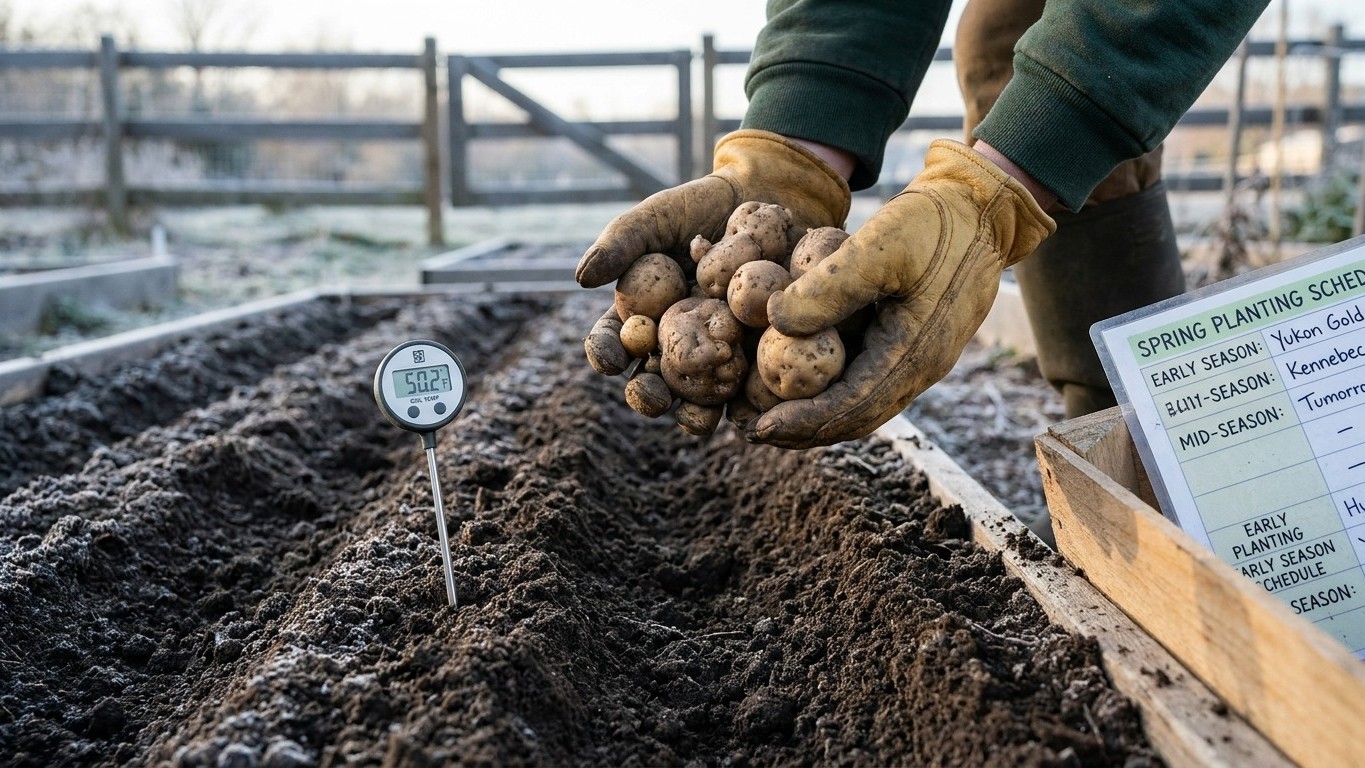
- Check soil temperature at planting depth in spring using a soil thermometer, rather than going by the calendar or the air temperature.
- Wait to plant until soil reaches 50 F, since seed potatoes set root and sprout poorly in colder ground.
- Match season class to the local frost-free window: favor early or mid-season classes where the window is short, saving late-season classes for spots with a longer stretch of workable soil.
- Source certified seed potatoes rather than saving tubers from a previous harvest or buying uncertified stock, since certification is what screens out virus.
- Plant roughly 14 to 21 days ahead of the local last frost date once the soil threshold is met, accepting that the local frost date itself is an average, not a hard line.
- Hill and protect emerging plants if a late frost arrives after planting, since the May 23 figure for Moncton is a midpoint and later frosts happen in about half of all years.
- Track soil temperature again as summer builds, and if it approaches the 90 F range, plan to dig an early-season crop before tuber set stalls rather than waiting on a late-season class to catch up.
What goes wrong
- Planting by the calendar instead of the soil. A gardener sees May 23 pass and plants that week regardless of conditions. Cold, wet soil below 50 F invites rot and poor sprouting. The fix is a soil thermometer, not a date circled in a planner.
- Using uncertified seed to save money. Uncertified tubers can carry virus without showing obvious symptoms the first season, and the decline shows up as underperformance that’s hard to trace back to its source. Buy certified seed potatoes every time, regardless of season class.
- Choosing a late-season class in a short-window district. A late-season class needs more total time in the ground than an early or mid-season one, and a district that runs behind the Moncton reference point, or one that simply had a late frost that year, can leave that crop short of finishing. Match the class to the local window, not the provincial average.
- Assuming one station’s frost date applies province-wide. May 23 describes Moncton. A gardener farther north or at higher elevation who plants on that exact date, assuming it applies to their own yard, is planting into a colder window than the figure suggests. Use the nearest local reading when one is available, and treat any single station’s number as a reference point, not a rule.
- Expecting irrigation to rescue a crop once soil passes 90 F. Watering doesn’t restart tuber set once soil heat has stalled it. Where hot stretches are a real risk, the fix is scheduling, not irrigation: an early-season class dug before the heat arrives, rather than a late-season class nursed through it.
Common questions
Which potato season class suits New Brunswick best?
Early and mid-season classes generally fit better than late-season ones, because they need less total time between the 50 F soil threshold in spring and harvest, which lowers exposure to a frost-free window built around Moncton’s average last frost of May 23.
Is May 23 safe to plant potatoes in New Brunswick?
Not as a guarantee. It’s the average last spring frost date at the Moncton station over 1981-2010, which means frost fell later than that date in roughly half of those years. Planting is better tied to soil reaching 50 F than to that calendar date alone.
Do I need certified seed potatoes?
Yes. Uncertified seed can carry virus that certification programs are specifically designed to screen out, and a virus-carrying tuber undermines a crop regardless of how well the season class matches the local climate.
What happens if soil gets too hot in summer?
Once soil rises above 90 F, tuber set and fill are inhibited, and extra watering doesn’t reverse that. In districts where hot soil stretches happen, an early-season class dug before that heat arrives is the more reliable choice than a late-season class still trying to finish.