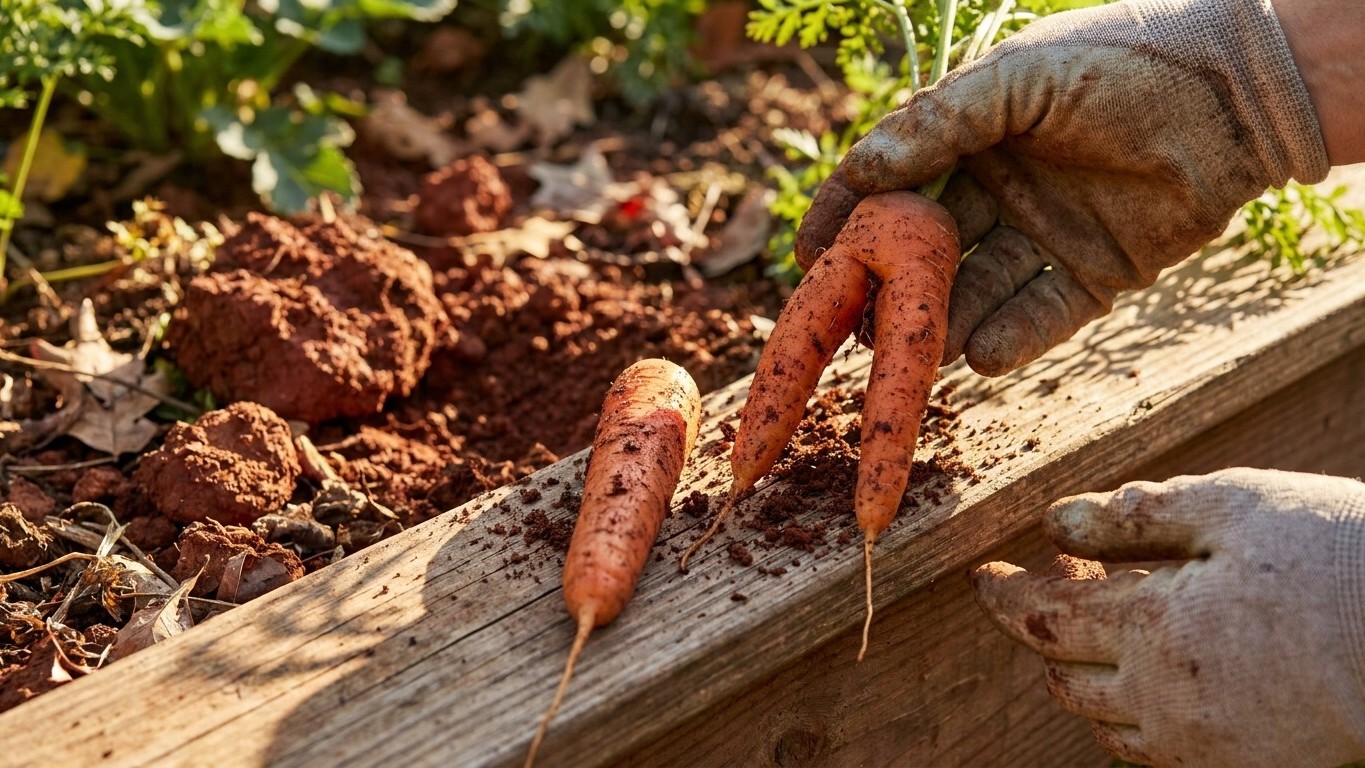

Kentucky’s official soil, the Crider series, is a well-drained silt loam with only 19 percent clay. That’s good news for carrots, which sulk and fork in heavy, compacted ground. But “the state soil” is one soil series among hundreds mapped across Kentucky, and your raised bed or backyard plot could be built on something entirely different.
The short answer
Kentucky’s state soil is the Crider series, an Alfisol, the kind of forest soil that formed under hardwood cover and holds nutrients reasonably well without being rich in the way a prairie soil is. The surface horizon runs slightly acid, with a pH around 6.2, and the texture breaks down to 5 percent sand, 19 percent clay, and 76 percent silt, classifying it as loam to silt loam. Organic matter sits around 3.0 percent. Drainage is classified as well drained. These are the representative values USDA’s Soil Data Access records for the surface horizon across 255 mapped components of the Crider series, not a number pulled from any one garden.
Set that against what a carrot actually wants. Carrots want deep, sandy, well-drained soil rich in organic matter, according to Utah State University Extension. Heavy or rocky soil makes the root fork, splitting into two or three legs instead of growing down as one clean taproot. Judged against that standard, Crider-type ground is a reasonably favorable starting point. It’s well drained, it’s mostly silt rather than clay, and 19 percent clay is on the lower end of what would count as “heavy” soil. A carrot sown in true Crider silt loam, worked to a fine tilth, has a fair shot at growing straight.
The catch is real. Silt loam, even well-drained silt loam, still compacts more readily than sand does, especially where foot traffic or tilling has packed the surface, or where a subsoil layer sits denser than the topsoil above it. Utah State’s guidance is specific about the fix: heavy soil needs plenty of compost worked in, and it needs double digging, turning the bed a full spade deep and then loosening the layer beneath that again, so roots meet no sudden wall of dense earth. Where a yard has been graded, filled, or compacted by construction equipment, and a lot of suburban Kentucky ground has, none of that Crider-series data applies, and a raised bed filled with a sandy, compost-rich mix is the faster route to straight carrots than fighting the native ground.
Kentucky spans a wide range of soil series beyond Crider, from river-bottom silt to clay-heavy uplands to soils scraped and reshaped by grading. This state soil profile is a starting point for guessing what your region’s ground tends to do, not a diagnosis of what’s under your own carrot bed.
The test that settles it in your own garden
State averages can’t tell you what’s eight inches under your own tomato cage. The only way to know if your soil will fork a carrot is to go look at it yourself, and it takes less time than a trip to the garden center.
- Dig a hole where you plan to sow. Go down at least a foot, straight-sided, so you can see the soil in profile rather than guessing from what comes up on the shovel blade.
- Check the depth of loose, workable soil before you hit a hard or dense layer. Carrots need a clear run downward; a shallow topsoil sitting over compacted clay or rock will fork the root right where it meets resistance.
- Look for stones, gravel, or old construction debris. Anything the taproot can’t push past becomes a second growing point, and that’s exactly how a fork starts.
- Feel the texture between your fingers. Rub a moist handful and note whether it feels gritty (sandy), silky and smooth (silty), or sticky and moldable (clay). A carrot’s ideal bed leans toward the loose, gritty end.
- Watch how the hole drains. Fill it with water and see how long it takes to disappear. Water that lingers for hours points to a dense or compacted layer nearby, the same layer that will deflect a growing root sideways.
- Repeat in more than one spot. Soil can change dramatically across a single yard, especially where a house was built, graded, or added onto.
What goes wrong here
- Forking in heavy or compacted ground. Even soil that classifies as loam to silt loam on paper can compact where it’s been walked on, tilled wet, or sits over a denser subsoil layer. The remedy Utah State University Extension gives is direct: work in plenty of compost and double dig the bed, breaking up the layer beneath the topsoil so the root has nowhere to hit resistance.
- Poor germination during a hot, dry stretch. Carrot seed is small and sits near the surface, and a crust that dries and hardens on top of silty soil can block seedlings from pushing through. Keeping the seedbed consistently moist until seedlings emerge, rather than letting it crust and dry between waterings, keeps germination from stalling out.
- Roots splitting from uneven watering. A carrot that goes dry for a stretch and then gets soaked can split as the root swells unevenly. Steady, even moisture through the growing season, rather than a feast-or-famine watering schedule, keeps the root growing smoothly instead of cracking.
- Rocky or debris-filled soil deflecting the root. Even a small stone can send a taproot off at an angle or force it to split around the obstruction. Screening or removing stones from the bed before sowing, and working the soil deeper than the stone layer, heads this off before seed ever goes in.
Common questions
Does Kentucky’s clay content mean carrots will always fork?
No. The Crider series, Kentucky’s state soil, carries only 19 percent clay in its surface horizon, which is a moderate figure, not a heavy one. Forking is more closely tied to compaction, stones, and a shallow workable layer than to clay percentage alone. A well-prepared bed in Crider-type soil, loosened deep and enriched with compost, gives a carrot a fair path to grow straight.
Should I test my own soil instead of trusting the state soil profile?
Yes, and it costs almost nothing beyond a shovel and a few minutes. Kentucky spans hundreds of mapped soil series, and any given yard, especially one that’s been graded, filled, or built on, can differ completely from the Crider series figures. Digging a test hole and checking depth, texture, stones, and drainage tells you what your carrots will actually meet.
What’s the fix if my soil turns out to be heavy?
Utah State University Extension recommends working in plenty of compost and double digging the bed, loosening a full spade depth and then breaking up the layer beneath that again. Where the native ground is badly compacted or full of construction fill, a raised bed filled with a sandy, compost-rich mix is often the more reliable route.
Does the state soil’s pH matter for growing carrots?
The Crider series carries a surface pH around 6.2, slightly acid, but that number describes the mapped series generally, not your particular bed. Soil pH shifts with amendments, prior use, and location, so it’s worth checking your own soil rather than assuming the state figure applies directly to your garden.