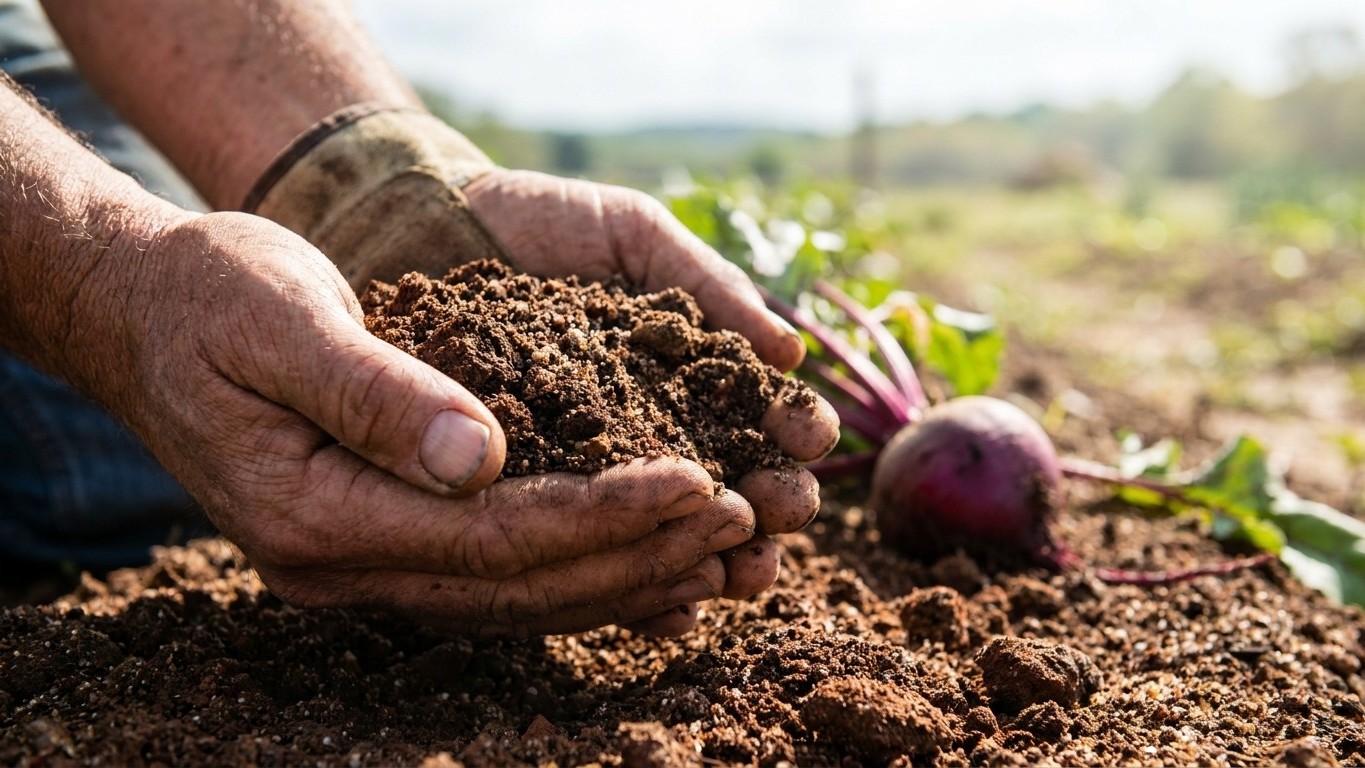

Michigan’s official state soil, the Kalkaska series, is sandy and drains fast, which lines up with what beets look for in a garden bed. But that same soil runs strongly acid and starts out with almost none of the organic matter beets need once it’s been dug and cultivated. The texture helps. The chemistry needs work. Neither cancels the other out.
The short answer
The Kalkaska series is Michigan’s legally designated state soil, named by state law and tracked by the USDA NRCS State Soils program. It’s a Spodosol, the kind of soil that forms under conifer forest through centuries of leaching, and USDA’s Soil Data Access records show why that matters for a root crop. The surface horizon runs 86 percent sand, 5 percent clay, and 9 percent silt, with a surface pH around 4.7, which is strongly acid. The series is classed as somewhat excessively drained.
For a beet, that sand content is the good news. Utah State University Extension’s guide to growing beets calls for deep, sandy, well-drained soil rich in organic matter, and Kalkaska’s texture checks the first two boxes without effort. Water moves through it. Roots don’t fight compaction. But “somewhat excessively drained” cuts both ways: the same looseness that keeps a beet root from forking also means the top few inches dry out fast between rain events, and that’s the exact condition that pushes beets toward premature flowering in their early weeks.
The pH figure deserves a caution of its own. USDA’s 4.7 reading is the representative value for the surface horizon of the Kalkaska series as mapped in its natural, forested state, not a number pulled from a tilled vegetable bed. The organic matter figure tells the same story even more clearly: USDA lists it at roughly 75 percent for this series’ surface horizon, a number that high only makes sense as a natural litter or duff layer under trees, not as the tilth of a worked garden row. A cultivated bed on Kalkaska-type ground won’t carry anywhere near that much organic matter unless someone has been adding it by hand for years. Neither figure should be read as “your garden’s number.” A soil test on your own plot is the only way to know where your pH and organic matter actually sit.
On heat, the published facts for this page don’t include a day-count of how often a Michigan reference city crosses 90 degrees Fahrenheit in a given year, so that figure isn’t stated here. What is documented is the mechanism: Utah State’s guide is specific that heat above 85 F combined with water stress is what turns a beet root woody, which matters most in whichever stretch of a Michigan summer runs hottest and driest, whenever that lands.
One more thing worth saying plainly: Michigan spans hundreds of mapped soil series, not one. Kalkaska is the state symbol, common across parts of the northern Lower Peninsula and the Upper Peninsula under old forest cover, but a yard in a river valley, a subdivision built on scraped and filled ground, or clay-heavy farmland downstate can look nothing like it. Treat everything above as a regional tendency, then confirm your own dirt with a test.
The six weeks that decide it here
MSU Extension’s frost-free date data puts the last spring frost around April 30 in the Detroit area, with early to mid May typical across most of the Lower Peninsula. Beets are direct-seeded, never transplanted, and the standard guidance is to get seed in the ground two to three weeks before that last frost date. That timing puts the crop’s first six weeks, the window Utah State identifies as the one where water stress triggers bolting, squarely into mid-April through late May or early June depending on where in the state a garden sits.
That’s a meaningful stretch to think through, because it’s the same period when Michigan’s weather is at its most unsettled. Snowmelt, cold rain, and the first genuinely warm days can all show up within the same two-week span, and a garden bed on sandy, fast-draining ground doesn’t hold onto moisture through a dry stretch the way a heavier clay soil would. On Kalkaska-type sand, a week without rain in early May can dry the top inches out well before a beet seedling has built the root system to reach deeper moisture. That’s the exact condition Utah State flags as the trigger for premature flowering, not heat, not day length on its own, but water stress landing on young plants in those first six weeks after seeding.
The practical takeaway isn’t complicated, but it is specific to this soil. Because the ground drains fast rather than holding water, the risk in a Michigan spring isn’t usually standing water rotting seed, it’s the reverse: a sandy bed going dry between rains while a gardener assumes April showers are doing the job. Checking soil moisture by hand in the top two inches during that six-week window, rather than trusting the calendar or the last time it rained, is the difference between a beet crop that sizes up normally and one that bolts before it ever fills out a root.
Later in the season, once beets are past that early window and Michigan’s summer settles into its warmest stretch, the same fast-draining sand creates a second, separate risk. That one isn’t about flowering, it’s about texture in the root itself, and it’s worth treating as its own problem rather than folding it into “keep it watered” advice for the spring.
What goes wrong here
- Bolting from early dry spells: Kalkaska-type sandy soil sheds water quickly, and a gap in rain during the first six weeks after seeding is enough to trigger premature flowering, per Utah State University Extension. The remedy is checking soil moisture by hand through that window rather than relying on rainfall alone, and watering when the top two inches dry out.
- Woody roots from summer heat plus water stress: This is a distinct failure from bolting, tied to temperatures above 85 F combined with dry soil later in the season, according to Utah State’s guide. Keeping moisture steady through the hottest stretch, and mulching to slow evaporation from sandy ground, addresses this without needing to guess at a specific heat threshold for any one Michigan city, since that day-count isn’t published here.
- Strongly acid soil chemistry: USDA’s data puts Kalkaska’s surface pH at roughly 4.7, well outside a neutral range. A garden built on similar ground benefits from a soil test before planting, since acidity this strong can limit how well a beet takes up nutrients regardless of how good the texture is.
- Overestimating natural fertility: The USDA organic-matter figure for Kalkaska’s surface horizon, around 75 percent, reflects a natural forest litter layer, not a tilled bed. Gardeners on this soil type should assume low fertility once the land is cleared and worked, and build it up deliberately rather than trusting the state soil’s reputation.
- Over-amending sandy ground: Utah State’s guide caps composted organic matter at no more than 1 inch per 100 square feet. On soil this loose, adding more than that doesn’t help root development and can throw off the balance the crop needs.
Common questions
Is Michigan’s state soil the same soil in my backyard?
Probably not exactly. Kalkaska is the soil series Michigan law named as its official state soil, and USDA maps it across parts of the state, mostly under historic forest cover. But the state has hundreds of other mapped soil series, and a yard in a floodplain, on old farmland, or on fill dirt from construction can differ completely. Use Kalkaska’s numbers as a regional starting point, then test your own ground.
When should I sow beets in Michigan?
Beets are direct-seeded, not transplanted, and the standard timing is two to three weeks before the last spring frost. MSU Extension puts that frost date around April 30 in the Detroit area, with early to mid May typical across most of the Lower Peninsula, so seeding windows shift earlier or later depending on where in the state a garden sits.
Why did my beets bolt instead of forming a root?
Utah State University Extension identifies water stress in the first six weeks after seeding as the trigger for premature flowering, or bolting. On sandy, fast-draining soil like Michigan’s Kalkaska series, dry spells during that early window are the most likely cause, not heat and not day length on their own.
Why are my beet roots woody even though they got watered?
Woodiness is a separate problem from bolting. Utah State’s guide ties it to temperatures above 85 F combined with water stress later in the growing season, after the roots have already started forming. Watering that was adequate in the first six weeks won’t prevent this if the plant goes dry during a hot stretch afterward.