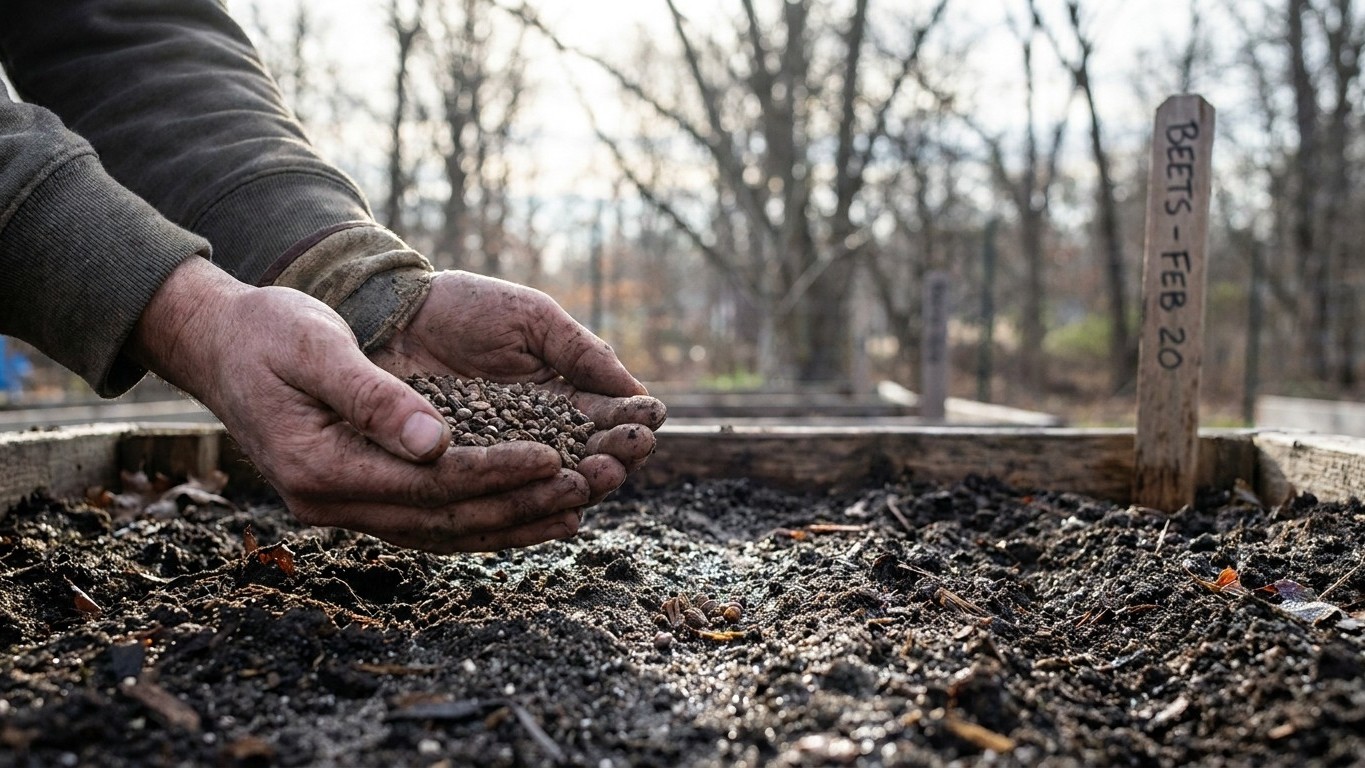

Sow beet seed directly into the ground two to three weeks before your area’s last spring frost date. In the Detroit area, that frost date lands around April 30, which puts beet sowing in mid-April. Across most of the Lower Peninsula, the last frost holds off until early or mid-May, so the seeding window shifts later. Beets go straight into the garden bed. They are never started indoors and transplanted, and that two-to-three-week head start before frost matters more than any single calendar date.
The short answer
Michigan’s official state soil, named by state law, is the Kalkaska series, a Spodosol that formed under conifer forest. Where the Soil Survey has mapped it, the surface horizon runs about 86 percent sand, 5 percent clay and 9 percent silt, with a surface pH near 4.7, strongly acid, and the profile is classed as somewhat excessively drained. For a beet, that combination means water moves through the root zone fast. Sandy ground like this warms early and rarely stays soggy, which is useful for getting seed in the ground promptly, but it also dries out between rains faster than a garden with more clay or silt would. Beets need deep, well-drained soil rich in organic matter to size up properly, according to Utah State University Extension, and Kalkaska-type ground supplies the drainage half of that equation more readily than the fertility half.
A caution belongs right here: Michigan spans hundreds of mapped soil series, and Kalkaska is a forest soil, not a description of any particular vegetable bed. A cultivated garden won’t carry the organic-matter figure recorded for this series either. Where the surface value runs near 75 percent organic matter, as it does for Kalkaska, that signals a natural litter or peat layer under conifers, not the crumbly, worked topsoil in a raised bed. Southern Michigan’s farmland, much of it built on heavier glacial till, can run in the opposite direction, holding more clay and draining slower than this state soil suggests. The only way to know what’s actually under your beets is a soil test of your own ground.
On heat, the mechanism is documented even where the local count is not. Utah State University Extension notes that temperatures above 85 F combined with water stress make beet roots woody. How many days a typical Michigan growing season spends above 90 F is not a figure carried in the sources for this page, so it isn’t stated here as a number. What can be said is that the risk described by that 85 F threshold applies whenever a hot, dry stretch lands on a bed that’s been allowed to dry out, regardless of the season’s overall average.
The six weeks that decide it here
Work backward from the frost dates and the six-week window comes into focus. Sowing around mid-April near Detroit, ahead of that April 30 frost date, means the first six weeks of a beet’s life run from mid-April into early June. Sowing in early-to-mid May, which fits the frost timing across most of the Lower Peninsula, pushes that same six-week stretch into mid-June. Either way, this window is the one Utah State University Extension flags as decisive: water stress during it causes premature flowering, known as bolting, before the root has had a chance to develop.
Michigan’s spring is shaped heavily by the Great Lakes, which tend to slow the arrival of sustained heat and can produce sharp swings between mild and cool stretches as lake-moderated air masses move through. That variability cuts both ways for a beet bed. A run of cool, damp days early in the window does the crop no harm and may even help germination. But a dry spell tucked into an otherwise cool spring is where the risk actually sits, because the trigger for bolting is water stress, not heat. A gardener watching the thermometer and skipping irrigation because the air feels mild can still end up with a bed that dried out at the root.
This is the detail that separates bolting from the woody-root problem covered in the next section. Bolting is an early-season failure, tied to the first six weeks after sowing and to moisture, full stop. It can happen in a spring that never gets hot. Woodiness comes later, when heat above 85 F lands on a plant that’s also short on water, and it affects the root’s texture rather than sending the plant to flower. Keeping the six-week window evenly moist, regardless of temperature, is the specific defense against bolting; it does not by itself guarantee against woodiness later in the season.
What goes wrong here
- Beds dry out fast because the ground is sandy. Where garden soil leans toward the Kalkaska-type texture, sand lets water pass through quickly, and a bed can go from moist to dry within days during a warm stretch, even in a cool spring. Check soil moisture with a finger, not the air temperature, through the first six weeks, and water during dry spells even when the weather feels mild.
- Native acidity limits root growth. A surface pH near 4.7, as recorded for Kalkaska, is far more acid than most vegetable roots tolerate well. If a soil test on your own bed comes back strongly acid, apply lime according to the test’s specific recommendation rather than guessing at an amount.
- A hot, dry stretch after the first six weeks turns roots woody. Once temperatures push past 85 F, any water stress at that point, separate from the earlier bolting risk, coarsens the root’s texture. Keep watering consistent through hot spells later in the season, not just during the initial six weeks.
- Over-amending sandy soil with compost. Utah State University Extension caps organic matter amendment at 1 inch per 100 square feet. Piling on more in an attempt to fix a fast-draining bed doesn’t hold water the way hoped and can unbalance nutrients instead.
- Heavier, compacted ground elsewhere in the state causes rot or misshapen roots. Southern Michigan’s till-plain farmland and any garden soil a builder has compacted or filled can drain far slower than the sandy state soil suggests. Raised beds or worked-in organic matter, guided by a soil test, correct for slow drainage the same way lime corrects for acidity.
Common questions
Can I start beet seed indoors to get ahead of Michigan’s short window?
Beets are sown directly in the garden. The taproot doesn’t take well to being started elsewhere and moved, and the standard maturity window, roughly 60 to 80 days depending on variety, is counted from the day the seed goes into the ground, not from a transplant date. Starting seed indoors doesn’t shorten how long the crop needs in the actual bed.
How do I know if my garden soil is anything like the Kalkaska series?
You likely won’t know without testing. Kalkaska is a sandy forest soil found under conifers in parts of Michigan, and it’s the state’s official soil, not a stand-in for any particular backyard. A cultivated vegetable bed, especially one that’s been amended or tilled for years, will differ from the mapped surface values of a forest soil in both texture and organic matter. A soil test remains the only reliable way to know your actual sand, clay, silt and pH numbers.
What’s the real difference between bolting and woody roots?
They’re two separate failures with two separate causes. Bolting happens when the plant is water-stressed during its first six weeks after sowing and responds by flowering prematurely, before the root has bulked up, regardless of whether the weather was hot or cool. Woodiness happens later, when temperatures climb above 85 F while the plant is also short on water, coarsening the texture of an otherwise developing root. Watering evenly through both stages addresses two different problems, not one.
Should I add lime before sowing if my soil seems acidic?
Test first. If your bed’s pH comes back strongly acid, similar to the roughly 4.7 recorded for Michigan’s Kalkaska series, follow the lime rate your soil test report specifies rather than applying lime by guesswork. Overcorrecting pH can create its own nutrient problems, so the test result should drive the amount, not an assumption based on the state soil figure alone.