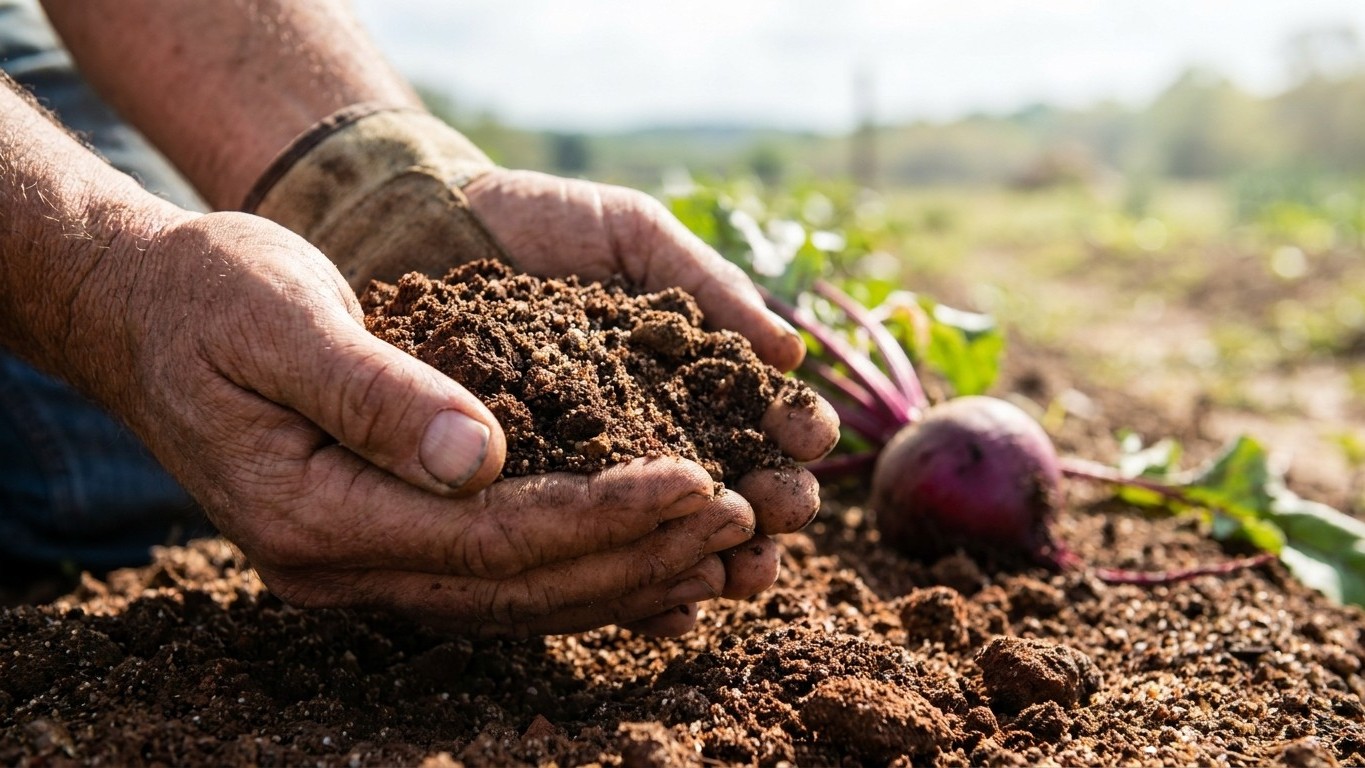

North Carolina’s benchmark soil, the Cecil series, is sandy and well drained, which suits a beet’s need for loose ground more than most Southeast soils do. But it’s also acid and nearly starved of organic matter, so the texture works in the root’s favor while the chemistry works against it. Add a Piedmont spring that can flip from dry to soaked in a week, and the real threat to a beet crop here isn’t the dirt at all. It’s timing.
The short answer
The Cecil series, an Ultisol, is what USDA NRCS lists as representative of North Carolina ground. It’s an old, heavily weathered and leached soil, the kind that’s been rained on and picked over for a long time, and it shows: naturally acid, low in nutrients, with a surface pH around 5.5. Texture-wise it runs 68 percent sand, 13 percent clay and 20 percent silt, and it’s classed as well drained. Organic matter sits around 0.8 percent.
For a beet, that texture is closer to friendly than most people assume. Utah State University Extension’s guidance on growing beets calls for deep, sandy, well-drained soil, and a 68 percent sand profile that drains freely checks that box without much argument. Beet roots push down and out; they don’t like to fight clay or sit in standing water, and Cecil soil won’t make them do either.
The problem is everything else on the label. That same USDA data point, 0.8 percent organic matter, is a long way from what Utah State calls “rich in organic matter.” Cecil soil, left alone, is thin on the stuff that feeds a root vegetable and holds moisture evenly through a dry week. The extension guidance answers that with a specific ceiling: no more than 1 inch of composted organic matter worked into every 100 square feet. Not because more compost hurts the beet directly, but because oversized organic inputs on a soil already prone to acidity and nutrient swings can throw the bed further off balance than it started.
The acidity matters too, if less dramatically. A surface pH of 5.5 is slightly acid, and while Utah State’s beet guidance doesn’t set an ideal pH number, a soil that starts acid and low in nutrients gives a beet less of a nutrient cushion to work with than a neutral, fertile bed would. That’s one more reason a soil test on the actual garden bed, not just this state-level reference, is worth the ten dollars before seed goes in the ground.
On the heat side, the brief for this soil doesn’t carry a published figure for how many days a year Charlotte, the Piedmont reference city, spends above 90 degrees Fahrenheit, so that number isn’t stated here. What is documented is the threshold that matters for the root itself: Utah State’s guidance ties heat above 85 F, combined with water stress, directly to woody beets. Piedmont summers routinely clear that mark for stretches at a time, which means the heat side of the equation isn’t in question. Whether the water side holds is the part the gardener controls.
None of this is a verdict on any one backyard. North Carolina spans hundreds of mapped soil series, and Cecil is simply the one USDA names as representative of the state as a whole. A garden on river-bottom ground, a lot a builder graded and filled, or a plot in the mountains or coastal plain can differ from this profile entirely. Cecil is a starting point for thinking about the state’s ground in general, not a stand-in for a soil test on a specific bed.
The six weeks that decide it here
Beets are sown directly in place, never transplanted, and the standard guidance is to get seed in the ground 2 to 3 weeks before the last frost. In the North Carolina Piedmont, NOAA NCEI’s 1991-2020 climate normals put the window for the last 32 F freeze, at the 30 to 70 percent probability band, between March 23 and April 5. That timing means the first six weeks of a beet crop’s life, the stretch that decides whether the plant bolts or grows a straight root, land squarely in the Piedmont’s early spring: late March through early May, roughly.
That stretch of the calendar in the Piedmont doesn’t hold to one pattern. It’s a season known for swinging rather than settling: a run of mild, dry days can flip into a week of steady rain, and a warm spell can be followed by a late cold snap that stalls growth without necessarily bringing a hard freeze. For a beet seedling, that instability is exactly the setup Utah State’s guidance flags as risky. Water stress in the first six weeks after sowing is what pushes beets toward premature flowering, meaning the plant bolts and puts energy into seed instead of root, and a swinging spring is precisely the kind of weather that produces water stress: not because rain is scarce overall, but because it doesn’t arrive evenly.
This is a different failure than the woodiness that shows up later from heat. Bolting is an early-season problem, driven by dry or unsteady conditions while the beet is still small and establishing. Woodiness is a summer problem, driven by heat above 85 F layered on top of water stress once the root is already sizing up. The Piedmont’s spring puts a beet crop at risk for the first one; the Piedmont’s summer sets up the second. Treating both as “keep the bed watered” misses the point that they happen at different stages, for different reasons, and call for different attention.
Practically, that means the six weeks right after sowing, whenever they fall inside that late-March-to-early-May window locally, are the stretch to watch most closely for consistency, not volume. A bed that gets an inch of rain in one downpour and then goes ten days dry has had the same monthly total as a bed watered evenly twice a week, but the beet growing in it has had a very different six weeks.
What goes wrong here
- Bolting from an uneven early spring. A Piedmont spring that swings between dry stretches and heavy rain creates the water stress that Utah State’s guidance links directly to premature flowering in the first six weeks after sowing. The fix is even moisture in that window specifically, not just watering in general: check the bed every few days rather than relying on rainfall to average out.
- Woody roots once summer heat sets in. Once temperatures climb past 85 F, any water stress on top of that heat makes the root fibrous and tough. Mulching to hold soil moisture and watering on a schedule through hot stretches, rather than waiting for the plant to show stress, keeps the root from toughening up.
- Nutrient-thin roots from low organic matter. Cecil soil’s 0.8 percent organic matter is well short of what a root crop wants to feed on. Work in up to 1 inch of composted organic matter per 100 square feet before sowing, staying at or under that ceiling so the acid, low-nutrient base isn’t pushed further out of balance.
- Slow or patchy germination in surface crusting. Sandy surface soil like Cecil’s can crust after a hard rain and then dry fast, which makes it harder for beet seed to push through evenly. Keeping the top inch of soil consistently damp, rather than soaked and then bone dry, gives seedlings a steadier path up.
- Guesswork on acidity. A surface pH around 5.5 is more acid than a nutrient-hungry root crop benefits from, but that figure describes the state’s representative soil, not any one garden. A soil test on the actual bed is the only way to know whether lime or another amendment is worth adding before sowing.
Common questions
Is North Carolina’s soil actually good for growing beets?
The texture is workable. The Cecil series, the state’s USDA-representative soil, is 68 percent sand and well drained, which matches the loose, deep, well-drained ground beets need according to Utah State University Extension. The weak point isn’t drainage, it’s fertility: at roughly 0.8 percent organic matter and a surface pH near 5.5, the soil is acid and thin on nutrients, so it needs compost worked in before it’s ready for a root crop.
How much compost should I add to a beet bed in this soil?
Utah State’s guidance sets a ceiling, not just a floor: no more than 1 inch of composted organic matter per 100 square feet. Given how low Cecil-type soil runs on organic matter to start, staying within that limit rather than overloading the bed is the more useful rule to follow.
When should I sow beets to avoid both frost and bolting?
The standard timing is 2 to 3 weeks before the last frost. In the Piedmont, NOAA NCEI’s 1991-2020 climate normals put that last-frost window, at the 30 to 70 percent probability band, between March 23 and April 5. That puts sowing in mid-to-late March for most Piedmont gardens, with the following six weeks, the period most sensitive to bolting from water stress, running into early May.
Why do my beets turn woody even when I water them?
Woodiness comes from heat above 85 F combined with water stress once the root is already developing, which is a separate failure from the early-season bolting caused by dry spells right after sowing. If watering happens unevenly, or only after the plant already shows stress, heat can still toughen the root even though water was applied at some point. Consistent watering through hot stretches, not occasional watering, is what the guidance points to.