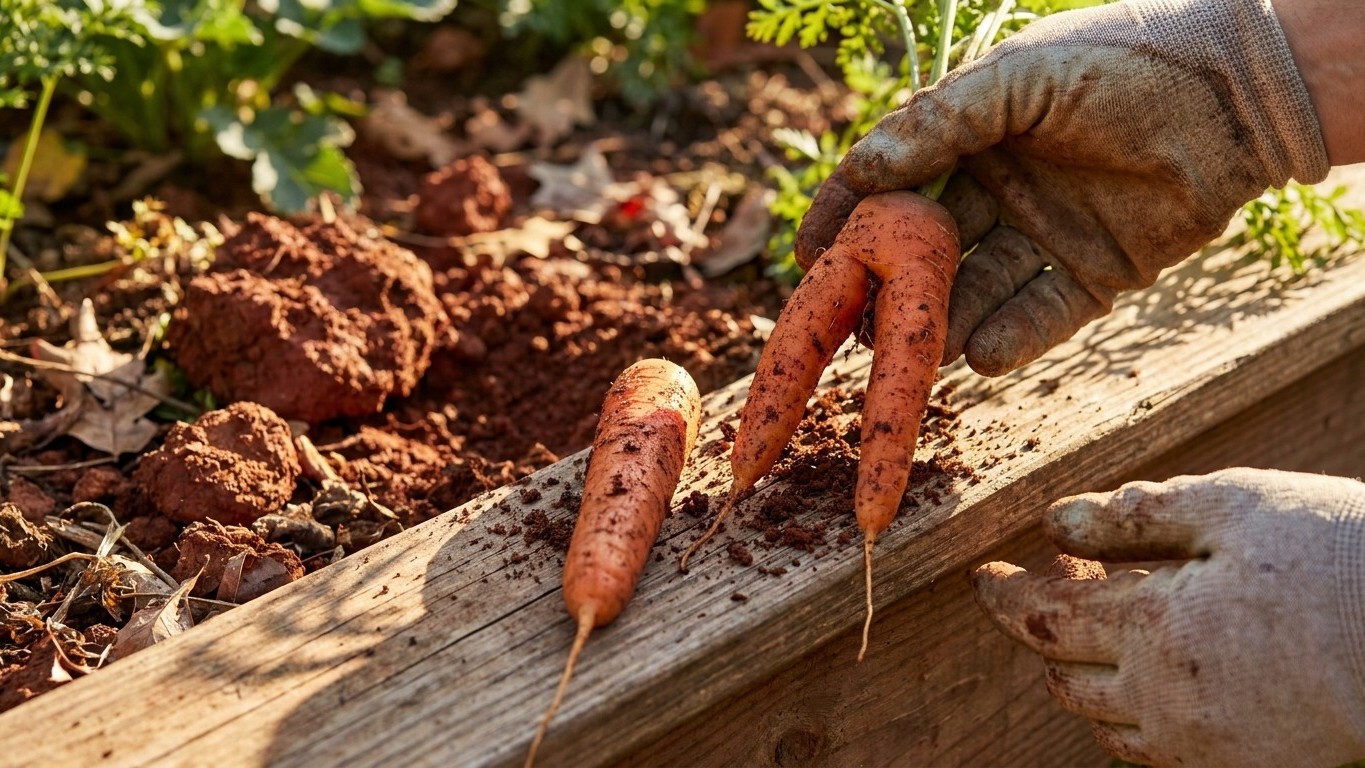

North Carolina’s representative soil, the Cecil series, runs sandy and well drained rather than heavy and clay-bound, so most gardens built on ground like it won’t push carrots into forked, twisted roots. The catch: that answer holds only where your dirt actually resembles Cecil. Low organic matter and mild acidity still call for compost, and any clay pocket, compacted spot, or builder’s fill changes the outcome fast.
The short answer
The soil USDA lists as representative of North Carolina is the Cecil series, an Ultisol. That word matters more than it sounds: Ultisols are old, heavily weathered, leached soils, naturally acid and short on nutrients after thousands of years of rain washing minerals downward. The surface horizon of the Cecil series runs 68 percent sand, 13 percent clay, and 20 percent silt, with organic matter around 0.8 percent and a surface pH near 5.5, slightly acid. Drainage class: well drained.
For carrots, that texture is mostly good news. Carrots want deep, sandy, well-drained soil rich in organic matter, according to Utah State University Extension, and forking happens when the root hits heavy or rocky ground and splits around the obstruction instead of pushing straight down. A soil that’s roughly two-thirds sand and only 13 percent clay isn’t the dense, sticky ground that typically deforms a taproot. Well-drained also means roots aren’t sitting in waterlogged pockets that rot or distort them.
So if your garden matches the Cecil profile, forking from soil density alone shouldn’t be your main worry. What will bite you is the other side of that same coin: 0.8 percent organic matter is thin, and a pH of 5.5 is acidic enough to lock up some nutrients carrots need to bulk up evenly. That’s exactly the gap Utah State’s advice is built to close for heavy soils and it applies here too, just for a different reason. Work compost into the bed before sowing, not after, since carrots are sown directly in place and won’t tolerate their row being disturbed later. Double digging loosens any residual compaction and gives the taproot a full 10 to 12 inches of soft going before it meets anything resistant.
Here’s the part that matters more than any of those numbers: North Carolina spans hundreds of mapped soil series, from river-bottom silt to Piedmont clay to coastal sand. The Cecil series is what USDA names as representative of the state as a whole. It is not a reading of your yard. If your neighborhood sits in a floodplain, on a ridge that’s been graded, or over one of the state’s many localized clay seams, your actual numbers could look nothing like 68-13-20. This is a starting point for what the region’s ground tends to do, not a diagnosis of the twelve feet of dirt behind your house.
The test that settles it in your own garden
State-level soil data can’t tell you what’s under your own raised bed or back forty. The only way to know is to go look, and it takes less time than a trip to the garden center.
- Dig a test hole at least 12 inches deep where you plan to sow. Carrots need that full depth clear of rock, hardpan, or a sudden clay layer. Note where the texture or color changes as you go down.
- Check for stones and obstructions. Run your fingers through the excavated soil. Pebbles, buried roots, or construction debris in the top foot are the most common cause of a carrot root splitting into two or three legs.
- Do a ribbon test on a handful of moist soil. Squeeze it between your thumb and finger and try to form a ribbon. Sandy soil won’t hold a ribbon at all and falls apart; heavy clay forms a long, slick ribbon over an inch or two before breaking. Somewhere in between is what most root crops prefer.
- Run a drainage check. Refill the same hole with water and watch how it behaves. Water that vanishes almost immediately points to sandy, fast-draining ground; water that sits for a long stretch points to a clay-heavy or compacted layer that will hold moisture around the root and encourage rot or forking.
- Compare what you found against the Cecil numbers above. If your hole looks sandy, loose, and quick-draining, you’re probably close to the state’s representative soil and can focus on compost and fertility. If it’s sticky, slow-draining, or full of rock, treat it as heavy soil and plan on a raised bed or thorough double digging before you sow a single seed.
What goes wrong here
- Forking in heavy or obstructed ground. Even in a state where the representative soil is sandy, plenty of individual gardens sit on compacted or clay-rich patches, especially anywhere fill dirt was brought in during construction. The root meets resistance and splits. The fix is the one Utah State University Extension recommends for any heavy soil: work in generous compost and double dig the bed to break up compaction before sowing.
- Poor germination during a hot stretch. Carrot seed is small and sits near the surface, and a dry, sandy soil like Cecil’s surface horizon can crust or dry out fast under a hot sun. Keep the seedbed consistently moist with light, frequent watering until seedlings are up, and a thin mulch layer can slow that surface drying without smothering the row.
- Splitting from uneven watering. Roots that go through a dry spell and then get soaked tend to swell too fast and crack open. A steady watering routine, rather than occasional deep soaks after long dry stretches, keeps growth even from seed to harvest.
- Stunted or pale roots from thin, acidic ground. At around 0.8 percent organic matter and a surface pH near 5.5, the state’s representative soil is naturally short on both fertility and the near-neutral pH many root crops grow best in. Working compost into the bed ahead of sowing addresses both problems at once, adding organic matter while buffering some of that acidity.
Common questions
Does the state’s representative soil mean my garden won’t have forked carrots?
No. The Cecil series describes what USDA lists as representative of North Carolina as a whole, not any individual yard. Your own soil could be sandier, heavier, or rockier depending on your location and history, which is why the dig-and-feel test matters more than any statewide figure.
What’s the ideal soil texture for carrots, regardless of state?
Utah State University Extension describes it as deep, sandy, and well drained, with plenty of organic matter. Heavy or rocky soil is the main cause of forking, and their fix is the same everywhere: compost and double digging to loosen the ground before sowing.
Do I need to test my soil’s pH before planting carrots?
The Cecil series’ surface pH runs around 5.5, slightly acid, but that figure describes the mapped representative soil, not your bed. A simple home or extension soil test will tell you your actual number, which is the only way to know whether lime or another amendment is worth adding.
How long do carrots take to mature after sowing?
Carrots are sown directly in the ground rather than transplanted, so there’s no transplant date to count from. Growth typically runs 70 to 100 days from seeding to harvest, depending on the variety and growing conditions.