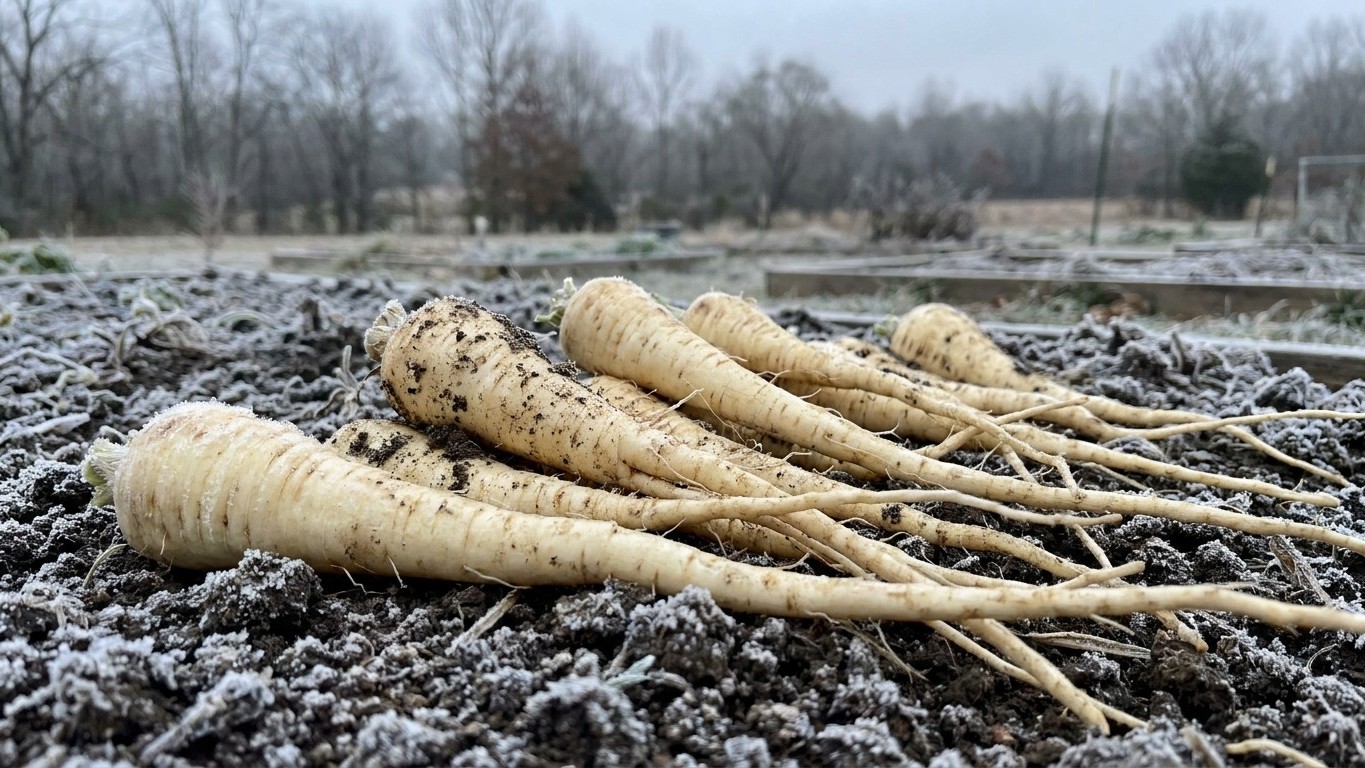

Yes, parsnips grown in Ontario will sweeten, and the region’s cold season all but guarantees it. The frost most gardeners try to dodge is exactly what turns a starchy, flavorless root into a sweet one, converting stored starch into sugar over several weeks of cold weather. The climate here does the heavy lifting. What matters is timing the sowing correctly and understanding the numbers behind that transformation.
The short answer
The question that settles this is simple: does this part of the province deliver several consecutive weeks of frosty weather each fall? For the Toronto area, tracked through Environment and Climate Change Canada’s climate normals, the answer is yes, decisively. The coldest month averages a daily minimum of 13.6°F, well below the freezing point parsnips need to trigger their starch-to-sugar conversion. That’s not a borderline reading typical of milder growing regions further south. It’s a sustained, reliable cold season, and that’s exactly the kind of exposure a parsnip root needs to reward the gardener who leaves it in the ground.
That 13.6°F figure matters far more than any hardiness zone number a gardener might look up. A hardiness zone rating tells you whether a perennial can survive winter outdoors where you live. It says nothing about whether an annual root vegetable, dug from the soil, will taste sweet. Sweetening is a frost-exposure phenomenon, not a zone phenomenon, and the two should never be swapped for each other. A parsnip grown in a comfortably rated zone with a genuinely mild winter can still grow into a full-sized, healthy-looking root and taste flat and starchy at harvest, simply because it never went through the sustained near-freezing stretch that converts stored starch into sugar.
Around Toronto, and across most of Ontario’s populated growing regions, that stretch is not in question. The first fall frost lands on average October 16, and the weeks that follow push toward that 13.6°F coldest-month minimum. A parsnip left in the ground through that cooling trend undergoes the conversion Utah State University Extension describes directly: cool, frosty weather turning stored starch into sugar. Northern and upland districts of the province turn cold earlier and harder than the Toronto reading suggests, which if anything works in the parsnip’s favor for sweetening, though it also shortens the growing window on the front end.
So the short version stands: a parsnip grown in this territory will sweeten, not merely grow, provided it stays in the ground through the frosty weeks rather than getting pulled the moment it looks big enough. The climate supplies the cold. The gardener supplies the patience and the correct sowing date so the root reaches maturity before that frost window opens.
Does the season fit?
Parsnips are sown directly in place, never transplanted, and the 100 to 120 days Utah State University Extension gives for maturity run from the seeding date itself, not from when green tops finally show. Laid against the Toronto-area frost dates, here’s how the arithmetic plays out.
- Sowing date: Utah State recommends sowing 2 to 3 weeks before the last spring frost. With the average last frost falling April 30, that puts seeding in the ground roughly between April 9 and April 16. Remember this is a mean date from Environment and Climate Change Canada, not a guarantee. In one year out of two, the actual last frost falls later than April 30, so a cautious gardener treats it as the midpoint of a window rather than a safe deadline.
- Germination lag: Parsnip seed is notoriously slow to sprout, taking 14 to 21 days to germinate. Sown in mid-April, that means bare-looking soil with no visible growth well into late April or even early May. Digging it up in frustration and re-sowing is the single most common way gardeners sabotage a crop that was actually fine.
- Maturity date: Counting 100 to 120 days from that mid-April sowing, not from emergence, lands maturity somewhere between late July and mid-August.
- Frost window comparison: The first fall frost arrives on average October 16. That leaves roughly two months of open buffer between the root reaching maturity and the first frost even touching the ground, and several more weeks of cooling weather after that frost before the ground locks up hard.
- Verdict: The season fits comfortably here, not tightly. There’s enough slack in the calendar to absorb a late spring frost, a slow germination stretch, or a cool summer, and still leave plenty of frosty weeks for the sweetening process to finish before deep winter sets in.
What goes wrong here
- Forked roots from heavy or stony ground: A taproot meeting compacted clay or buried stones splits into two or three legs instead of growing straight down. This is a soil-structure problem, not a watering problem. The remedy is double-digging the bed to a depth of 12 to 15 inches before sowing, or building a raised bed filled with loose, stone-free soil, since Utah State University Extension specifically notes that heavy soil must be double dug for parsnips to form properly.
- Forked roots from overwatering: This is a separate cause from heavy soil, and the two shouldn’t get lumped together. Inconsistent or excessive watering, heavy soaking followed by dry stretches, encourages the root to branch rather than grow as one clean taproot. The fix is steady, moderate moisture from sowing onward rather than infrequent deep drenchings.
- Running out of season: Sowing later than the 2-to-3-week window before the average April 30 last frost, or forgetting to budget for the 14-to-21-day germination lag, eats into the calendar fast. In a territory with this much buffer before the October 16 frost, running out of season usually traces back to a late start rather than the climate itself.
- Harvesting too soon: With a winter this reliably cold, the real local risk isn’t a season too mild to sweeten. It’s impatience, digging up nice-looking roots the day they reach size instead of leaving them through several weeks after that first October frost. The remedy is simply waiting, and mulching heavily over the bed if the plan is to keep pulling roots deeper into the cold season.
Before pulling a single root or trimming the tops, there’s a warning worth taking seriously. North Carolina Extension Gardener Plant Toolbox states it plainly: “All parts of this plant contain furocoumarins which can make skin sensitive to light causing burns so be sure to wear gloves, long sleeves and long pants when dealing with it.” That’s not limited to the leafy tops; it covers the whole plant.
What makes this surprising is the mechanism. The burn doesn’t come from the sap alone. It comes from sap on the skin combined with sunlight. That’s why it tends to show up after a bright day spent harvesting or clearing tops, and why the reaction often doesn’t appear until hours later, once the skin has been exposed to sun following contact with the plant’s juices. It also explains why the protection that matters is what you wear while working, gloves, long sleeves, long pants, rather than anything done afterward at the sink. Washing up after the fact doesn’t undo sun exposure that’s already happened.
Checking this against your own county
The figures here come from a single reference station near Toronto, and Ontario is not one climate. A garden in a northern or upland district can run weeks behind the Toronto frost dates on both ends of the season, which shifts the sowing window and the sweetening timeline described above. Before finalizing a sowing date based on these numbers, check them against local guidance from Ontario’s agriculture ministry, reachable through Ontario’s Ministry of Agriculture and Food, which tracks regional growing conditions across the province in more detail than a single station can capture.
Common questions
Do parsnips need to be left in the ground over winter to sweeten?
They need several weeks of cool, frosty weather after reaching maturity for the starch-to-sugar conversion to happen. That doesn’t require leaving them buried all winter, but pulling them the moment they size up, before any real frost exposure, skips the process entirely.
Can I sow parsnip seed indoors and transplant it?
The guidance from Utah State University Extension describes sowing directly in the garden, in place, rather than starting seedlings elsewhere and moving them. Parsnips form a single long taproot that doesn’t take well to transplanting disturbance.
Why didn’t my parsnip seed come up after two weeks?
That’s normal. Germination takes 14 to 21 days, noticeably slower than most garden vegetables. Keep the soil consistently moist during that stretch rather than assuming the seed has failed.
Is the skin-burn risk only from the leafy tops?
No. North Carolina Extension Gardener Plant Toolbox specifies that furocoumarins are present in all parts of the plant, not just the foliage, so the same precautions apply when handling the roots as well.