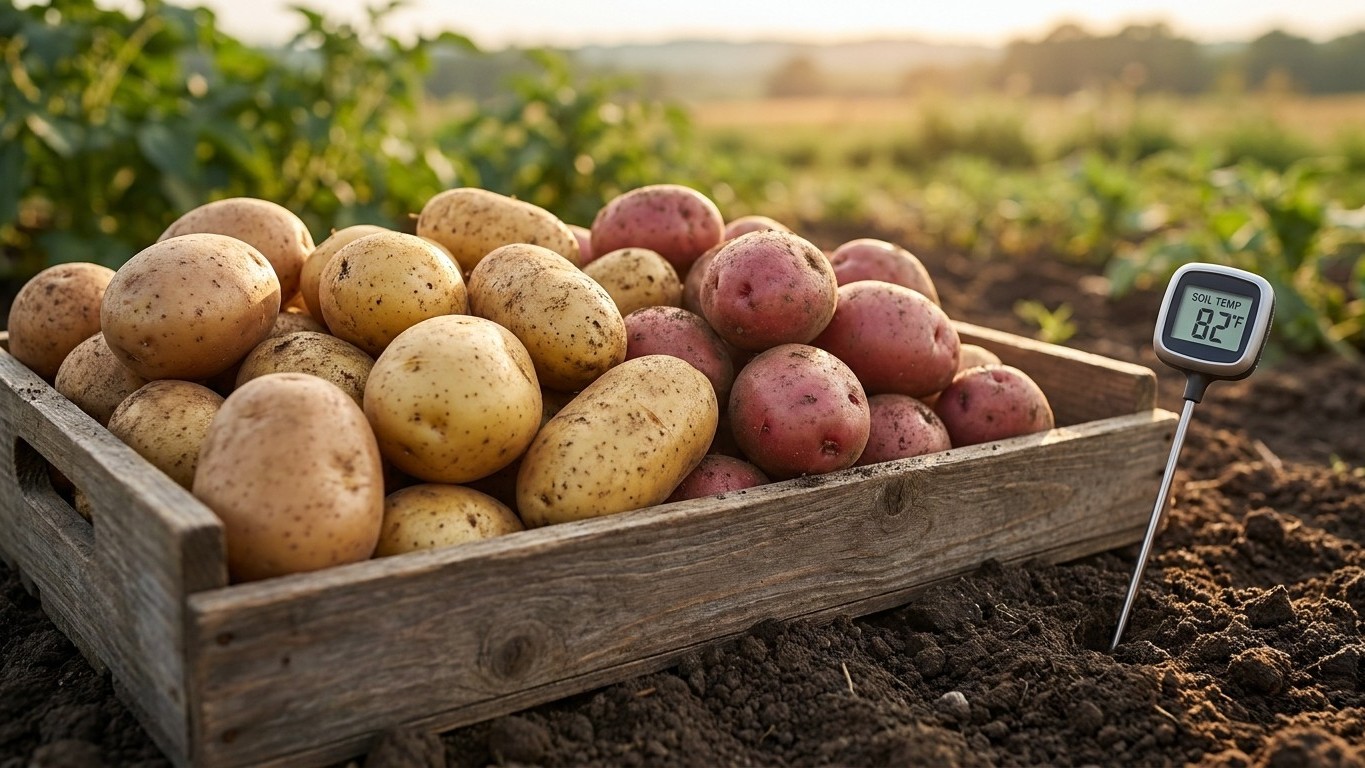

Washington doesn’t have one climate, so it doesn’t have one answer. West of the Cascades, the last spring frost falls between February 27 and March 18 near Seattle (NOAA NCEI 1991-2020 Climate Normals, station USW00024233), and soil warms slowly under cool marine air. East of the mountains, summer heat routinely pushes soil past the 90 F ceiling where tubers stop sizing. The variety that suits one side can struggle on the other.
The short answer
Start with the number that actually matters here: February 27 to March 18 is the last spring frost window for the Seattle reference station, USW00024233, per NOAA NCEI’s 1991-2020 Climate Normals. That figure sets the planting calendar for western Washington, but it says nothing about eastern Washington, where the growing season runs shorter and hotter under high-desert conditions.
So “which potato variety suits Washington” splits into two real questions depending on where the garden sits. In the maritime west, cool nights and slow-warming, often wet soil favor varieties across all three season classes, early, mid-season, and late, because the ceiling problem (soil running past 90 F) rarely shows up until late summer, if it shows up at all. Growers there can let a late-season variety take its time.
East of the Cascades, the calculation changes. Summer soil temperatures climb well above the 90 F threshold that Utah State University Extension and the University of Maine Cooperative Extension both identify as the point where tuber set and fill shut down. Watering does not reverse that shutdown once it happens. The safer bet there is an early-season variety, planted as soon as soil reaches 50 F, so the crop can be dug before the hottest stretch of the season arrives.
Neither extension source publishes a days-to-maturity figure for named varieties, and this page won’t invent one. What they do publish is the season class, which is the number a gardener can actually use to plan: early varieties bulk up and finish before the heat peaks, mid-season varieties need a longer stretch of moderate soil temperatures, and late-season varieties want the most time of all, which is exactly why they suit the milder, slower-warming soils west of the mountains better than they suit the high desert to the east.
Use category matters just as much as season class. The sources describe varieties by what they’re for, baking or boiling, rather than by texture words like waxy or floury, which don’t appear in either fact sheet. A baking-type russet and a boiling-type red can both do well in the same Washington garden; the deciding factor is soil temperature timing, not which side of the state grows “better” potatoes in general.
What actually decides it
Two temperature thresholds run this whole system, and once a gardener understands them, the choice of variety in any Washington location, even one this page never mentions, becomes a matter of matching season class to local soil behavior.
The planting threshold: 50 F soil
Potatoes go in the ground once soil reaches 50 F, and that point typically falls 14 to 21 days before the last frost date, according to Utah State University Extension and the University of Maine Cooperative Extension. That’s a soil measurement, not an air-temperature guess. A mild frost date, like the one for the Seattle area, doesn’t automatically mean early planting is safe: cold, wet soil and low late-winter light hold spring crops back well past the last freeze, so the 50 F soil reading is the real trigger, not the calendar.
The ceiling: 90 F soil
At the other end of the season, soil above 90 F inhibits tuber set and fill. This is the mechanism that decides the whole crop, and it’s the part gardeners tend not to anticipate: once soil crosses that line, the plant stops sizing tubers, and no amount of irrigation brings that process back. The fix isn’t more water. It’s timing the crop so it finishes before the ceiling gets crossed at all.
Regional soil behavior sets the strategy
Western Washington’s maritime climate keeps soil temperatures moderate for most of the growing season, so the ceiling threat is low and a gardener can run early, mid-season, or late varieties depending on preference and use. Eastern Washington’s high-desert climate pushes far more days above that 90 F soil mark, which reframes the whole strategy: the goal shifts from choosing a favorite variety to choosing a fast one, planted early, and dug as a spring crop before summer heat closes the window. Anywhere in the state, this same two-threshold logic applies, whether the local soil warms fast or slow, whether summers run mild or scorching.
| Factor | Western Washington (Seattle reference) | Eastern Washington (high desert) |
|---|---|---|
| Last spring frost | February 27 to March 18 (NOAA NCEI, station USW00024233) | Not published here; reference station applies to western WA only |
| Soil warming pattern | Slow, often wet late winter | Faster spring warm-up, then sharp summer heat |
| 90 F soil ceiling risk | Low for most of the season | High; frequent summer soil temps above 90 F |
| Season class that fits best | Early, mid-season, or late | Early, dug before peak heat |
How to do it
- Check soil temperature directly with a soil thermometer rather than relying on the calendar or the air temperature.
- Wait to plant until soil reaches 50 F, which lands roughly 14 to 21 days before the local last frost date.
- Buy certified seed potatoes rather than saved or grocery-store tubers; uncertified seed carries virus that shows up as reduced yield and weaker plants.
- Match season class to region: choose early-season varieties in eastern Washington’s high-desert areas so the crop can finish before soil crosses the 90 F ceiling; in western Washington’s milder maritime soils, early, mid-season, or late varieties are all workable.
- Choose the variety by intended use, baking or boiling, since that’s the distinction the extension sources actually publish, rather than by texture labels that aren’t part of their fact sheets.
- Track soil temperature again as summer progresses, especially east of the Cascades, and plan to dig early varieties before the hottest stretch arrives rather than leaving them in the ground “just in case.”
What goes wrong
- Planting by the calendar instead of the soil. A grower sees the frost date pass and plants immediately, but cold wet soil under 50 F just sits there. Remedy: measure soil temperature directly and wait for 50 F, even if that means planting later than the frost date would suggest.
- Using uncertified seed. Saved tubers or grocery-store potatoes often carry virus that isn’t visible at planting but shows up later as stunted growth and poor yield. Remedy: buy certified seed potatoes from a known supplier every season.
- Growing a late-season variety in high-desert conditions. East of the Cascades, a variety that needs a long, moderate season runs straight into the 90 F soil ceiling before it finishes sizing. Remedy: switch to an early-season variety and treat the crop as a spring dig, not a summer-long project.
- Assuming one frost date applies to the whole state. The February 27 to March 18 window is specific to the Seattle-area reference station; it doesn’t describe conditions on the dry side of the mountains. Remedy: use a frost reference for the actual local area rather than applying a western Washington figure statewide.
- Trying to water through a heat problem. Once soil passes 90 F, tuber set and fill are inhibited, and extra irrigation doesn’t reverse that. Remedy: dig the crop before soil temperatures climb that high in the first place, especially in hot inland areas.
Common questions
Do early-season potato varieties taste different from late-season ones?
The extension sources describe varieties by intended use, baking or boiling, not by a taste ranking tied to season class. An early-season variety and a late-season variety can both be suited to baking, or both suited to boiling; season class describes timing, not flavor.
Can I plant the same variety in both eastern and western Washington?
The variety itself isn’t restricted to one side of the state, but the outcome depends on soil temperature timing. A late-season variety that thrives in western Washington’s milder soils may run into the 90 F ceiling before finishing in eastern Washington’s hotter summers, so the practical answer often comes down to season class rather than variety name.
Why does soil temperature matter more than air temperature for planting?
Tubers respond to what’s happening in the ground, not the air above it. Utah State University Extension and the University of Maine Cooperative Extension both tie the planting window to soil reaching 50 F, which is why a mild air-temperature frost date doesn’t guarantee the soil is ready.
Is certified seed really necessary, or can I reuse potatoes from last season’s harvest?
Reused or uncertified seed can carry virus that reduces yield without obvious symptoms at planting time. Certified seed is the one detail worth treating as non-negotiable rather than optional, since virus problems are far harder to fix after the fact than to avoid at purchase.