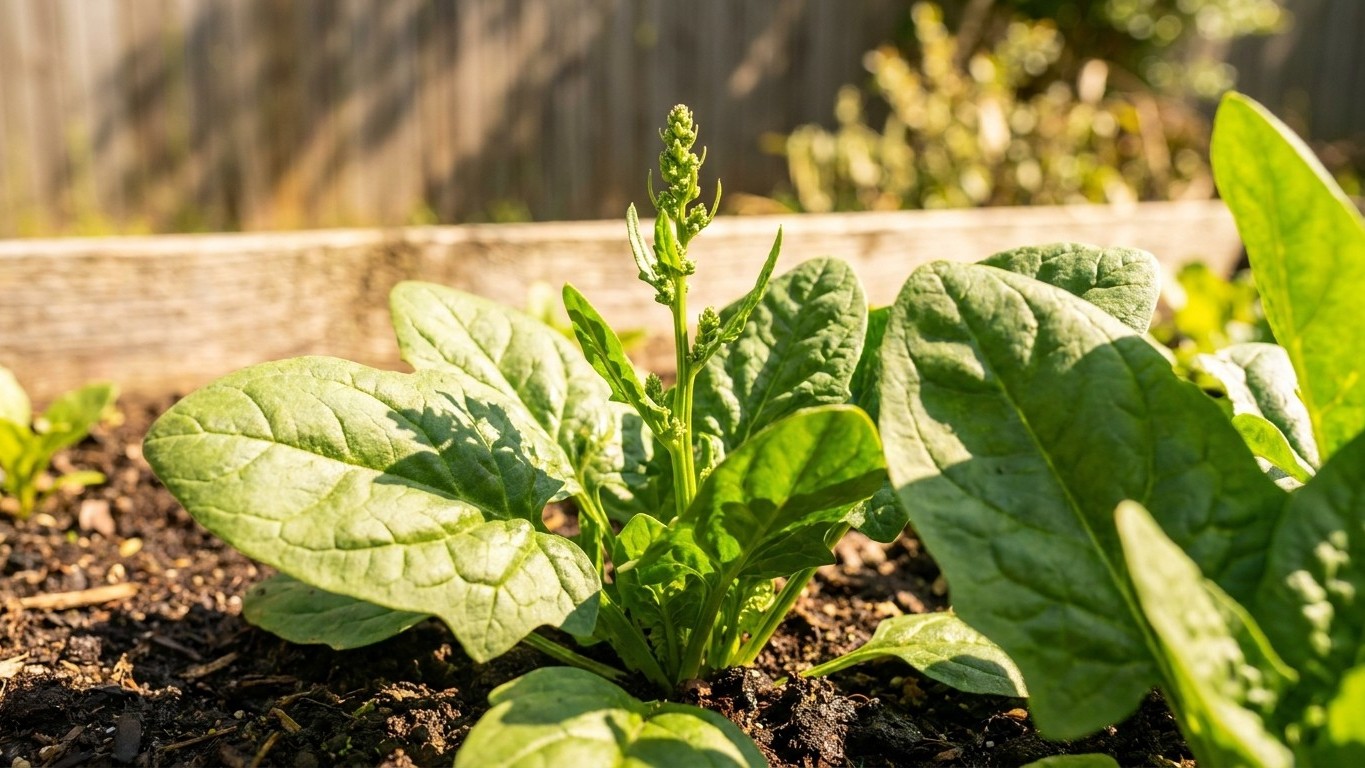

Connecticut spinach faces a double bind: long summer days push the plant toward flowering no matter how mild the season feels, and the state’s coastal climate still delivers enough heat to speed that process along. The real question isn’t whether spinach bolts early here, it’s how narrow the two growing windows are around that pressure, and how a gardener plans sowing dates to work inside them rather than against them.
The short answer
On the longest day of the year, the Connecticut coast sees 14 hours and 58 minutes of daylight. That number matters more than most gardeners expect, because spinach responds to day length the same way a switch responds to a flip: once daylight stretches past a certain point, the plant reads it as a signal to stop making leaves and start making seed. Nearly 15 hours of light is well beyond that trigger point. A cool, cloudy Connecticut June does nothing to cancel that signal. The plant doesn’t measure temperature to decide when to bolt, it measures light, and light is not something a mild summer can dial back.
That’s the piece people get backwards. They assume a state with only 6.2 days a year averaging 90°F or hotter must be forgiving territory for a cool-season crop. In one sense it is, since spinach genuinely prefers weather that stays under 75°F, and Connecticut’s coastal climate doesn’t pile on extreme heat the way the Mid-Atlantic or the Deep South does. But that heat tolerance argument only helps if the day-length trigger isn’t already firing. In Connecticut, both mechanisms stack against the plant during the heart of summer: the days grow long enough to signal flowering, and the same stretch of the calendar tends to nudge temperatures past that 75°F comfort ceiling too. Bolting in Connecticut isn’t a heat problem or a light problem in isolation, it’s both pressures landing in the same six-to-eight-week stretch of the year.
So the honest framing is this: day length sets the outer boundary on when spinach can be grown at all, and heat narrows that boundary further by making the plant bitter and stressed before it even reaches the point of visible bolting. The 75°F threshold isn’t a hard wall the way a frost date is. It’s a growth ceiling, above which the plant sacrifices flavor and vigor, and it’s also the temperature past which bolting accelerates once day length has already primed the plant to flower. Neither factor works alone. Together they explain why Connecticut gardeners get two short, productive windows instead of one long summer-long harvest.
How long the spring window really is
Utah State University Extension recommends sowing spinach two to three weeks before the last expected frost, and growth stays reliable only as long as temperatures hold below that 75°F ceiling. Applying that guidance to Connecticut’s own frost data lays out a fairly compact planting sequence.
- Frost baseline: Along the mild Long Island Sound coastline, the last spring frost typically falls between April 2 and April 12, based on NOAA’s 1991-2020 climate normals for the region. Inland and northwest Connecticut push that date later, sometimes by a couple of weeks, so gardeners away from the coast should treat this as an early estimate, not a fixed calendar day.
- Earliest sowing: Counting back two to three weeks from that frost window puts the earliest safe sowing date somewhere in mid-to-late March along the coast, with inland gardens waiting into very early April.
- Good growth period: Once seedlings are up, spinach grows steadily as long as daytime temperatures stay under that 75°F mark. In coastal Connecticut, that generally holds through April and into May.
- Approach to the trigger zone: As the calendar moves toward the June solstice, day length climbs toward that near-15-hour peak, and temperatures start crossing 75°F more frequently. This is where the two mechanisms converge and the plant shifts from leaf production to bolting.
- Practical harvest cutoff: Most of the usable spring harvest window closes by late May to early June, giving Connecticut gardeners roughly eight to ten weeks total from an early sowing to the point where quality and flavor start to slide.
That’s a workable window, not a generous one. A gardener who sows late, or who gets a wet cold snap that delays germination, can easily lose half of it. Succession sowing every ten days or so through that March-to-April stretch is the standard way to stretch the harvest without gambling everything on one planting date.
The autumn crop, and when the soil lets you sow
Fall spinach in Connecticut runs into a different obstacle than the spring crop does. Instead of racing daylight, the challenge is waiting out summer’s leftover soil heat, then getting a harvest in before the season’s first hard frost shuts things down.
Soil still too warm to germinate
Utah State University Extension notes that spinach seed germination drops off once soil temperatures climb above 80°F. Connecticut’s air temperatures rarely spend much of the summer at extreme highs (again, just 6.2 days a year average 90°F or more at the coastal reference station), but soil holds heat longer than air does, and late-summer soil in a sunny garden bed can sit above that 80°F threshold well into August even when the thermometer itself looks mild. That means the fall sowing window doesn’t open the moment air temperatures feel comfortable. It opens once the soil itself has cooled, which for most Connecticut gardens lands sometime in the second half of August, and sometimes not until early September in a warm year.
The frost that ends the season
The other boundary is the season’s first fall frost, which along the coast typically arrives between October 28 and November 10, per the same NOAA climate normals. Inland and northwest parts of the state should expect frost noticeably earlier than that coastal range. Utah State University Extension’s guidance for a fall crop is to sow 50 to 75 days before the date you want to harvest, and no specific days-to-maturity figure is published for spinach beyond that window. Counting backward from a harvest timed to land just ahead of frost puts the sowing date somewhere between late August and early September, depending on whether a gardener is working the 50-day end or the 75-day end of that range.
Put the two obstacles together and the fall window in Connecticut is tight but real: soil needs to drop below that 80°F germination ceiling, which usually happens in late August, and the harvest needs to land before frost arrives in late October to mid-November. That leaves roughly a two-to-three-week sowing target in most years, tighter along the immediate coast and slightly more forgiving where soil cools fastest. Utah State University Extension lists Bloomsdale, Melody, Teton, and Olympia among spinach varieties gardeners grow, though the source publishes no performance or maturity data comparing them, so variety choice comes down to seed availability rather than any documented edge for Connecticut’s conditions specifically.
| Factor | Spring crop | Fall crop |
|---|---|---|
| Main obstacle | Long days plus rising heat | Warm soil blocking germination |
| Sowing trigger | 2-3 weeks before last frost (~mid-to-late March, coastal) | Once soil drops below 80°F (~late August) |
| Season-ending event | Day length and heat converge (late May-early June) | First fall frost (Oct 28-Nov 10, coastal) |
| Approximate usable window | 8-10 weeks | 50-75 days from sowing to harvest |
Common questions
Does a cooler summer in Connecticut delay bolting?
Not meaningfully. Bolting is triggered by long days as well as heat, and the state’s summer daylight still reaches nearly 15 hours on the longest day regardless of how mild or humid the season feels. A cool June doesn’t cancel that light signal.
Why can’t spinach just be grown all summer in Connecticut?
Because the two pressures that cause bolting, long daylight and temperatures above 75°F, both land during the same summer stretch. Even with only 6.2 days a year averaging 90°F or hotter, enough days cross the lower 75°F growth ceiling to push spinach toward flowering and bitterness.
How early can fall spinach be sown if the soil is still warm?
Sowing before soil temperature drops below 80°F risks poor germination, according to Utah State University Extension. Testing soil temperature directly, rather than going by air temperature alone, gives a more reliable read on when the fall window actually opens.
Do inland and coastal Connecticut gardens follow the same schedule?
No. The frost dates cited here come from a Long Island Sound coastal station, the mildest part of the state. Inland and northwest Connecticut see frost arrive earlier in fall and linger later in spring, which compresses both the spring and fall spinach windows compared to the coast.