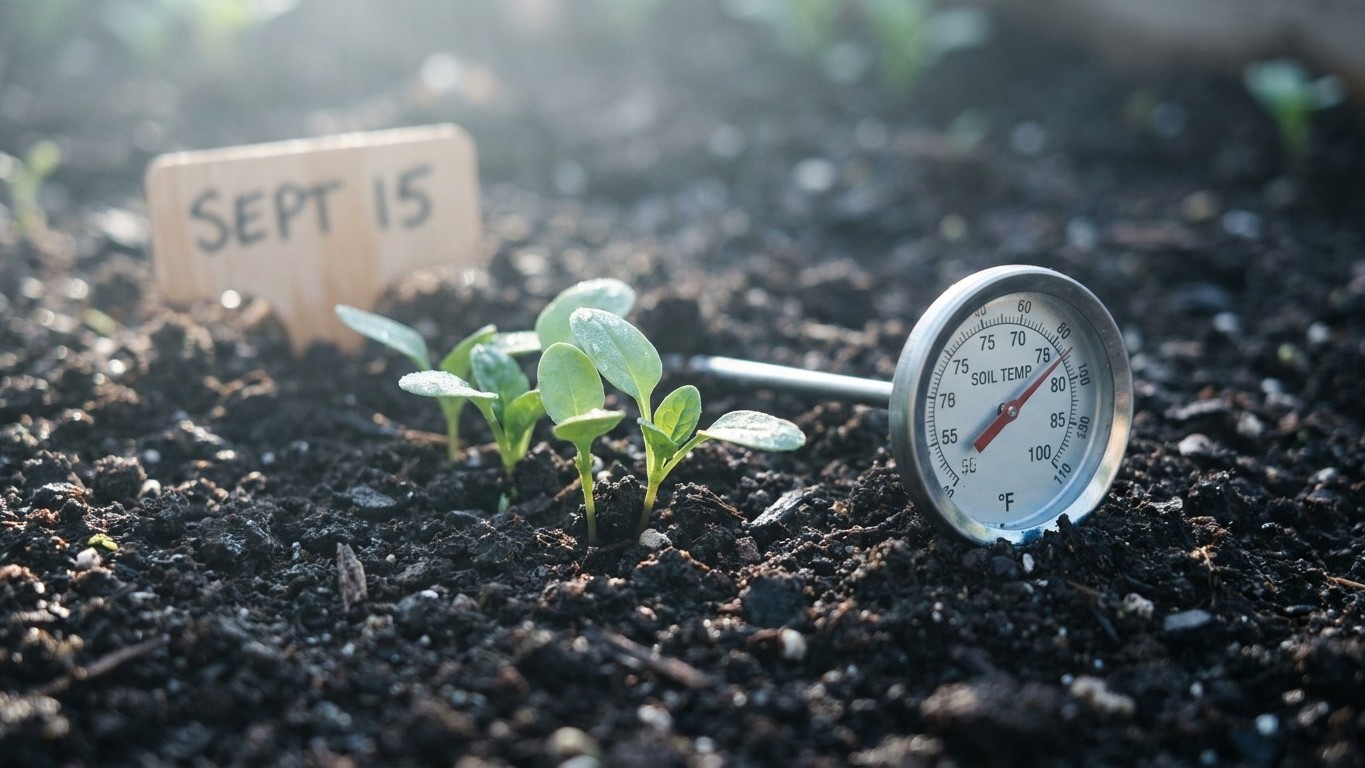

Connecticut gardeners get one reliable answer: sow the autumn spinach crop between mid-August and late September, counting back from the first fall frost. The exact week depends on where you garden and when you want to harvest, but the two things that set the boundaries are warm soil at the front end and freezing air at the back end.
The short answer
On the longest day of the year, Bridgeport gets 14 hours and 58 minutes of daylight. That number matters more than most gardeners realize, because spinach bolts under long days as well as under heat. A cool, cloudy Connecticut summer does nothing to stop that clock. The plant reads day length the way a onion reads it for bulbing, except the effect runs the opposite direction: long days push spinach to flower, not to grow bigger leaves. So even in a mild year, once the calendar pushes past the solstice, spinach in full sun is fighting its own biology.
Heat adds a second pressure, but it is a smaller one here than in much of the country. Bridgeport averages only 6.2 days a year at 90°F or hotter, a modest heat load compared to the Mid-Atlantic or the Southeast. Spinach grows best below 75°F, and that ceiling is also the point where leaves start turning bitter. In Connecticut, the plant rarely bakes the way it would in a hotter state. The bigger problem is that day length and the 75°F ceiling tend to arrive close together in late spring, so the two pressures stack instead of canceling out.
That stacking is the real answer to when to sow. In spring, the window is short because both triggers close it from the same side of the calendar: lengthening days and rising heat happen together in May and June. In autumn, the situation flips. Days are getting shorter, which favors spinach, but the soil is still holding summer’s heat, and germination drops once soil runs above 80°F. So the limiting factor changes with the season. Spring sowing is capped mainly by day length, with heat compounding it. Autumn sowing is capped by soil temperature at the start and by the first hard freeze at the finish.
None of this means Connecticut is a poor spinach state. It means the crop has two narrow doors rather than one long season, and missing either door by a couple of weeks either drops yields or sends the plants straight to seed. Knowing which door you’re walking through, spring’s daylight problem or autumn’s soil-heat problem, changes how you plan the sowing date rather than just when you mark the calendar.
How long the spring window really is
- Start from the last spring frost. At the Bridgeport reference station, that date falls between April 2 and April 12. Inland and northwest Connecticut typically lag behind this coastal date, so gardeners away from Long Island Sound should expect their own last frost later.
- Move sowing 2 to 3 weeks earlier. Spinach seed can be sown into cool soil ahead of the last frost, which puts a typical Connecticut sowing date somewhere in the second half of March for the milder coastal belt, and into early April further inland.
- Track the two closing triggers. As the calendar moves toward the June solstice, day length climbs toward that 14-hour-58-minute peak, and air temperatures climb toward the 75°F growth ceiling at roughly the same time. Both push the plant toward bolting together, rather than one giving way before the other kicks in.
- Add up the usable stretch. From a mid-to-late March sowing to the point in late May or June when day length and warmth combine to trigger flowering, Connecticut gardeners get roughly two and a half to three months of productive spring spinach, shorter near the coast where warmth arrives earlier, slightly longer inland where spring lags.
That window is workable, but it closes fast once the days get long. Succession sowing every couple of weeks through the window, rather than one large planting, spreads the harvest and reduces the odds that a whole bed bolts at once.
The autumn crop, and when the soil lets you sow
Fall sowing runs on a different clock. Instead of counting forward from the last frost, the source recommends counting backward from the date you want to harvest, allowing 50 to 75 days between seed and table. Four spinach varieties commonly show up on seed racks: Bloomsdale, Melody, Teton, and Olympia. The source used for this page names them but publishes no days-to-maturity or performance data for any of them, so treat variety choice as a separate decision from timing, not something this page can size for you.
Soil still too warm to germinate
Germination drops once soil temperature climbs above 80°F, and Connecticut’s late-summer soil, warmed by weeks of sun even where air temperatures stay moderate, commonly sits above that mark through much of August. This is the reason an autumn sowing date can’t simply be picked off a calendar without checking the ground. Waiting for an evening rain, watering a bed down before sowing, or shading the soil surface for a few days ahead of planting are the practical ways gardeners nudge soil temperature down without waiting on the weather alone.
The frost that ends the season
At the Bridgeport reference station, the first fall frost lands between October 28 and November 10. That date is the mildest in the state; inland and northwest Connecticut see frost measurably earlier. Counting back 50 to 75 days from that range puts the sowing window between roughly mid-August and late September for coastal areas, with inland gardeners needing to shift the whole window earlier to match their own, earlier frost date. A harvest targeted for late October, near the early edge of the frost range, calls for sowing closer to mid-August using the 75-day end of the range; a harvest planned for right around the first frost itself allows sowing as late as mid-to-late September using the 50-day end.
Put together, the two obstacles bracket a real but narrow window: soil has to cool below that 80°F germination threshold before seed goes in, and the whole crop has to mature before the first hard freeze arrives. For most of Connecticut, that means sowing sometime between mid-August and late September, with coastal gardeners able to lean toward the later end and inland or northwest gardeners needing to sow earlier to stay ahead of their earlier frost date.
Common questions
Can I sow autumn spinach earlier than mid-August to get a bigger harvest?
Sowing earlier runs into the soil-temperature problem before it solves anything. If soil is still above the germination threshold, seed sits without sprouting or comes up unevenly, which usually costs more time than it saves.
Does a light frost end the autumn spinach harvest?
The facts available for this page only establish the first fall frost date at the Bridgeport reference station, October 28 to November 10, without a separate light-frost or hard-freeze threshold. Plan the harvest around that single published date rather than assuming an earlier soft frost changes anything.
Why does Connecticut’s cool summer not extend the spring spinach season?
Because bolting is triggered by day length as much as by heat. Once days approach the summer solstice length of 14 hours 58 minutes, spinach moves toward flowering regardless of how mild the air feels.
Is inland Connecticut better or worse for autumn spinach than the coast?
Both directions cut the window, just at different ends. Inland and northwest areas get an earlier first frost, which shortens how late you can sow, but they may also see soil cool below 80°F sooner in late summer, which can open the sowing window earlier than on the coast.