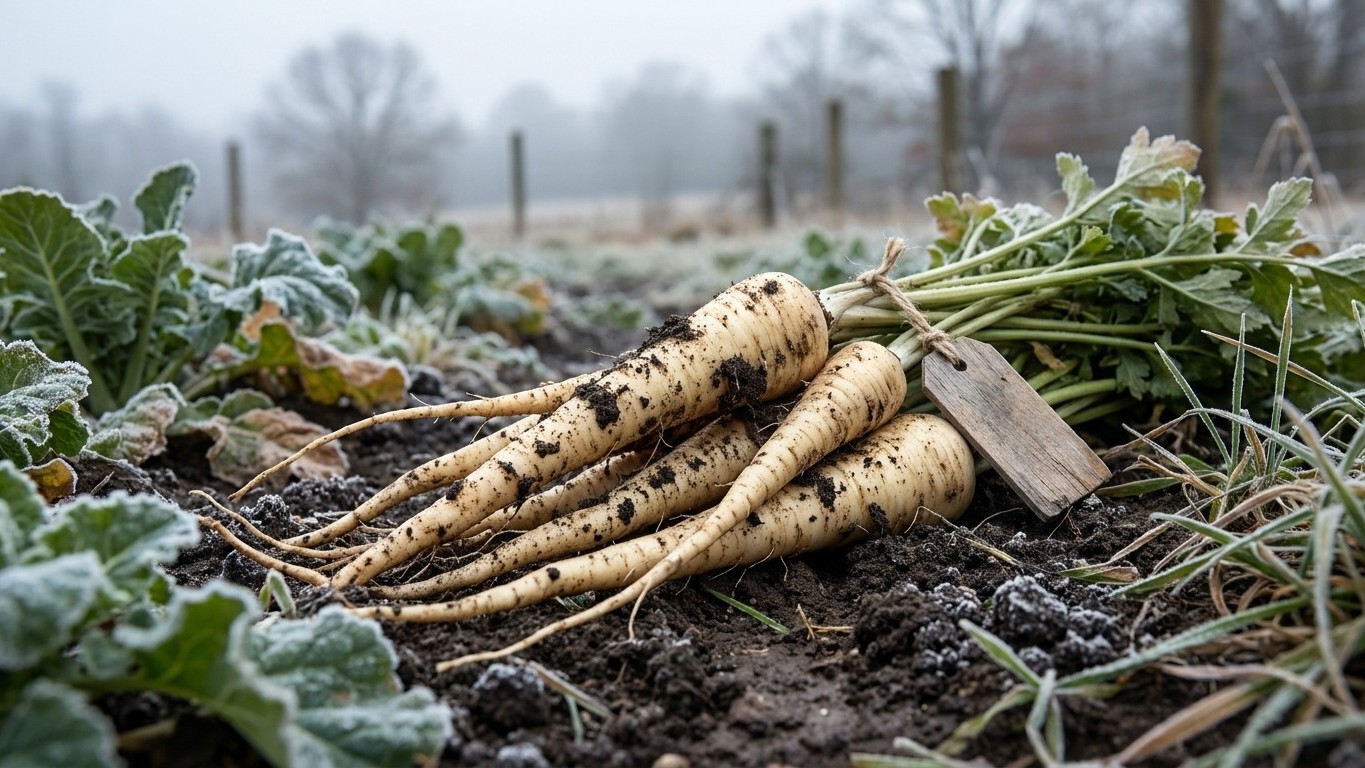

Yes. New Brunswick delivers the sustained cold that turns a parsnip from starchy to sweet. The Moncton reference station records a mean minimum of just 6.9 degrees Fahrenheit in its coldest month, and the growing season runs from a mean last frost on May 23 to a mean first frost on October 2. That combination of a workable season and real, extended frost exposure is exactly what converts stored starch into sugar in the root. The details below cover how to time the sowing and where the risks still sit.
The short answer
Does this territory deliver several frosty weeks, or just a light nip that comes and goes? That’s the question that actually decides whether a parsnip grown here tastes sweet or just tastes like a carrot that forgot to try. A single overnight dip below freezing does almost nothing to the sugar content. What matters is a stretch of consistently cold weather that holds the root at cold temperatures for days and weeks on end, slowly breaking down starch into simple sugars through an enzymatic process the plant can’t control once the cold sets in.
What 6.9°F actually tells you
The 6.9 degree figure is not a record low and not a monthly average. It’s the mean daily minimum for the coldest month at the Moncton station, drawn from the 1981-2010 Canadian Climate Normals published by Environment and Climate Change Canada. In practice that means most nights in the depth of winter drop to around that mark or colder, night after night, for weeks. That’s a far cry from a borderline climate that flirts with freezing a few times and then warms back up. A parsnip left in that ground after the fall frosts arrive gets weeks of the kind of sustained chill that Utah State University Extension points to as the trigger for sweetening.
Compare that to a coastal or southern zone where the coldest month’s mean minimum sits well above freezing. In that kind of climate a parsnip can grow a perfectly fine root, full size, good shape, decent flavor, and never sweeten the way the recipe writers promise, because the cold never really commits. New Brunswick doesn’t have that problem. The plain answer, based on the frost exposure this territory actually delivers rather than any zone map, is that parsnips sown and left in the ground here through fall will sweeten, not merely grow.
Does the season fit?
Fitting the parsnip’s calendar into New Brunswick’s frost window takes some counting, but the arithmetic works out with room to spare. Here’s how it lines up, step by step.
- Start with the sowing date. Parsnips are sown in place, directly into the bed where they’ll grow, and Utah State University Extension recommends sowing 2 to 3 weeks before the last expected frost. With a mean last spring frost of May 23, that puts the sowing window at roughly early May, from about May 2 to May 9.
- Account for slow germination. Parsnip seed is notoriously slow to sprout, taking 14 to 21 days to germinate. Sown in early May, seedlings won’t reliably show themselves until mid to late May. Anyone who digs up the row before then and re-sows, thinking the seed failed, is usually just impatient.
- Count the 100 to 120 days to maturity from the seeding date, not from germination. Starting the clock in early May, 100 days lands around mid-August, and 120 days lands around early September. That’s when the roots reach full size and are ready for the next stage.
- Check that stage against the first fall frost. The mean first fall frost falls on October 2, roughly four to seven weeks after the roots finish sizing up. That gap is the window where the crop sits in mature, harvest-ready condition and simply waits for cold to arrive.
- Let the frost do its work. Once temperatures start dropping through October and the coldest month’s typical minimum sinks to 6.9°F, the roots left in the ground under a layer of mulch get the sustained chill that converts starch to sugar, with harvest possible any time from late fall into early winter as long as the ground can still be worked.
The fit is comfortable, not tight. There’s enough season to mature the crop well before frost, and enough frost afterward to sweeten it properly. The one caution worth repeating: May 23 and October 2 are mean dates from the Moncton station, meaning in one year out of two the actual frost falls later than that. Treat both dates as a midpoint to plan around, not a guarantee, and remember that northern or upland parts of the province typically run weeks behind Moncton’s numbers.
What goes wrong here
The climate favors sweetening, but the crop can still fail for reasons that have nothing to do with cold exposure. Most trace back to the soil or to how the bed is watered.
- Forked or split roots from heavy, stony ground. Parsnips push a single taproot straight down, and any rock, clod, or compacted layer splits that root into two or more forks the moment it hits resistance. Utah State University Extension calls for deep, sandy soil, and where the native ground is heavy clay or full of stones, double digging the bed to break up the subsoil before sowing is the fix, not amending after the fact.
- Forked roots from a separate cause: overwatering. This is not the same problem as heavy soil, even though the result looks identical. A root that’s kept too wet, especially early on, tends to branch and fork even in decent ground. The remedy is simply watering less and letting the top few inches dry between soakings rather than keeping the bed constantly saturated.
- A season that runs out before the roots size up. Late sowing, a cool spring that delays germination past the usual 14 to 21 days, or a wet start that rots seed all push the maturity date closer to the first fall frost. Sowing right at the front of the recommended window, in early May rather than late, builds in the buffer this territory’s timeline allows for.
- A winter too mild to sweeten. This is the failure that shows up in milder maritime pockets or warmer zones, where the coldest month never gets consistently cold enough to trigger the starch-to-sugar shift. New Brunswick’s mean coldest-month minimum of 6.9°F puts this territory well clear of that risk, which is exactly why the crop here has a real shot at tasting the way parsnip recipes promise.
Common questions
Can parsnips be left in the ground all winter in New Brunswick?
The figures here don’t publish a specific overwintering recommendation, but a coldest-month mean minimum of 6.9°F means the ground will freeze hard for extended stretches. A thick mulch layer helps keep the soil workable enough to dig roots through fall and into early winter, though once the ground is frozen solid, harvest becomes a matter of physical access rather than plant biology.
Should parsnip seed be started indoors and transplanted?
No. Parsnips are sown directly in place because the taproot doesn’t tolerate transplanting well, developing forks or stunted growth when disturbed. The 100 to 120 day count runs from that direct seeding date, not from any indoor head start.
How soon after the first fall frost can parsnips be harvested?
The sweetening comes from several weeks of sustained frosty weather, not a single overnight dip, so digging the day after the first frost misses most of the benefit. Waiting through multiple hard frosts, well into the cold stretch that follows October 2 on average, gives the starch more time to convert.
Does the type of soil matter more than the climate here?
Both matter, but they cause different problems. Climate and frost exposure decide whether the root sweetens at all. Soil texture decides whether the root grows straight or forks. New Brunswick’s climate handles the sweetening question well; getting the soil deep, loose, and stone-free is the part left to the gardener.