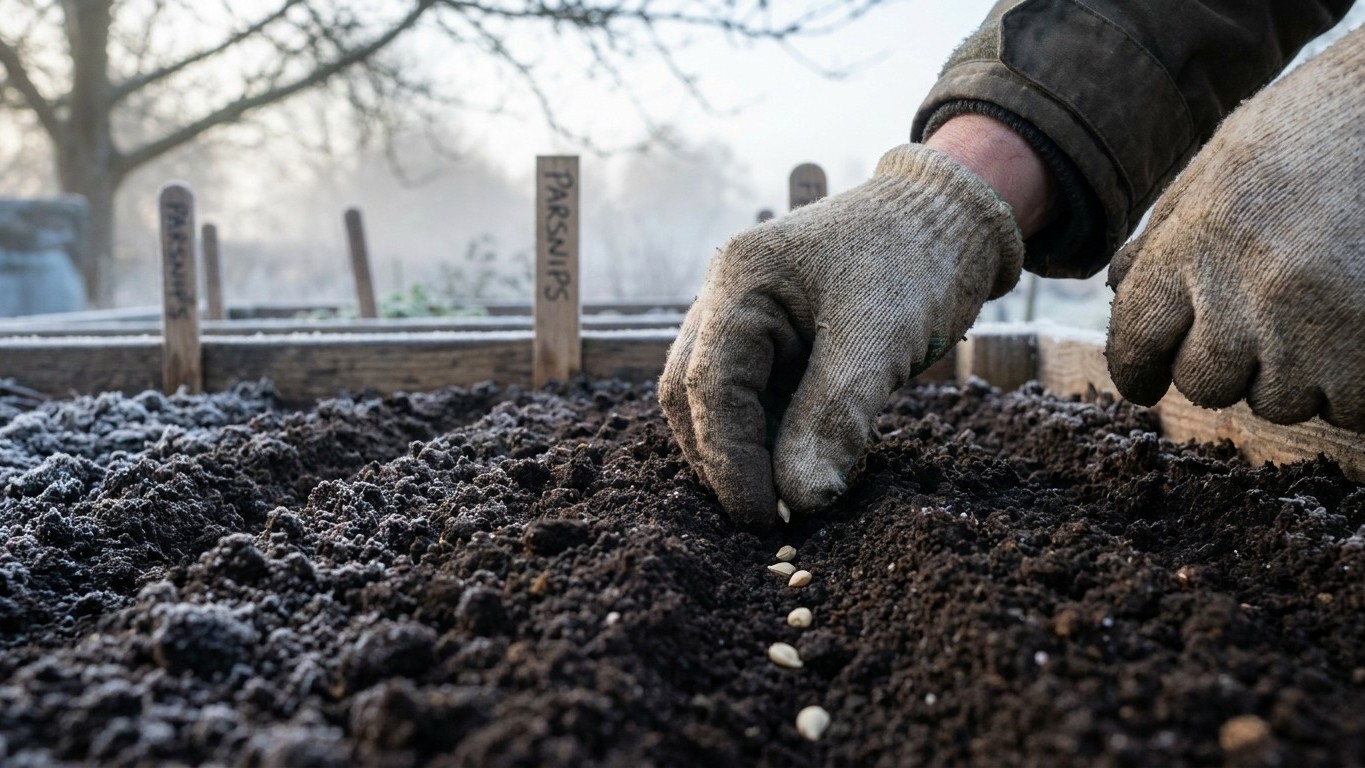

New Brunswick sows parsnips outdoors from early to mid May, about two to three weeks before the mean last frost, so the seed spends its slow germination period in cold, damp soil. The province’s real winter cold, not a comfortable hardiness zone, is what turns the crop sweet once the first hard frosts arrive in fall.
The short answer
The question that actually decides whether a New Brunswick parsnip is worth pulling from the ground isn’t which zone the province sits in. It’s whether the coldest month here delivers several straight weeks of hard frost, because that exposure is what converts the root’s stored starch into sugar. A parsnip can grow perfectly well in a mild winter and still taste flat and starchy at harvest, because sweetening is a frost reaction, not a growth outcome.
New Brunswick clears that bar with room to spare. At the Moncton reference station, the mean daily minimum during the coldest month sits at 6.9°F, according to three-decade climate normals from Environment and Climate Change Canada. That’s not a single cold snap. It’s the average low across an entire month, which means the province routinely spends weeks well below freezing, night after night. A root left in that kind of ground, or dug just after those frosts set in, has had every opportunity to sweeten.
Contrast that with a hardiness zone rating, which only tells a gardener whether a perennial’s roots will survive the winter underground. Zone maps say nothing about how many frosty weeks a region gets, how deep the cold reaches, or how long a root sits exposed to falling temperatures before harvest. Two locations can share a zone and differ enormously in frost duration. New Brunswick’s 6.9°F coldest-month minimum is the figure that actually answers the sweetening question, and it answers it clearly: yes, this climate delivers enough sustained cold for parsnips to convert properly.
So the short answer has two parts. Sow in early to mid May, timed to the region’s last frost date, because parsnip seed germinates slowly and tolerates cool soil better than warm. Then leave the roots in the ground past the first fall frosts rather than pulling them the moment they reach size. In New Brunswick, that patience gets rewarded. The climate here isn’t marginal for sweetening the way a mild coastal winter might be. It’s a genuinely cold winter climate, and that’s exactly what this crop needs.
Does the season fit?
Utah State University Extension puts parsnips at 100 to 120 days from seeding to maturity, with sowing recommended two to three weeks before the last frost since the seed germinates slowly in cold soil, typically 14 to 21 days before any green shows. Laid against New Brunswick’s frost dates, here’s how that timeline actually plays out.
- Start with the frost window. Environment and Climate Change Canada’s Moncton station puts the mean last spring frost at May 23 and the mean first fall frost at October 2. That’s a mean, not a guarantee, so in roughly half the years frost arrives later on both ends, but it gives a working window of about 132 days between the two dates.
- Set the sowing date. Two to three weeks before May 23 lands the sowing window in early to mid May, roughly the first through the ninth of the month.
- Account for germination. Add the 14 to 21 days parsnip seed typically needs just to break the surface. Nothing visible happens above ground during that stretch, which is exactly why it’s worth marking the sowing date rather than assuming a failed seed.
- Run out the 100 to 120 days from seeding. Sown in early May, a 100-day crop matures by roughly mid-August; a 120-day crop by early September. Both fall comfortably before the mean first fall frost of October 2.
- Compare to the frost-free window. With maturity landing in mid-August to early September and the mean first frost not until October 2, New Brunswick leaves three to seven weeks of slack even before counting the frosty weeks the crop still needs afterward for sweetening.
- Verdict. The season fits comfortably here, with enough margin to absorb a late spring frost or a slow germination stretch without pushing harvest past the point where frost exposure and flavor development can still happen.
What goes wrong here
- Forked roots from heavy or stony ground. New Brunswick’s Extension source is explicit that parsnips want deep, sandy soil and that heavy ground has to be double dug before sowing. A root meeting a rock, a clay lens, or compacted subsoil splits around the obstruction instead of growing straight down. The remedy is working the bed a full spade’s depth or more before seeding, clearing stones, and choosing the loosest, sandiest patch available rather than the most convenient one.
- Forked roots from overwatering. This is a separate cause from soil texture, and it’s worth keeping distinct. Inconsistent or excessive watering, wet spells followed by dry ones, or heavy irrigation on already-moist ground can push a taproot to split even in decent soil. The fix is steady, moderate moisture rather than deep soaking followed by neglect, particularly once the root has sized up in mid-summer.
- Pulling the crop before frost has done its work. New Brunswick’s winter cold is more than sufficient for sweetening, but a gardener who harvests in September, as soon as the roots look ready, skips the very exposure that makes the difference. The roots will be edible, but starchy and flat rather than sweet. Leaving them in the ground through the first hard frosts, or mulching heavily and digging through fall and into early winter, is what actually cashes in on the region’s cold.
- Mistaking slow germination for a failed sowing. With 14 to 21 days needed before any seedling appears, an impatient gardener sometimes digs up the row and resows, doubling the wait and pushing maturity closer to the frost line than necessary. Marking the sowing date and waiting out the full three weeks before judging the row avoids losing that early-season slack.
Common questions
Can parsnips stay in the ground over winter in New Brunswick?
Given a coldest-month mean minimum of 6.9°F, unprotected ground will freeze hard, so roots left fully exposed can be difficult or impossible to dig once the soil locks up. A heavy mulch layer applied before the ground freezes solid can keep a bed workable longer into the cold season, letting a gardener harvest progressively after several frosts rather than all at once.
When exactly should parsnip seed go into New Brunswick soil?
Two to three weeks before the mean last frost of May 23 puts the sowing window in early to mid May. Since that date is a mean rather than a guarantee, and frost arrives later than average in roughly half of all years at the Moncton station, watching the soil and short-range forecast still matters more than circling a fixed calendar date.
Why hasn’t my parsnip row sprouted after two weeks?
That’s normal. Germination runs 14 to 21 days per Utah State University Extension, and parsnip seed is notoriously slow compared with faster root crops. Give it the full three-week window in cool soil before concluding the sowing failed.
Which parsnip variety grows best in New Brunswick?
The Extension source behind this page’s figures doesn’t name a specific variety, so none is recommended here. What it does specify is the soil: deep and sandy performs best, and heavy ground needs to be double dug regardless of which variety ends up in the row.