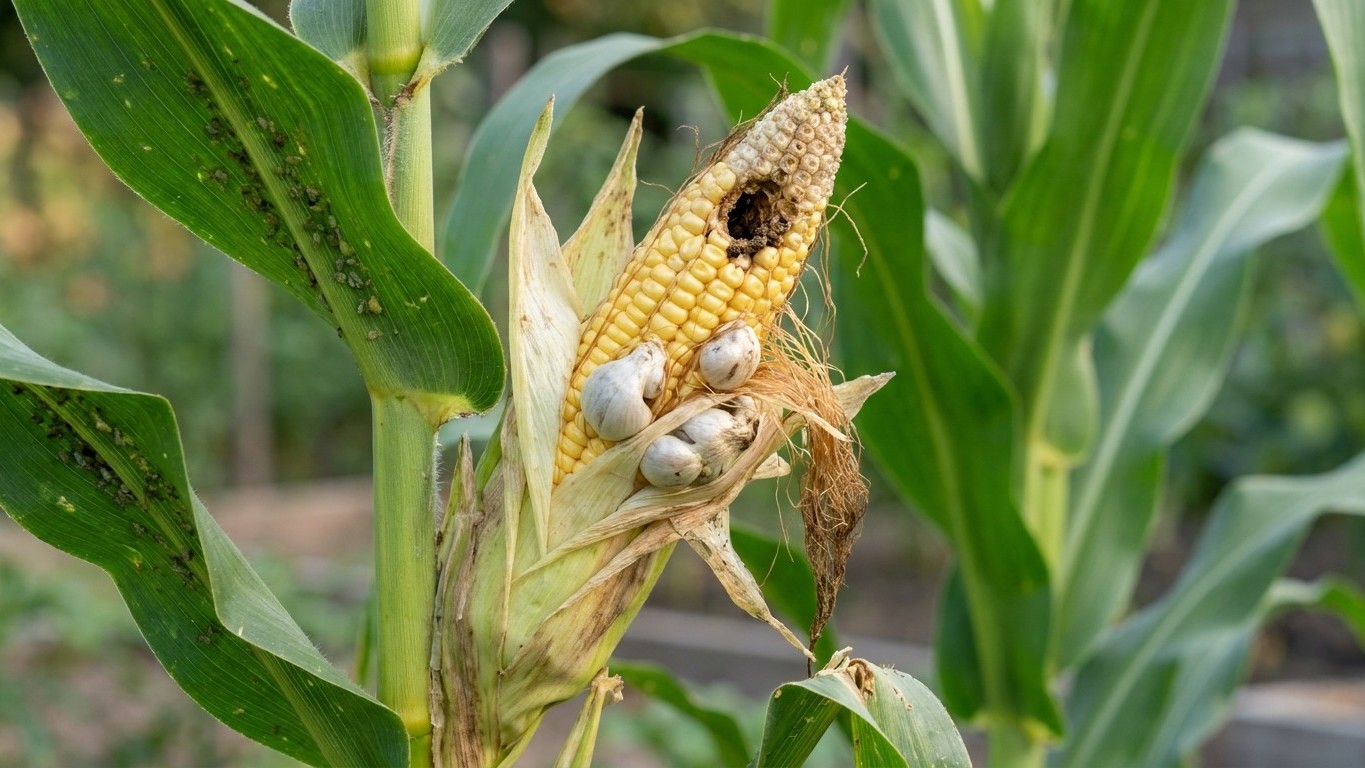

Sweet corn fails for a short, repeatable list of reasons, not bad luck. Utah State University Extension names six recurring troubles in the home garden: aphids, corn earworms, cutworms and army worms, root rots and damping off, smut, and wilt diseases. Layer on top of that the biology of the kernel itself, since sugar starts leaving the moment an ear is picked, and most “bad corn” complaints trace back to timing, watering, or storage habits rather than a mystery ingredient gone wrong.
The short answer
Ask Utah State University Extension what typically goes wrong with a backyard stand of sweet corn, and the list stays short and specific: aphids, corn earworms, cutworms and army worms, root rots and damping off, smut, and wilt diseases. Each shows up differently. Aphids cluster on leaf undersides and stunt growth. Corn earworms burrow straight into the ear tip. Cutworms and army worms attack young stalks close to the ground, sometimes overnight. Root rots and damping off take seedlings before they ever get established. Smut swells into pale galls on ears and stalks. Wilt diseases choke off the plant’s internal plumbing so it collapses even when the soil looks fine.
But pests and disease aren’t the whole story. Extension is just as clear that water management decides a lot of outcomes on its own: soils should be maintained near field capacity, and water needs are critical during tasseling, silking, and ear formation. Skip that window and the ear can look normal from the outside while the tip stays half-filled.
Nutrition matters on the same schedule. Extension recommends side dressing sweet corn with 1/2 lb. of 21-0-0 per 100 square feet when plants are near knee high (8 to 10 leaves), with an additional 1/4 lb. when the first tassel or silks appear. Skip either feeding and the plant simply runs out of what it needs right as it’s building the ear.
The last piece is timing at harvest. Ears are mature when silks are dry and brown, the husks appear moist and green, and kernels at the tip release milky juice when punctured. Miss that combination and the ear is picked too soon or too late, and even a healthy, pest-free stalk turns into disappointing corn on the plate.
What actually decides it
Cross-pollination timing between corn types
Sweet corn comes in different genetic types, generally grouped as su, se, and sh2, and they don’t get along in the pollen department. The problem shows up specifically when these types tassel at the same time in the same garden. Pollen drifts, kernels get cross-fertilized, and the resulting ears turn starchy and tough instead of sweet, since starchy genes tend to dominate over sugary ones. The fix is staggering planting dates so tasseling windows don’t line up, and shaping the planting itself: growing corn in blocks of three or more rows rather than one long skinny row improves how pollen actually reaches the silks, regardless of when you plant.
Water at the three critical stages
Extension’s water guidance is blunt: soils should be maintained near field capacity, and the need becomes critical during tasseling, silking, and ear formation. Corn doesn’t spread that need out evenly across the season. A dry stretch during any other stage is forgivable. A dry stretch during those three stages shows up permanently as poor kernel fill, and there’s no way to water your way back out of it once the ear has already set.
Why sweetness disappears fast after harvest
According to Clemson Extension, sweet corn loses sugar from the kernel rapidly at high temperatures, and it can be stored under optimal conditions for about five days, but will lose sweetness with each day of storage. That decline runs at a different pace depending on the type of corn in the ground.
| Type | Sugar retention after picking |
|---|---|
| su (standard sugary) | Loses sugar fastest |
| se (sugary enhanced) | Holds sugar longer |
| sh2 (shrunken-2 / supersweet) | Holds sugar longest |
That’s the real mechanism behind the old advice about running from the garden straight to the pot: it isn’t superstition, it’s sugar actively converting to starch, and heat speeds the process along.
How to do it
- Wait until the soil itself has warmed enough for seed to germinate reliably, not simply until the calendar shows the last frost has passed; the ground lags behind the air by a noticeable margin.
- Plant in blocks of three or more rows rather than one or two long rows, since that shape improves pollination regardless of variety or planting date.
- Keep soil moisture near field capacity from planting onward, checking it more carefully rather than less as the season progresses.
- Side dress with 1/2 lb. of 21-0-0 per 100 square feet once plants are near knee high, at roughly 8 to 10 leaves.
- Watch water especially closely once tasseling begins, since Extension marks tasseling, silking, and ear formation as the stages where water needs become critical.
- Add a second feeding of 1/4 lb. of 21-0-0 per 100 square feet when the first tassel or silks appear.
- Start checking ears once silks begin to dry, looking for all three ripeness signs together: dry brown silks, husks that are still moist and green, and milky juice from a punctured kernel at the tip.
- Harvest by grasping the ear and snapping it downward while twisting, rather than pulling straight out.
- Refrigerate promptly and leave the husk on until you’re ready to use the corn, since Extension notes sweet corn can be stored for several days if refrigerated, but should not be husked ahead of time.
What goes wrong
- Aphids: colonies build up on leaf undersides, coating growth in sticky honeydew and weakening plants. Check leaves regularly through the season and knock populations down early with a strong water spray before they establish.
- Corn earworms: the worm bores directly into the ear tip and feeds on kernels out of sight. Check ear tips as silks start to brown, since damage is easy to miss until the husk is peeled back.
- Cutworms and army worms: these chew through stems at soil level or strip leaves in groups, sometimes killing young plants in a single night. Inspect seedlings each morning and act the moment stems show chew marks.
- Root rots and damping off: seedlings collapse or roots blacken when soil stays saturated rather than merely moist. Keep soil near field capacity, not waterlogged, particularly in compacted or poorly drained beds.
- Smut: pale galls swell on ears, tassels, or stalks and eventually rupture, spreading spores. Remove and destroy galls before they burst and avoid wounding stalks during cultivation.
- Wilt diseases: plants yellow and collapse even with adequate water because internal tissue is compromised. Pull affected plants promptly and avoid replanting corn in the same spot the following season.
- Reading only one ripeness sign: dry silks alone, without checking husk color and kernel juice, leads to picking too early or too late. Confirm all three signs together before cutting an ear.
- Storing corn husked or too long: sugar drains from the kernel with every day of storage, faster in heat and faster once husked. Refrigerate unhusked and use it within a few days rather than counting on “still fine.”
Common questions
Can a plant recover once aphids or corn earworms show up?
Aphid colonies can be knocked back with regular monitoring and a strong water spray before numbers build. Corn earworms are harder to reverse once they’re inside the ear tip, since the damage is already done to that portion of the kernels by the time it’s visible.
Why did my sweet corn come out starchy instead of sweet?
This usually points back to cross-pollination between different corn types, su, se, or sh2, tasseling at the same time in the same garden. Staggering planting dates and growing in blocks rather than single rows both help avoid the overlap.
How long can I actually store sweet corn before it loses its sweetness?
Clemson Extension puts the outer limit at about five days under optimal, refrigerated, unhusked conditions, and notes the corn loses sweetness with every day that passes. That five days is a ceiling, not a guarantee, and su types decline faster than se or sh2 types.
How do I know exactly when to pick an ear?
Utah State University Extension ties ripeness to three signs appearing together: silks that are dry and brown, husks that are still moist and green, and milky juice released when a kernel at the tip is punctured. One sign alone isn’t enough to call it.