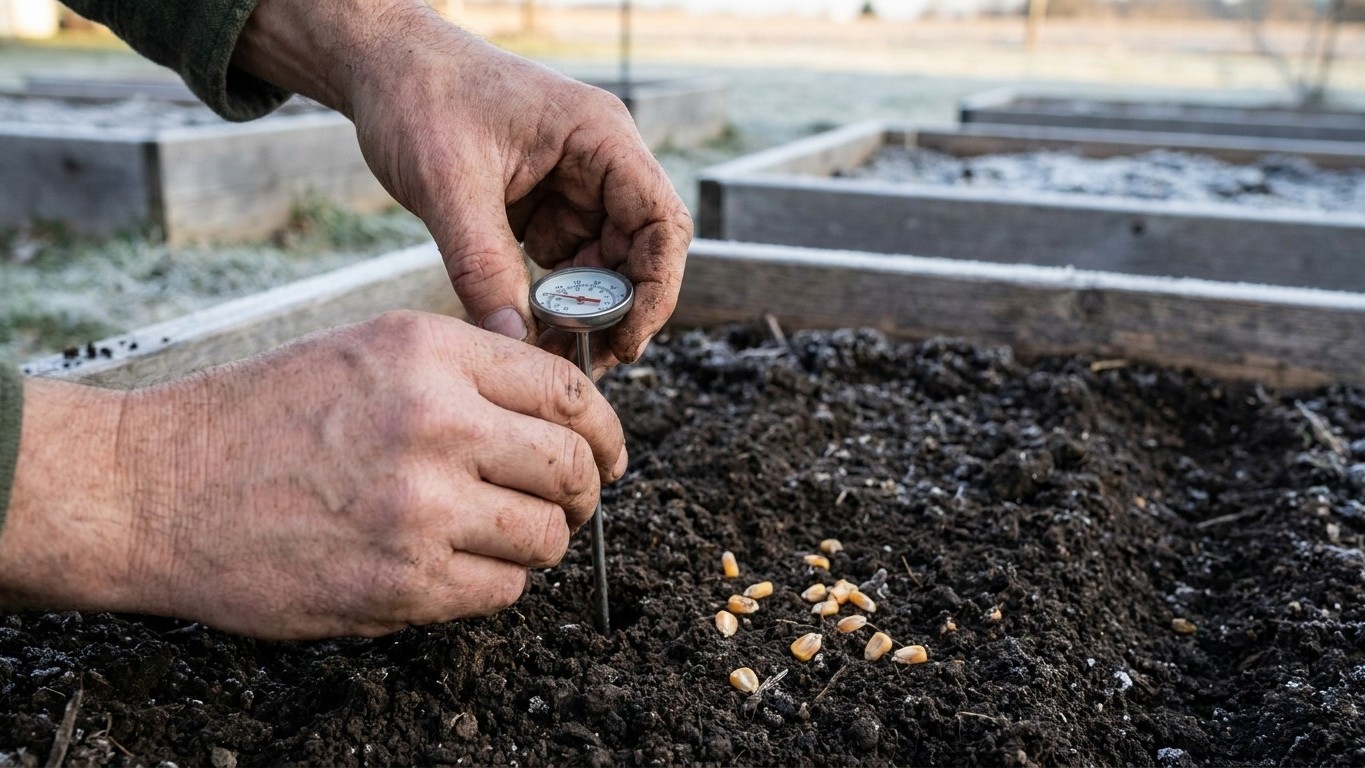

Soil temperature settles the question, not the calendar. Utah State University Extension calls for soil and air temperatures above 60 F for best germination and plant growth. A frost date might come and go while the ground underneath is still too cold for a kernel to do anything but sit there and rot. Check the dirt, not the forecast page.
The short answer
Utah State University Extension is direct about the threshold: sweet corn needs soil and air temperatures above 60 F for best germination and plant growth. That single number does more work than any date on a seed packet. Corn seed placed in cold, wet soil doesn’t just germinate slowly, it often doesn’t germinate at all, and what does come up tends to be weak and uneven. The fix is simple in theory and easy to skip in practice: measure the soil, don’t guess from the air temperature or from a frost-free date printed on a chart.
Here’s where gardeners get tripped up. A frost date marks when the air is unlikely to drop below freezing. Soil is a different material with a different clock. It holds cold longer than air does, so the ground stays chilly well after the last frost has passed and the thermometer on the porch reads warm. Treating the frost date as the green light for corn means planting into soil that hasn’t caught up yet. The two events are related but they are not the same day, and conflating them is the single most common reason a corn stand comes in patchy.
Once soil hits that 60 F mark, sweet corn actually has two separate clocks running, and they answer two different questions. The first is maturity range: sweet corn matures in 60 to 90 days from planting depending on variety, and that number tells you whether the crop fits inside your growing season at all. The second clock only starts once the plant is already tasseling and silking: ears mature in 17 to 24 days from silk emergence, and that number tells you which week to actually walk out with a basket. Mixing these two up leads to two kinds of frustration, either pulling ears too early because the days-to-maturity number “sounded about right,” or missing the harvest window because nobody was watching the silks.
So the short answer has three parts. Wait for 60 F soil before you plant. Use the 60 to 90 day maturity range to plan whether the variety fits your season. Then switch your attention to the silks and count 17 to 24 days from the day they emerge to know when to pick.
What actually decides it
Why 60 F is the real threshold
Germination in corn is a chemical process before it’s a visible one. Cold soil slows the enzymes that break down starch inside the kernel, which is what fuels the sprout’s first push toward the surface. Below the 60 F line, that process crawls, and a seed sitting in cold, damp ground for days without sprouting is a seed exposed to rot and to soil fungi that thrive in cool, wet conditions. Utah State University Extension frames this plainly: soil and air temperatures above 60 F give the best germination and plant growth. It’s not a suggestion about vigor, it’s a threshold about whether the seed comes up at all.
Why the soil lags behind the air
Soil is dense and holds thermal energy differently than air does. Air can warm up on a sunny afternoon and cool right back down overnight, but a few inches of soil takes days or weeks of sustained warmth to catch up. That’s the mechanism behind the caution worth repeating: the soil reaches 60 F well after the frost date, never treat them as the same day. Anyone who’s stuck a hand in garden soil in early spring, after a stretch of warm afternoons, has felt this directly. The air says spring. The dirt says not yet.
Two clocks, two different jobs
The 60 to 90 day maturity window and the 17 to 24 day silk-to-harvest window aren’t redundant, they answer different questions. The first is a season-planning number: it tells you, based on your local growing season length, whether a given variety has time to finish before fall weather shuts things down. The second is a week-to-week field number: once silks appear, that’s the countdown that actually predicts when kernels will be ready to eat. A gardener who only tracks days-from-planting will miss the ear entirely, because that number was never built to pinpoint harvest day.
How to do it
- Check the soil, not the calendar. Use a soil thermometer a few inches down at planting depth and confirm it reads above 60 F for at least a few consecutive days before sowing, since Utah State University Extension ties germination success directly to that threshold.
- Choose block planting over a single row. Plant corn in blocks to ensure good pollination and ear development, using blocks of three or more rows rather than one long row. This is a garden shape decision, not a date, but it has to be settled before seed goes in the ground.
- Space and depth matter together. Space rows 24 to 30 inches apart and plant seeds 1 inch deep and 7 to 9 inches apart in the row. For a high-density layout, plant in 15 by 15 inch squares instead.
- Match the variety’s maturity range to your season. Use the 60 to 90 day maturity range to decide whether a given variety has time to finish before your growing season ends.
- If growing more than one sweet corn type, separate the timing of the plantings so they don’t tassel together, since cross-pollination problems arise when different types tassel at the same time.
- Watch for silk emergence, then start the second clock. Once silks appear, count forward 17 to 24 days as the harvest window.
- Confirm ripeness with three signs together: dry brown silks, husks still moist and green, and milky juice from a punctured kernel. One sign alone isn’t enough to call it.
- Harvest and cook or refrigerate quickly. Sweet corn loses sugar from the kernel rapidly at high temperatures, and it can be stored under optimal conditions for about five days, but it loses sweetness with every day of storage.
What goes wrong
- Planting by the frost date instead of the soil. Seed goes into ground that’s still cold, germination is slow and spotty, and some seed simply rots before it sprouts. The remedy is to hold off until a soil thermometer confirms readings above 60 F, regardless of what the frost calendar says.
- Planting in one long row. Corn is wind-pollinated, and a single row scatters pollen away from the silks instead of onto them, producing ears with missing kernels and bare patches. The remedy is planting in blocks of three or more rows, which improves pollination and ear production.
- Letting different corn types tassel at the same time. When multiple sweet corn types tassel together, cross-pollination between them becomes an issue and can affect kernel quality on the ears that result. The remedy is staggering planting dates so the tasseling windows don’t line up.
- Judging ripeness from one sign instead of three. Brown silks alone, or green husks alone, can both mislead. The reliable check combines dry brown silks, husks still moist and green, and milky juice from a punctured kernel, all three together.
- Letting picked corn sit around before eating or storing. Sugar leaves the kernel fast, especially in warm weather, and even under good storage conditions about five days is the outside limit before sweetness has clearly faded. The remedy is cooking or refrigerating promptly, and choosing genotypes bred to hold sugar longer if storage time is unavoidable, since sugary types lose sweetness fastest, sugary-enhanced types hold it longer, and supersweet types longest of the three.
Common questions
Can I plant sweet corn right after the last frost date?
Not reliably. The frost date marks air temperature risk, while soil temperature is what actually determines germination. Soil reaches 60 F well after the frost date passes, so checking the ground directly is the only way to know it’s ready.
Why does my corn have ears with missing kernels?
That’s almost always a pollination problem tied to garden layout. Corn is wind-pollinated, and a single long row often fails to deliver pollen evenly to the silks. Planting in blocks of three or more rows improves pollination and ear development.
How do I know which week to actually pick my corn?
Track silk emergence rather than planting date. Ears mature 17 to 24 days after silks first appear, and that window, combined with checking for dry brown silks, moist green husks, and milky kernel juice together, is what tells you the ear is ready.
How long does picked sweet corn stay sweet?
Not long. Sugar leaves the kernel quickly, especially in heat, and even under optimal storage conditions corn holds up for about five days before sweetness noticeably declines. Cooking or refrigerating soon after picking preserves more of that sugar.