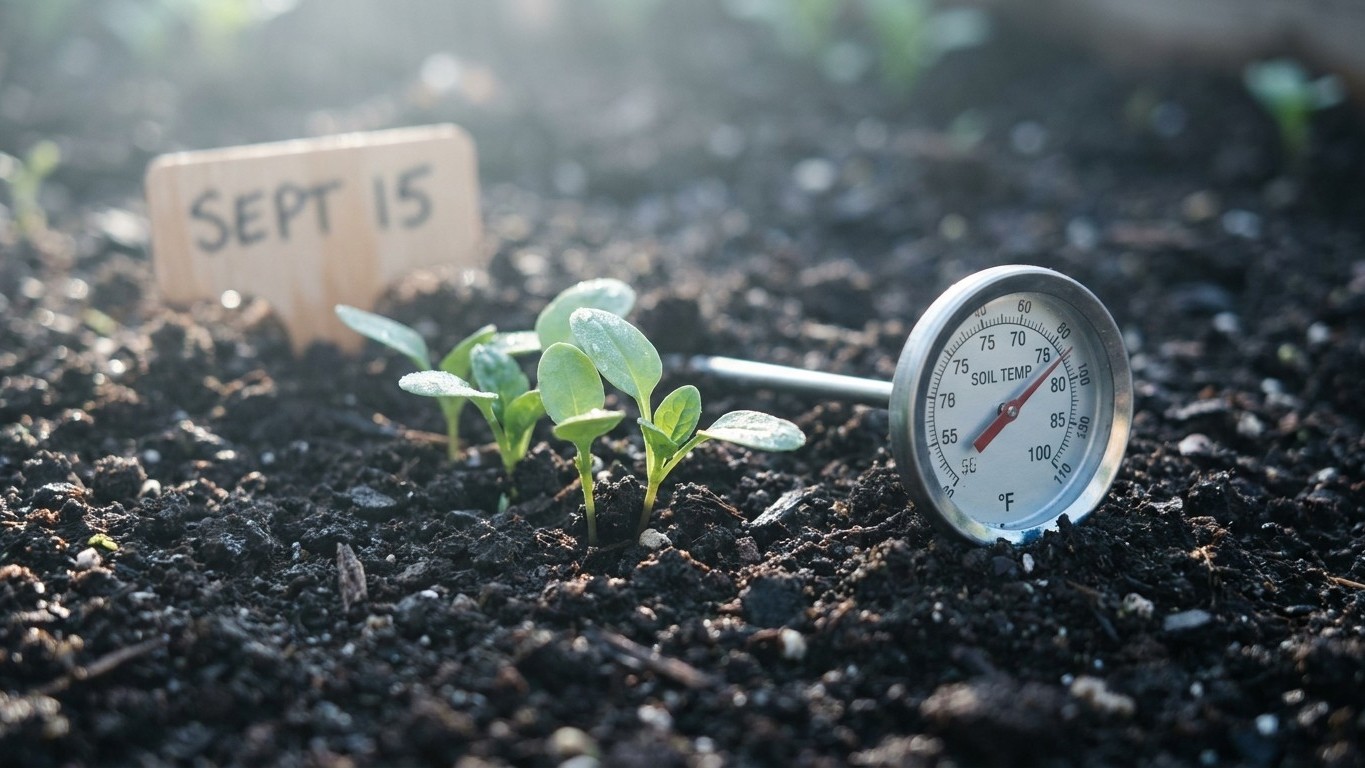

Autumn Spinach in Kentucky goes into the ground somewhere between mid-August and late September, but the calendar isn’t what decides the date. The real gatekeeper is soil temperature: spinach seed germinates poorly once soil climbs above 80 F, and Kentucky summers keep soil hot well past Labor Day. Count backward 50 to 75 days from your first fall frost, then check whether the ground has actually cooled enough to plant.
The short answer
At the reference city for Kentucky’s climate data, the longest day of the year delivers 14 hours and 39 minutes of daylight. That number matters more than most gardeners realize, because spinach bolts, meaning it shoots up a flower stalk and turns bitter, in response to long days as much as to warm weather. A day length near 14 hours and 39 minutes sits well above the threshold that pushes spinach toward flowering. A cooler-than-average summer wouldn’t change that. The plant doesn’t measure temperature to decide when to bolt; it measures how much light it’s getting, and Kentucky’s early-summer days hand it more than enough.
That’s the first strike against a long summer sowing season. The second is heat. The reference station averages 37.2 days a year at 90 F or hotter, a heat load that pushes soil and air temperatures past the point where spinach grows well. Utah State University Extension notes spinach performs best where temperatures stay under 75 F, and that same 75 F line marks where the leaves start turning bitter even if the plant hasn’t fully bolted yet. In Kentucky, both problems land at once. The days get long enough to trigger bolting right around the time the heat load starts climbing toward that 37-day stretch of 90-degree afternoons. There’s no gap where one factor eases up while the other holds back.
So the honest answer to “why can’t I just grow spinach all summer” is that Kentucky’s limit isn’t day length alone, and it isn’t heat alone. It’s both, arriving together. A spinach plant sown in May faces lengthening days through June and rising heat through July, and it will bolt or turn bitter before either factor lets up. That’s why gardeners in this region split the crop into two narrow windows, one in early spring before the days get long and the heat arrives, and one in late summer or early fall after the days have started shortening and the heat has begun to break. Neither window is generous. Both depend on watching actual conditions rather than trusting a fixed date on a seed packet.
How long the spring window really is
Spring spinach has to thread a narrow gap between frost risk and rising heat, and in Kentucky that gap opens later and closes faster than gardeners expect.
- Start with the frost date. The reference station’s last spring frost falls between March 24 and April 4. Spinach seed is typically sown 2 to 3 weeks before that date, which puts a realistic sowing window somewhere in the first half of March, sometimes earlier if the soil has thawed and dried enough to work.
- Mark where the ceiling sits. Growth stops being good once temperatures climb above 75 F, and that ceiling doubles as the bitterness threshold. Kentucky’s spring air temperatures typically cross that line sometime in mid-to-late May, though it varies year to year.
- Subtract the overlap. That leaves roughly eight to ten weeks of usable spring, starting in early-to-mid March and running through late April or the first half of May, before rising heat and lengthening days start working against the crop at the same time.
- Watch for the squeeze. Because the reference station is an urban site, NWS Louisville notes it runs later in spring and earlier in fall than the surrounding rural county. Rural gardens should plan on an even tighter window than the averages suggest, sowing at the earlier edge of that March range rather than the later one.
Eight to ten weeks sounds workable, and it is, but only if the seed goes in early. Wait until April to sow spring spinach in Kentucky and there’s a real chance the plants are still small when the 75 F ceiling arrives, cutting the harvest window down to almost nothing.
The autumn crop, and when the soil lets you sow
Fall spinach in Kentucky isn’t limited by cold the way most people assume. It’s blocked, at the start, by soil that’s still too warm to let the seed germinate well, and it’s bounded, at the end, by the arrival of a hard frost that finishes the season.
The soil is still too warm to germinate
Utah State University Extension is clear that spinach seed germination drops off once soil temperature climbs above 80 F. That’s the whole obstacle for an August sowing in Kentucky: the air may feel like it’s easing toward fall, but soil holds heat far longer than air does, and a region averaging 37.2 days a year at 90 F or hotter keeps its topsoil well above 80 F through most of August. Gardeners who sow too early often see thin, patchy germination, not because the seed was bad, but because the soil simply wasn’t ready to let it sprout. Waiting until soil has measurably cooled, rather than sowing on a fixed date, is the difference between a full stand and a disappointing one.
The frost that ends the season
The reference station’s first fall frost lands between November 2 and November 12, and for a fall crop, Utah State University Extension’s guidance is to plant 50 to 75 days before the date you want to harvest. Counting 75 days back from November 2 lands near August 19. Counting 50 days back from November 12 lands near September 23. That gives Kentucky gardeners a realistic sowing window running from roughly mid-August through late September, with the earlier end of that range only workable once soil temperatures have actually dropped below the 80 F germination ceiling.
The source publishes no days-to-maturity figure for spinach, so treat the 50-to-75-day range as a planting guideline tied to harvest timing, not a fixed maturity date for any particular variety. Four varieties commonly grown for fall harvest are Bloomsdale, Melody, Teton, and Olympia, though no performance or timing data for any of them is published in the source used for this page. As with spring, rural gardens outside the reference station’s urban footprint should expect frost to arrive earlier, which shifts the safe end of the fall sowing window a few days sooner as well.
Common questions
Can I sow spinach in Kentucky in the middle of summer?
Not with good results. By midsummer, day length is already past the point that triggers bolting, and the region’s heat load, averaging 37.2 days a year at 90 F or hotter, keeps soil and air well above the 75 F ceiling where spinach grows well and stays sweet.
What’s the actual risk if I sow fall spinach too early?
Soil above 80 F reduces germination, so an early sowing often means a thin, uneven stand rather than an outright failure. It’s a germination problem, not a frost problem, since the season’s cold hasn’t arrived yet.
Does a cooler summer let me sow spinach earlier or later here?
No. Bolting in spinach is triggered by long days as well as warm temperatures, so even a mild summer doesn’t extend the window where day length alone is already long enough to push the plant toward flowering.
Should rural Kentucky gardens use the same dates as the reference station?
Not exactly. NWS Louisville notes that station runs later in spring frost and earlier in fall frost than surrounding rural Jefferson County, so rural gardeners should sow spring spinach a bit earlier and wrap up fall sowing a bit sooner than the reference dates suggest.