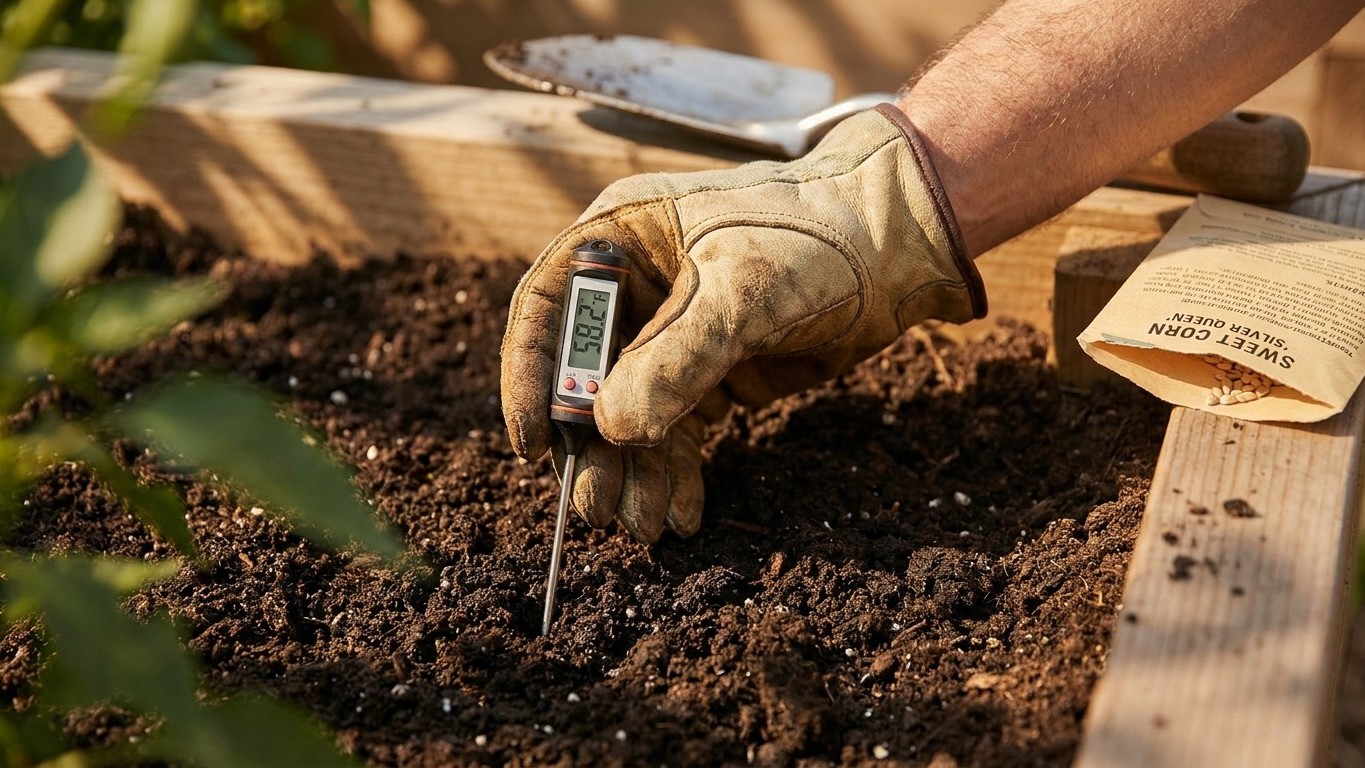

Sweet corn in Michigan goes into the ground once soil hits 60 F, which lands in mid-to-late May across most of the Lower Peninsula and can slip into early June in cooler pockets. That’s a different date than the last frost. From that planting date, the variety needs 60 to 90 days to mature before the first fall frost arrives, October 6 to October 21 in zone 6a. Anything cutting it closer than that window is a gamble.
The short answer
Here’s the part that trips people up: the last frost date and the planting date for sweet corn are not the same thing, and treating them as interchangeable is the single most common reason a first planting fails. The last spring frost lands around April 30 near Detroit and stretches into early-to-mid May across the rest of the Lower Peninsula, according to Michigan State University Extension’s frost-free date data. But soil doesn’t warm at the same pace as air. A patch of ground can sit chilly and wet for two, three, even four weeks after the last freeze, especially if it’s shaded, heavy clay, or holds moisture. Sweet corn seed dropped into soil still under 60 F tends to sit and rot rather than sprout, no matter how mild the air feels overnight.
That gap between frost and workable soil temperature is why the real planting window in Michigan typically opens later than gardeners expect, often stretching from mid-May into the first week of June depending on the site. A south-facing bed with light, well-drained soil warms faster than a low spot that stays soggy into late spring. That’s a real variable, and it shifts the calendar by more than a week in either direction on the same property.
Once soil is reliably above 60 F, the next question is arithmetic: does the maturity window fit before the first fall frost? Sweet corn varieties run 60 to 90 days from planting to harvest, per Utah State University Extension. Zone 6a in Michigan sees its first fall frost anywhere from October 6 to October 21. Count forward from a realistic planting date, whatever it turns out to be on a given property, and there is almost always enough runway for a 60-day variety, and usually enough for a 90-day one too, provided planting isn’t pushed into mid-June by a slow spring.
Summer heat matters here too, though less as a scheduling factor and more as a stress factor. The Detroit-area reference station averages 10.3 days a year at 90 F or above, according to NOAA’s 1991-2020 climate normals. That’s not extreme heat by national standards, but it’s enough to spike water demand during tasseling and silking, the stage where a stressed corn plant produces poorly filled ears regardless of how well the calendar math worked out.
Does a late variety fit here?
The 60-to-90-day range isn’t a formality. It’s the number that decides whether a variety has any business going into a Michigan garden at all, and the two ends of that range play out very differently once you run the calendar against this state’s frost dates.
A 60-day variety
Plant a 60-day variety once soil clears 60 F, even on the later side of the window, say the last days of May or the first days of June, and the math is comfortable. Sixty days out lands harvest in late July to early August. Measured against a first fall frost of October 6 to October 21, that leaves roughly two months of open calendar with nothing left to do. This is the safer choice for anyone gardening in a cooler microclimate, a shaded yard, or a spot where soil is slow to warm in spring. It also leaves room for a second planting a few weeks later if the first crop comes in thin.
A 90-day variety
The 90-day type is a tighter fit, and in the cooler edges of zone 6a, it often doesn’t fit reliably at all. Planted in early June, a 90-day variety matures around early September, still ahead of the October frost window on paper. But push planting to mid-June, which happens easily in a cold, wet spring, and that harvest date slides toward mid-September. In a location where the first fall frost lands on the early side of the range, October 6 rather than October 21, the buffer shrinks to just a few weeks. A single stretch of unseasonably cool, wet weather at tasseling time, common in a Michigan August, can stall development enough that the crop is still filling ears when frost arrives. For anyone gardening in a low-lying spot, a shaded lot, or the northern edge of zone 6a, a 90-day variety is a real risk rather than a safe default. The 60-day option is the one that leaves margin for a difficult year.
What goes wrong here
- Soil sown too cold. Seed goes in right after the last frost date instead of waiting for soil to clear 60 F, and it sits in cold, damp ground instead of germinating. The fix is patience: check soil condition rather than the calendar, and wait for consistently warmer ground even if that means planting two or three weeks after the last frost has already passed.
- A variety too late for the season. A 90-day type gets planted in mid-June after a slow, wet spring, and the maturity window collides with an early fall frost, particularly in the cooler pockets of zone 6a where frost can arrive by October 6. The fix is matching the variety to the actual planting date each year, not the date on a seed packet’s ideal calendar, and defaulting to a 60-day type whenever planting slips past the first week of June.
- Sweetness lost because two types tasselled together. This one has nothing to do with weather. Standard (su), sugary-enhanced (se), and supersweet (sh2) sweet corn types cross-pollinate readily, and if two different types tassel at the same time nearby, the resulting kernels lose the sweetness and texture each type was bred for, according to Utah State University Extension. There’s no distance published that guarantees separation; the fix is timing, not feet. Stagger plantings of different types so they don’t shed pollen in the same window, or grow only one type per season, and plant sweet corn in blocks of three or more rows rather than single rows, since that block shape improves pollination for the crop as a whole.
Common questions
Is it safe to plant sweet corn right after the last frost in Michigan?
No. Soil typically needs additional weeks past the last frost to climb above 60 F, and planting before then usually means poor germination or rotted seed rather than an early harvest.
How do I know when sweet corn is actually ready to pick?
Look for all three signs together, not just one: silks that have turned dry and brown, husks that are still moist and green, and milky (not clear, not chalky) juice from a punctured kernel. As a general rule of thumb, ears are ready roughly 17 to 24 days after silks first emerge, though that harvest-timing count is separate from the 60-to-90-day planting-to-maturity figure used to plan the season.
Does the part of Michigan I live in change the planting date?
Yes. The last frost runs around April 30 near Detroit but stretches into early-to-mid May across much of the rest of the Lower Peninsula, and the first fall frost in zone 6a can land anywhere from October 6 to October 21 depending on location. Both ends of the growing season shift by location, which is why the same variety can be a comfortable fit in one yard and a tight squeeze in another.
Can I grow two different sweet corn types in the same garden?
Yes, but only if they don’t tassel at the same time. Su, se, and sh2 types cross-pollinate when their tassels overlap, which flattens the sweetness of both crops. Stagger planting dates so tasseling windows don’t coincide, rather than relying on distance alone.