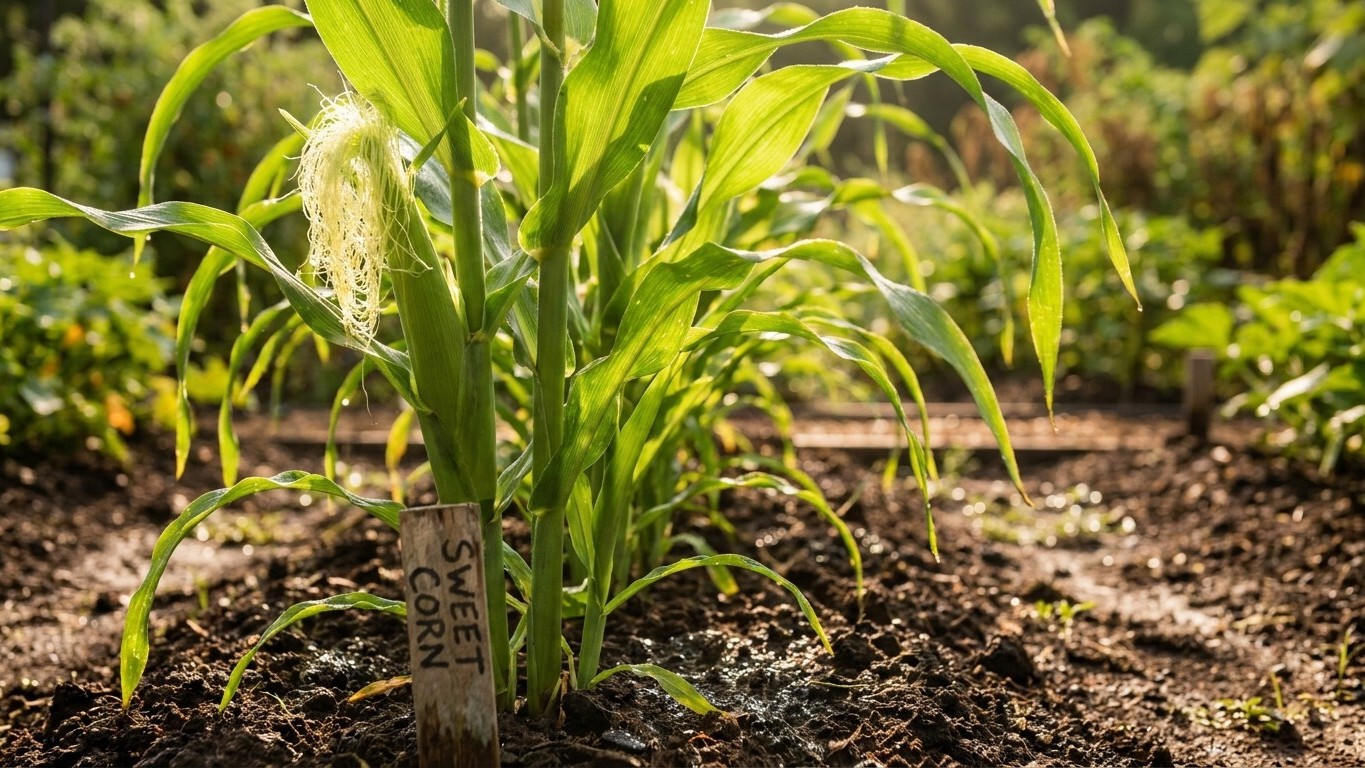

Yes, in most of Michigan’s Lower Peninsula, sweet corn ripens reliably when planted after soil reaches 60°F rather than right after the last frost. The frost-free window here runs long enough, roughly 159 to 174 days depending on location, that both quick 60-day types and slower 90-day types can mature before the first fall frost arrives.
The short answer
Start with the date most gardeners get wrong. The last spring frost lands around April 30 in the Detroit area, and early to mid May across most of the rest of the Lower Peninsula, according to MSU Extension’s Frost-Free Dates. That’s the number people write on their calendars. It is not, however, the number that matters for corn.
Sweet corn seed needs soil warmed above 60°F before it germinates well, and that threshold arrives weeks after the last frost, not on the same day. Air can warm up fast in spring while six inches of soil lags behind, holding onto winter’s chill. A gardener who plants the week after the last frost, using that date as a green light, is very often planting into soil that hasn’t caught up yet. The fix isn’t a calendar trick, it’s a soil thermometer pushed into the bed at planting depth, checked over a few mornings before seed goes in the ground.
Once that 60°F mark is hit, the clock that actually decides ripening starts running: sweet corn needs 60 to 90 days from planting to harvest, per Utah State University Extension. The question for any Michigan grower is simple arithmetic: does that 60-to-90-day window fit between whenever the soil actually warms and whenever the first fall frost shows up?
On the fall end, Michigan’s zone 6a areas see their first frost between October 6 and October 21, according to MSU Extension’s Michigan Garden Calendar. That’s a comfortably late date. Even accounting for soil that doesn’t reach 60°F until well into late spring, there’s a wide stretch of summer left over, plenty of room for the full 60-to-90-day range. This isn’t a state where growers are scrambling to squeeze in a crop before an early frost. The margin is real.
Summer heat load matters too, not for whether corn ripens but for how much water it needs while it does. The reference station near Detroit averages 10.3 days a year at 90°F or above, according to NOAA’s 1991-2020 Climate Normals. That’s a moderate number, enough heat to push water demand up during tasseling and ear fill, not so much that heat stress becomes the dominant risk the way it can farther south. Translation: watch the watering can during any stretch of 90-degree days, especially right as silks emerge, but don’t expect the heat itself to be what stops your corn from ripening.
Does a late variety fit here?
The frost window described above gives a rough answer already: yes. But it’s worth walking through both ends of the maturity spectrum, because the math looks different depending on how quick or slow the variety is.
A 60-day variety
A quick 60-day type has the easiest path in Michigan. Even with soil that takes until late spring to warm past 60°F, a 60-day corn planted at that point still finishes well before the October 6 to October 21 frost window. There’s enough slack here that a second, later sowing three or four weeks after the first is a realistic option for gardeners who want a longer harvest stretch instead of one big crop all at once. Few climate constraints get in the way of a fast variety in this state.
A 90-day variety
The slower end of the range is where a lot of gardeners assume trouble, and in Michigan that assumption doesn’t hold up. Run the numbers against the earliest of the fall frost dates, October 6. Counting backward 90 days lands in early July, meaning a 90-day variety planted anytime through early-to-mid summer, once soil is warm, still has room to mature before frost risk sets in. Even in areas that see the earlier end of that fall frost window, there’s cushion left over. A 90-day sweet corn variety does fit in most of Michigan’s growing season, it simply leaves a narrower buffer than the 60-day type does, so it rewards a gardener who plants promptly once soil temperature checks out rather than waiting.
The one place caution is warranted: far northern parts of the state, or any spot with a documented later local frost than the zone 6a range cited above. Nothing here changes that reality; a grower unsure of local frost timing should confirm it locally before betting on the full 90 days.
What goes wrong here
Three failure patterns show up again and again in Michigan sweet corn patches, and only one of them has anything to do with the state’s climate at all.
- Soil sown too cold. Planting right after the last frost date, using that as the go-ahead, often means seed goes into ground that hasn’t reached 60°F yet. The result is rot, gaps in the row, and a stand so uneven that some plants tassel weeks apart from others. The remedy is a soil thermometer, not a calendar: wait for a confirmed 60°F reading at planting depth before dropping seed, even if that means planting later than the frost date would suggest.
- A variety too late for the season. This isn’t a widespread Michigan problem given the long frost-free stretch described above, but it still happens when a grower plants a slow variety unusually late in summer, past the point where 90 days still fits before the October frost window. Count backward from October 6, the earlier end of the local frost range, and treat that as the last safe planting date for a 90-day type.
- Sweetness lost to timing, not weather. Standard (su), sugary-enhanced (se), and supersweet (sh2) types cross-pollinate if their tassels shed pollen at the same time, and the resulting kernels turn starchy instead of sweet. Nothing about Michigan’s soil or frost dates causes this; it’s purely a matter of what’s tasseling nearby when. The fix is staggering planting dates between types so their tassel windows don’t overlap, or keeping different types in separate garden areas altogether, and always planting each variety in blocks of three or more rows rather than a single skinny row, since block planting is what lets wind-blown pollen actually reach the ears reliably.
Common questions
When should I plant sweet corn in Michigan?
Plant once a soil thermometer confirms 60°F at planting depth, not on the last frost date itself. In most of the Lower Peninsula that means waiting past early May, since soil warming lags well behind air temperature.
How do I know when the corn is actually ripe?
Look for all three signs together: dry, browned silks; husks that are still moist and green rather than dried out; and milky (not clear, not chalky) juice when a kernel is punctured. Any one sign alone can mislead. As a rough guide, ears are typically ready 17 to 24 days after silks first emerge, though the three-sign check is what should decide the actual picking day.
Can I grow two sweet corn varieties in the same garden?
Yes, as long as their tasseling windows don’t overlap. Staggering planting dates by a few weeks, or choosing varieties with different maturity lengths, keeps standard, sugary-enhanced, and supersweet types from cross-pollinating and turning starchy.
Does Michigan’s summer heat threaten sweet corn?
Not typically. With an average of only 10.3 days a year reaching 90°F at the Detroit reference station, heat stress is a minor factor here compared to hotter regions. The bigger risk in this state is cold, wet soil at planting, not heat during the growing season.