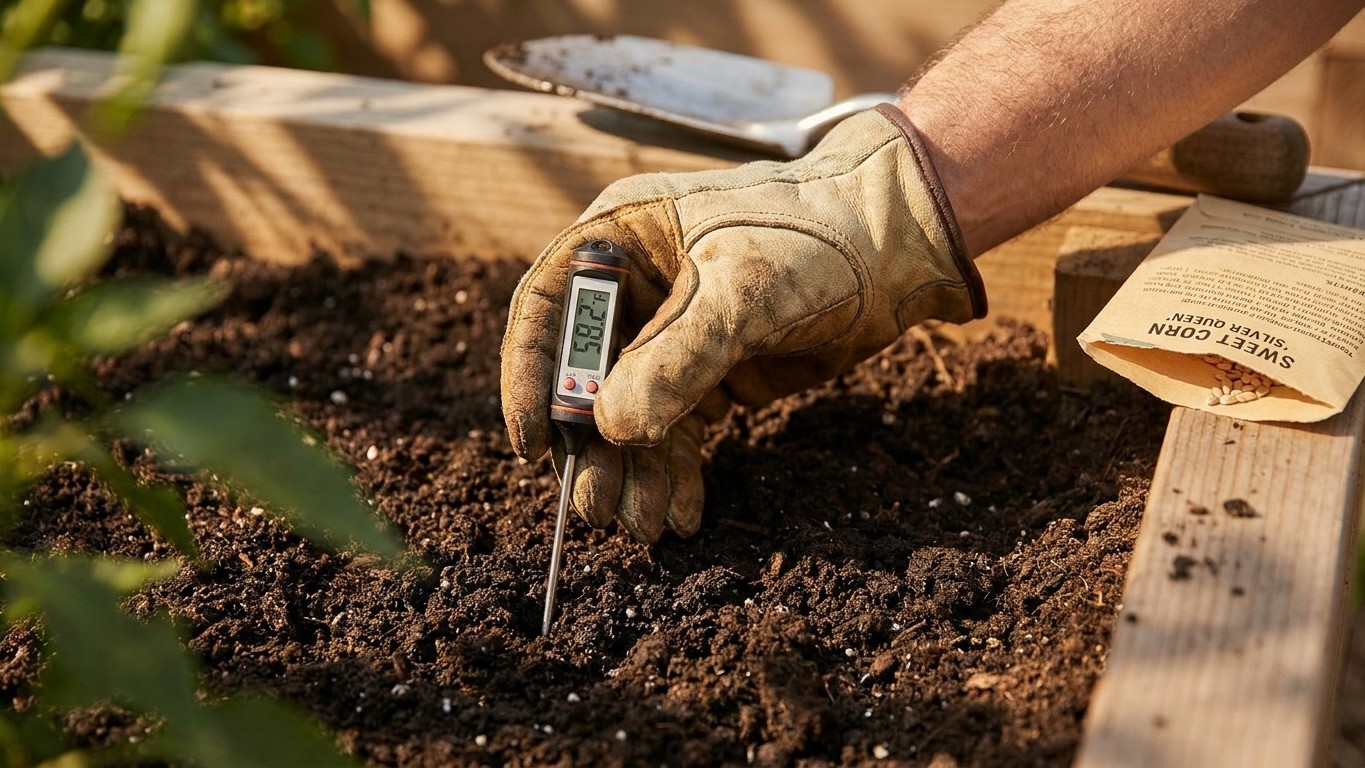

Sweet corn goes into Virginia ground once the soil holds steady above 60°F, not on the last frost date. Near the coast, that means waiting well past early April into a stretch of settled warmth. From there, a 60- to 90-day variety needs to finish before the first fall frost arrives, and along the coast that window runs wide open through mid-November.
The short answer
Here’s the part gardeners miss: the last spring frost and the soil temperature corn actually needs are two separate clocks, and they don’t run together. At the reference station for coastal Virginia (Virginia Beach), the last spring frost falls somewhere between March 20 and April 3. That’s an air-temperature measurement, tracking the risk of a 32°F freeze killing tender growth. Soil warming is a slower, different process. Ground that thawed out in March doesn’t jump to 60°F the week after the last frost passes. It takes sustained daytime warmth and settled nighttime lows, so the actual planting window for corn opens later than the frost calendar suggests. Sowing on the frost date, or even a week or two after, usually means dropping seed into cold, wet soil that rots kernels instead of sprouting them.
Once soil crosses that 60°F threshold, the second clock starts: sweet corn needs 60 to 90 days from planting to harvest, depending on the variety. The question is whether that window closes before the first fall frost shows up. On the coast, first frost runs November 10 to November 24. That gives an enormous stretch, easily seven months, between a realistic soil-warming date and the first fall freeze. A 90-day variety planted even a bit later than ideal still has room to finish. This is one of the more forgiving parts of the state for corn timing.
The caution matters here, though. Virginia Beach sits at the mild end of the state’s climate spread. The Blue Ridge and southwest Virginia see spring arrive weeks later and fall frost arrive weeks earlier. Nobody has published exact soil-warming or frost dates for those regions in the source used here, so treat the coastal numbers as the mild-case scenario, not a statewide guarantee. Gardeners in the mountains and the southwest should expect their own planting window to open later and close sooner, and should watch soil temperature directly with a thermometer rather than count on a calendar date borrowed from tidewater Virginia.
Heat load is the other factor worth flagging. Virginia Beach averages 26.0 days a year at or above 90°F. That’s not a planting-date issue, but it shapes water demand and stress on the crop once it’s growing, especially during tasseling and ear fill in the hottest stretch of summer.
Does a late variety fit here?
Whether a longer-season variety is worth planting comes down to simple arithmetic: how many days sit between a realistic soil-warming date and the first fall frost, matched against the days that variety needs to mature.
A 60-day variety
A 60-day variety is the low-risk choice almost anywhere in Virginia. Planted once soil is reliably above 60°F, coastal gardeners could sow one as late as mid-summer and still clear harvest well before the November 10 to November 24 frost window closes. This is the safer pick for anyone planting later than they’d like, whether because of a wet spring, a late soil warm-up, or simply wanting a second planting for a staggered harvest. It’s also the more forgiving option for gardeners in the Blue Ridge or southwest, where the season likely runs shorter on both ends even though exact dates for those regions aren’t published in the source used here.
A 90-day variety
A 90-day variety asks more of the calendar. Using the coastal reference numbers, there’s still comfortable room: even accounting for a soil-warming delay past the last frost date, the stretch to a November 10 to November 24 first frost leaves months to spare. In this territory, a 90-day variety fits without much strain. The caution belongs to the rest of the state. In the Blue Ridge and southwest, where spring runs weeks later and fall frost arrives weeks earlier, that same 90-day variety has far less cushion, and depending on how much time is actually lost on each end, it may not reliably finish before frost. Nobody has published the exact inland dates here, so the honest answer for those regions is to treat a 90-day variety as a gamble rather than a safe bet, and to lean on a 60-day one instead unless local experience says otherwise.
What goes wrong here
- Sowing before the soil is warm enough. Planting on or soon after the last frost date, rather than waiting for soil to hold above 60°F, is the most common failure. Seed sits in cold, damp ground, rots before it sprouts, or germinates weak and uneven. The fix is patience: check soil temperature directly rather than counting days from the frost date, since the two clocks don’t move together.
- Choosing a variety too long for the season. This mostly bites gardeners outside the mild coastal zone. A 90-day variety planted in a region where spring lags and fall frost comes early can run out of season before the ears finish filling. The remedy is matching variety length to the actual local window, favoring a 60-day type wherever that window looks tight.
- Losing sweetness to a nearby tasseling variety. This one has nothing to do with weather. Sweet corn types (su, se, and sh2) lose their sweetness if they tassel at the same time as a different type nearby, including field corn or a neighbor’s plot. The source doesn’t publish a distance to keep between plantings, so the fix isn’t measured in feet. It’s about timing: stagger planting dates so different types don’t tassel in the same week, or choose a single type for the whole garden and any nearby corn patch.
Common questions
Is soil temperature or the frost date more important for planting sweet corn?
Soil temperature decides it. The last frost date only marks when air-temperature risk to tender plants eases. Corn seed needs the ground itself above 60°F to germinate reliably, and that point comes later than the frost date, sometimes by several weeks depending on how quickly the season warms.
Can I plant sweet corn twice in one season in coastal Virginia?
The window between a realistic soil-warming date and the November 10 to November 24 first fall frost is wide enough near the coast to support a first planting followed by a second one several weeks later, particularly with a 60-day variety for the later sowing. Inland and mountain gardeners have less room to work with.
Why did my sweet corn turn out starchy instead of sweet?
This is almost always a pollination issue, not a growing-condition one. If a sweet type tassels at the same time as another corn type nearby, whether a different sweet variety or field corn, the sweetness is lost. It isn’t fixed with better soil or watering; it’s fixed by keeping tasseling times separated.
Does the same timing apply across all of Virginia?
No. The frost and soil-warming figures here come from a coastal reference station, the mild end of the state’s climate range. The Blue Ridge and southwest Virginia run weeks later in spring and weeks earlier in fall, tightening the whole planting window, even though exact dates for those regions aren’t published in the source used here.