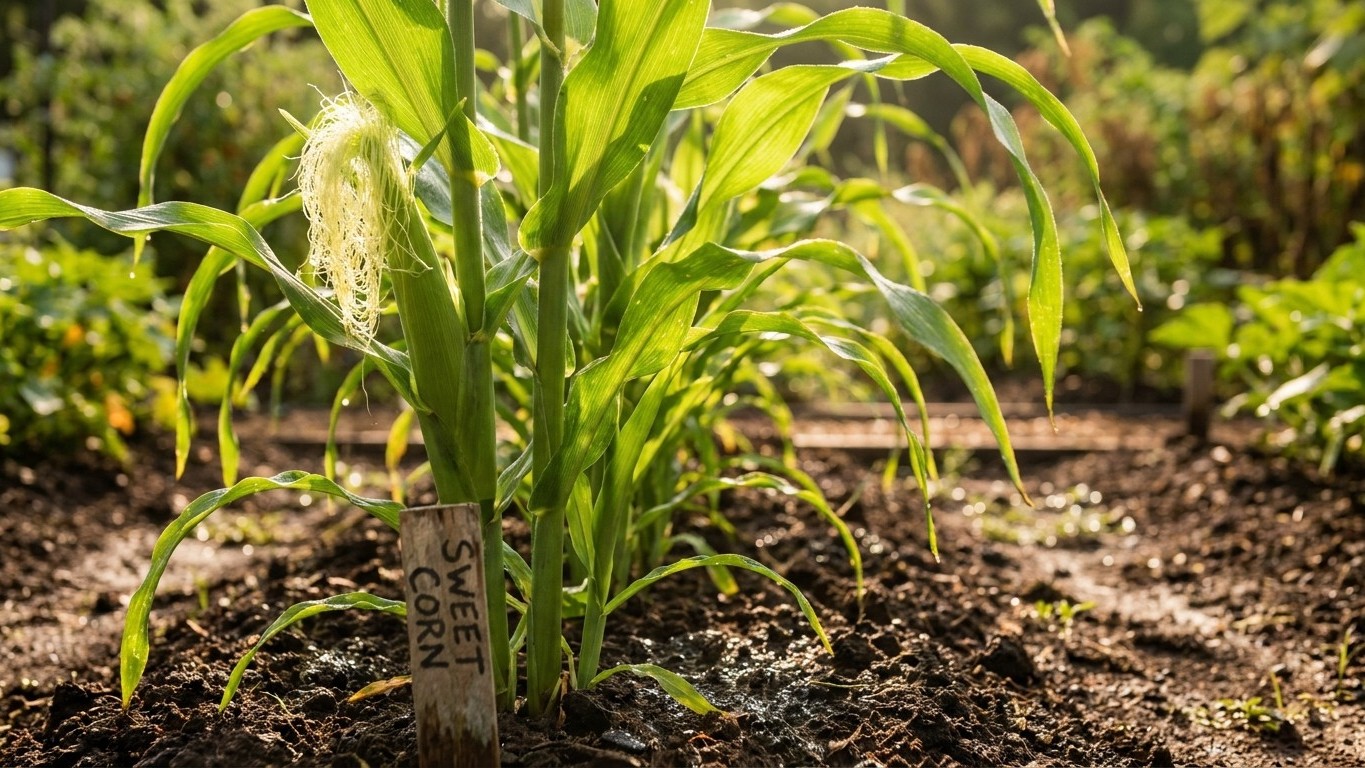

Yes, sweet corn can ripen in Virginia, but the calendar that matters isn’t frost, it’s soil temperature. Coastal Virginia’s soil crosses 60 degrees well after the last spring freeze clears, and from that point a 60 to 90 day variety has to squeeze in before the first fall frost arrives. In the mountains, that whole window shifts and shrinks.
The short answer
Start with the number growers actually need: soil at 60 degrees Fahrenheit, sustained, not a single warm afternoon. That threshold has nothing to do with the last spring frost. At the Virginia Beach reference station, the last spring freeze falls somewhere between March 20 and April 3, but the ground doesn’t hold 60 degrees that early. Soil warms on its own schedule, lagging behind the air by weeks, because a few inches of earth take far longer to shed winter cold than the atmosphere does. Planting sweet corn seed into soil that’s still in the 40s or low 50s doesn’t kill the seed outright, but it sits, it rots more easily, and germination turns spotty at best.
So the real planting window opens later than most gardeners assume, sometime after that last-frost date has already come and gone, once the soil itself has caught up. From there, the math is straightforward. Sweet corn needs 60 to 90 days from planting to harvest, depending on the variety. The first fall frost at the coastal reference station lands between November 10 and November 24. Counted from a soil-warm planting date in spring through to that November window, there’s a wide stretch of frost-free growing time, easily enough to cover even the slower 90-day types with room to spare.
Heat is the other half of the equation. Virginia Beach averages 26.0 days a year at 90 degrees or hotter. That’s the load that drives water demand and pushes plants into stress during pollination, the single most sensitive stage for sweet corn. It’s not the same measurement as an average summer temperature, it’s a count of the extreme days, and it explains why irrigation during silking matters as much as the calendar does.
One more distinction worth holding onto: the 60 to 90 day figure counts from planting and tells you whether the crop fits the season at all. A separate count, 17 to 24 days from when silks first appear, tells you which week to actually pick. Those are two different clocks answering two different questions, and mixing them up is how gardeners end up either pulling ears too early or leaving them on the stalk until the sugar turns to starch. When picking time nears, judge readiness by three signs together: dry, browned silks, husks that are still moist and green, and milky juice from a kernel you’ve punctured with a thumbnail. Any one of those alone can mislead you.
Does a late variety fit here?
Whether a given variety fits Virginia’s season comes down to counting its days-to-maturity against the frost-free stretch described above, then checking the caution that coastal figures don’t travel inland unchanged.
A 60-day variety
A fast, 60-day type is the low-risk choice almost anywhere in the state. Planted once the soil has reached 60 degrees, even a mid-to-late spring start leaves months of room before the first fall frost at the coastal station. This is the variety that tolerates a late spring, a cool stretch in early summer, or a gardener who simply got the seed in the ground later than planned. It also opens the door to a second planting later in the season for gardeners chasing a fall harvest, since the short cycle leaves enough calendar left over to try again.
A 90-day variety
A slower, 90-day type demands more discipline about the planting date but still fits comfortably at the coastal reference station, where the gap between soil-warm planting and the November frost window is generous. The caution matters more here than for the fast variety: in the Blue Ridge and southwest Virginia, spring runs weeks later and fall arrives weeks earlier than at the coast. Stack a delayed soil-warm date onto an earlier fall frost, and a 90-day variety’s margin narrows fast. For those higher, cooler regions, a grower betting on the slowest variety available is the one most likely to run out of season before the ears finish filling. The coastal numbers don’t answer that question for the mountains, and no figure here should be stretched to cover both.
What goes wrong here
- Soil sown too cold. Seed goes in in early spring, chasing the last-frost date instead of waiting for the soil itself to hold 60 degrees. The fix is patience: test the soil with a simple thermometer a few inches down, several days in a row, before dropping seed. A week or two of delay costs far less than a poor stand.
- A variety too late for the season. A 90-day type gets planted on a schedule that only makes sense for the coast, then falls short in a shorter-season pocket inland or in the mountains. The remedy is matching the variety’s day count to the local frost-free stretch, not to a statewide average, and leaning toward the faster type whenever the season is already tight.
- Sweetness lost to a nearby crossing. This one has nothing to do with weather. Su, se, and sh2 sweet corn types lose their flavor and texture when their tassels shed pollen at the same time as another type nearby, corn is wind-pollinated and doesn’t care what a gardener intended. The fix is timing, not distance: stagger planting dates so the varieties don’t tassel together, and plant each type in its own block of three or more rows so pollen from one block reliably falls on its own silks rather than a neighbor’s.
Common questions
When should sweet corn actually go into the ground in Virginia?
Once the soil has held 60 degrees for several consecutive days, not on the calendar date of the last spring frost. The frost date and the soil-temperature date are two separate milestones, and the soil one always comes later.
How can I tell when an ear is ripe without guessing?
Check for all three signs at once: the silks have dried and browned, the husk is still moist and green, and a punctured kernel releases milky juice rather than a clear or thick, doughy liquid. One sign alone isn’t reliable.
Can I grow two different sweet corn varieties in the same garden?
Only if they don’t tassel at the same time. The published guidance from Utah State University Extension ties the flavor problem to simultaneous tasseling among su, se, and sh2 types, not to a fixed planting distance, so stagger the planting dates and keep each type in its own block of three or more rows.
Does the schedule change much between the coast and the mountains?
Yes, and by more than a few days. Coastal Virginia’s frost-free window runs from late March or early April to mid-to-late November. The Blue Ridge and southwest Virginia see a later last frost and an earlier first fall frost, which shortens the growing season and makes the choice of variety, fast versus slow, matter far more than it does near the coast.