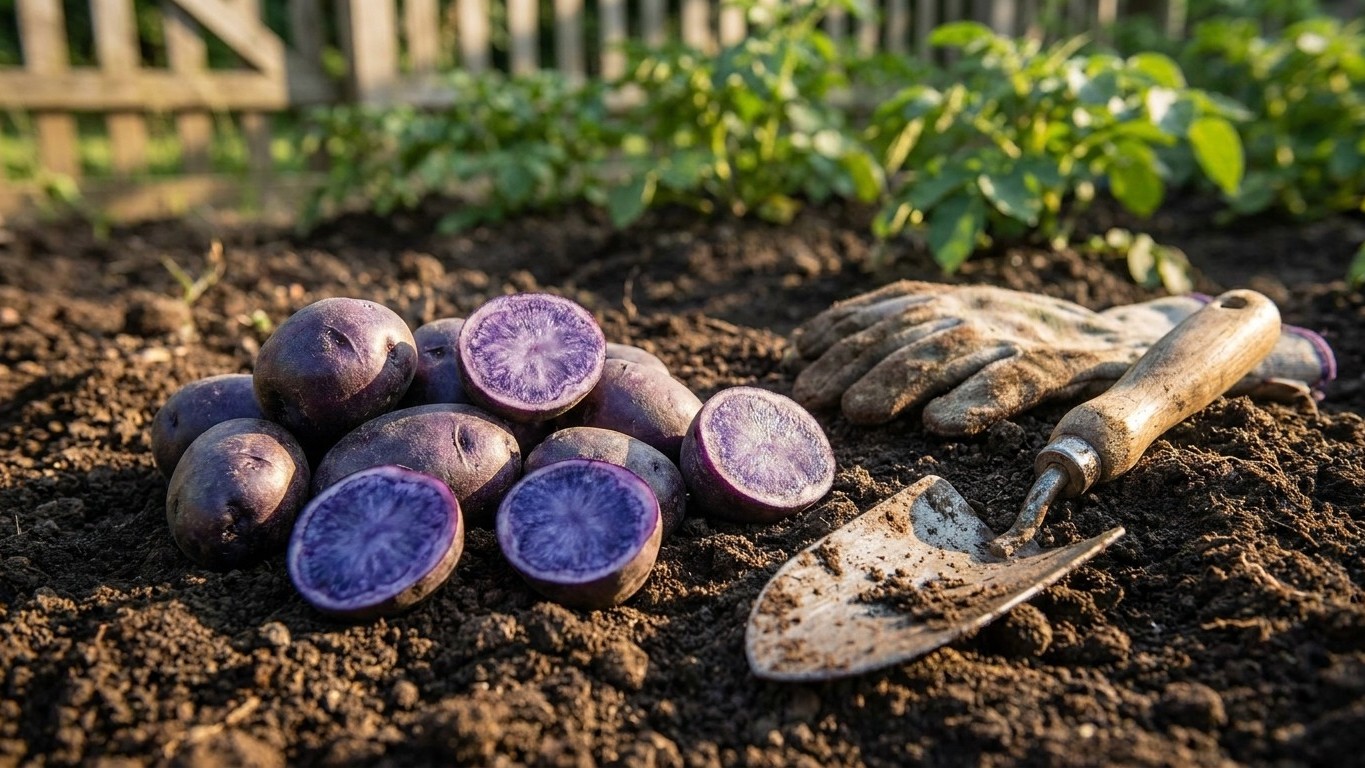

All Blue is a late-season potato with purple skin and purple flesh straight through, published for boiling use by the University of Maine Cooperative Extension in Bulletin #2077, Growing Potatoes in the Home Garden. That single line, season class, skin color, flesh color, and kitchen use, is the whole varietal record a home gardener needs before deciding whether this potato belongs in their plot.
The short answer
Four separate facts define a potato variety in the University of Maine bulletin, and each one answers a different question. All Blue carries purple skin and purple flesh, which is worth stating plainly because those two traits are recorded in different columns of the source and do not always match. A well-known variety like Red Norland proves the point: white flesh, red skin. All Blue skips that mismatch entirely. Skin and flesh are both purple, so the potato looks the same on the outside as it does once you cut into it, which is part of why it shows up in specialty produce bins labeled by color rather than by name.
The season class listed for All Blue is late. That word does real work. It tells a gardener how long the plant needs in the ground and, more importantly, what kind of summer it can tolerate before the crop stalls. A late-season potato is not a slower version of an early one that eventually catches up. It is a plant that keeps building tubers over a longer stretch of the growing year, which changes where it can be grown successfully far more than it changes how it tastes.
The kitchen use published for All Blue is boiling. That is the term the extension bulletin uses, and it is the one worth repeating accurately. No source consulted here calls this variety waxy or floury, and neither term should be assigned to it, because doing so would be inventing a texture claim the University of Maine never made. Boiling, as a published use, tells a cook what the potato is suited for at the stove: whole or halved tubers cooked in water, not necessarily a dry-heat bake.
What the bulletin does not include is just as relevant as what it does. There is no days-to-maturity figure attached to All Blue in the University of Maine bulletin or in Utah State University Extension’s variety guidance. Gardeners who want to plan a harvest date around a specific number will not find one here, and no other source should be treated as filling that gap. The season class, late, is the planning tool the university actually provides.
Where it suits, and where it does not
Season class only means something once you set it against soil temperature. Utah State University Extension states that tuber set and tuber fill stop once soil temperatures climb above 90 F. That threshold is the dividing line between varieties that work in a short, hot growing season and varieties that need the ground to stay cooler for longer. An early-season potato can be planted, bulk up its tubers, and be dug before summer heat pushes soil past that ceiling. A late-season potato does not have that option. It needs the growing season to hold below 90 F in the soil for a longer stretch, because it is still setting and filling tubers well into the part of the year when an early variety has already been harvested.
All Blue, as a late-season variety, belongs to the second group. It is suited to gardens where summer soil temperatures stay moderate for an extended period, think coastal and northern climates, higher elevations, and regions with long, mild growing seasons rather than short, scorching ones. Gardeners in the Pacific Northwest, the Northeast, the upper Midwest, and mountain-valley regions of the Intermountain West are working with exactly the kind of season length a late variety needs.
The same trait becomes a liability in a different climate. Home gardeners in the low-elevation desert Southwest or the humid Deep South, where soil temperatures push past 90 F for weeks at a stretch during peak summer, are asking a late-season variety to keep filling tubers through conditions Utah State University Extension identifies as the point where that process shuts down. The plant does not necessarily die, but tuber development stalls, and yield suffers accordingly.
| Season class | Best-suited climate | Main risk |
|---|---|---|
| Early | Short, hot summers; high-desert or southern gardens | Can be dug before heat shuts down tuber set |
| Late (All Blue) | Long, mild summers; coastal, northern, high-elevation gardens | Soil heat above 90 F stalls tuber fill before harvest |
The practical takeaway is not that All Blue is a difficult variety, only that it is a specific one. It rewards a garden where the growing season is long and the summer soil never gets punishingly hot, and it underperforms wherever those two conditions are not met.
In the kitchen
Boiling is the use the University of Maine bulletin assigns to All Blue, and that designation shapes how a cook should actually treat this potato once it is out of the ground. Boiled whole or halved in salted water, the tubers hold their shape well enough for potato salad, a soup that needs distinct pieces rather than a dissolved thickener, or a simple side dish finished with butter and herbs. That is the direct, practical meaning of a published boiling use: it is the cooking method the variety was evaluated for, not a texture label dressed up as a recommendation.
Purple flesh brings a visual advantage to the boiling pot specifically. Because the color runs all the way through the tuber rather than sitting only in the skin, a pot of boiled All Blue potatoes turns a plate of potato salad or a simple boiled-potato side dish into something that looks distinctly different from a bin of standard russets or reds. Cooks who want that color to show, in a salad, on a relish tray, or diced into a chilled side dish, get more visual payoff from boiling than from a preparation that hides the interior, like a heavily browned roast.
None of this should be read as a claim about starch content or texture. The words waxy and floury do not appear in the University of Maine bulletin or in Utah State University Extension’s published material on this variety, and neither term should be treated as an unstated fact. What is published is the use, boiling, and that is the guidance worth following: cook All Blue the way you would cook a potato meant for the pot, not the oven, and let the purple color do the rest of the work on the plate.
For a cook deciding what to make with a harvest of All Blue, the straightforward approach is to lean on preparations built around boiled potatoes: a mustard-forward potato salad, a simple boiled-and-buttered side, or diced boiled potatoes folded into a cold vegetable dish where the color contrast matters as much as the flavor.
Growing it
Growing a late-season variety like All Blue successfully comes down to sequencing the season correctly around that 90 F soil ceiling, rather than following a fixed calendar date.
- Prepare and plant seed potatoes once soil has warmed past the risk of hard frost but is still well below the summer heat ceiling. Because All Blue is a late-season variety, the goal is to give it as much of the cool-to-moderate part of the growing season as possible before soil temperatures climb.
- Space seed pieces to allow full root and tuber development, since a late variety will be occupying that row for a longer stretch of the season than an early one, and crowded rows compound heat stress later.
- Hill soil around the stems as the plants grow, covering developing tubers to protect them from sunlight and to help moderate the soil temperature immediately around the root zone, which matters more for a late variety that needs that zone to stay below the 90 F threshold for longer.
- Monitor soil temperature through the heart of summer rather than counting days, since neither University of Maine Extension nor Utah State University Extension publishes a maturity date for this variety. The season class, late, is the guidance: expect tuber fill to continue well past the point where an early variety would already be finished.
- Lift the crop once vines have died back and soil conditions remain favorable, taking advantage of the longer fill period a late-season variety is bred to use, rather than digging on a fixed schedule borrowed from an early or mid-season potato.
The through-line across every step is the same one that governs where All Blue should be grown at all: keep the soil on the cool side of that 90 F line for as much of the season as possible, because that is the condition Utah State University Extension identifies as the one this class of potato actually needs.
Common questions
Is All Blue potato waxy or floury?
Neither term is published for this variety by the University of Maine or Utah State University Extension. The published information is a kitchen use, boiling, which describes how the variety is meant to be cooked rather than a starch texture category.
How many days does All Blue take to mature?
No days-to-maturity figure is published by either source used here. What is published is the season class, late, which tells a gardener the plant needs a long, moderate growing season rather than giving a fixed harvest date.
Does the purple color survive cooking?
The University of Maine bulletin lists boiling as the published use for All Blue, and the flesh color, purple, runs through the tuber rather than sitting only at the surface, which is why boiled preparations are commonly used to showcase the color in dishes like potato salad.
Can All Blue be grown in a hot-summer climate?
It is not the best fit. Utah State University Extension notes that tuber set and fill stop above 90 F in the soil, and because All Blue is a late-season variety needing an extended cool-to-moderate stretch, gardens where summer soil regularly exceeds that threshold will see reduced yield compared with an early-season variety planted in the same location.