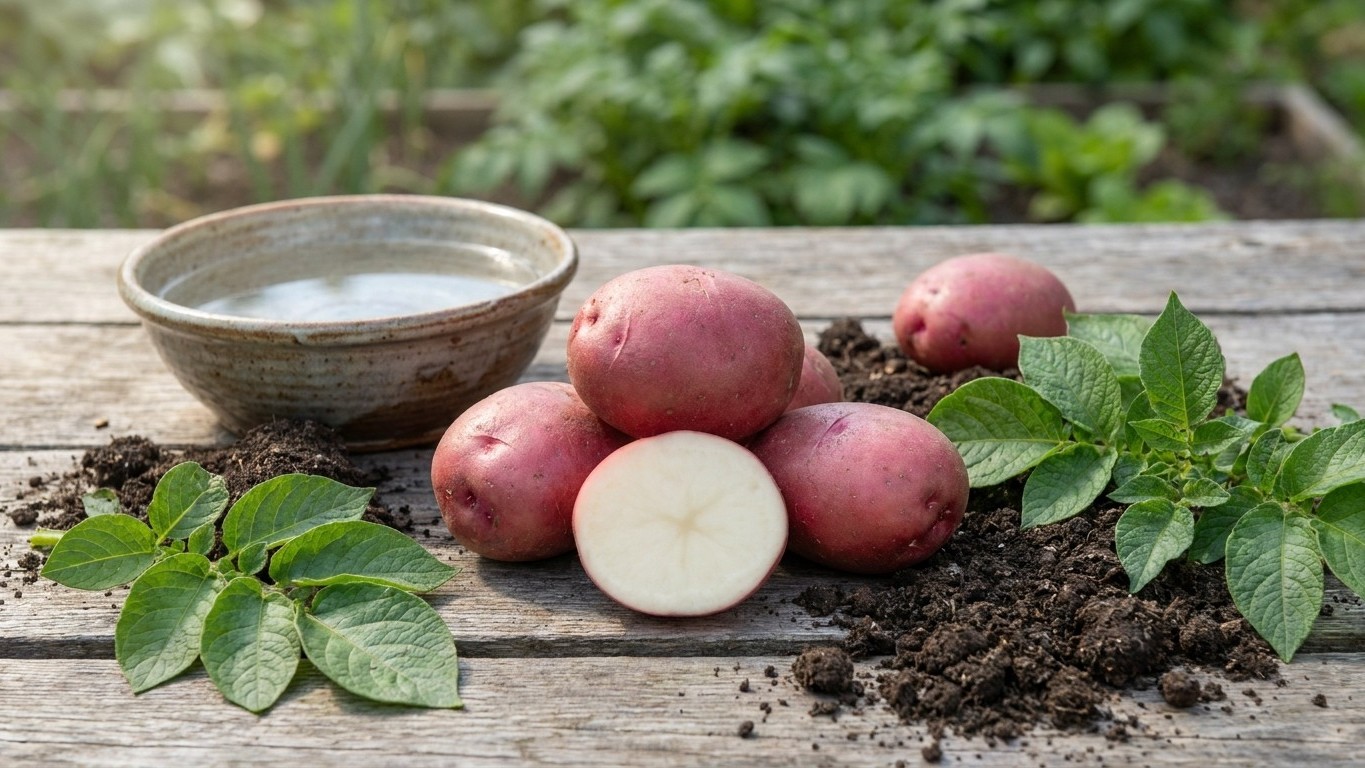

Red Pontiac is a late-season potato with red skin and white flesh, listed by the University of Maine Cooperative Extension for both baking and boiling. That single line settles what the variety is and what it does at the stove. The details below explain why the “late” label matters more than most gardeners assume, and what that word actually changes about where and when this potato belongs in a garden.
The short answer
Start with the name, because it gets muddled more than most: Red Pontiac. Not “Pontiac Red,” not “Red Norland” (a different variety with the same white-flesh, red-skin combination, which is exactly why naming matters here). University of Maine Cooperative Extension, in Bulletin #2077, Growing Potatoes in the Home Garden, by Steven B. Johnson, lists Red Pontiac with four published attributes: skin color, flesh color, season class, and culinary use. Those four data points are the whole identity card for this variety, and they’re worth taking one at a time.
The skin is red, a deep rosy red that’s usually smooth enough to spot at a glance in a mixed bin. The flesh underneath is white, not red, not yellow. That gap between skin color and flesh color trips people up constantly, because the two are recorded as separate columns in the extension data and they frequently disagree. Red Norland is the classic example: red skin, white flesh, same combination as Red Pontiac, different variety entirely. If you describe Red Pontiac only by its flesh, you’ve described half a dozen other potatoes too. The skin is the identifying mark a gardener actually sees first.
Season class is the fourth attribute, and it’s late. Bulletin #2077 doesn’t attach a days-to-maturity figure to that label, and neither does Utah State University Extension. Neither source publishes one, for any variety, so any number you see elsewhere for “days to harvest” isn’t coming from either of these two authorities. What the season class does tell you is where this potato falls in the calendar relative to earlies and mid-season varieties, which turns out to be the more useful planning tool anyway.
Last is the “in the kitchen” line: baking, boiling. That’s the published culinary use, straight from the bulletin. It’s not a texture rating, and the source doesn’t call this potato waxy or floury anywhere. It states what the potato is for, and that’s the phrase worth repeating to yourself at the grocery store or seed rack: baking, boiling.
Where it suits, and where it does not
Season class isn’t a garden trivia detail. It’s the geography of the whole crop. Utah State University Extension has documented that tuber set and tuber fill stop once soil temperature climbs above 90°F. That threshold is the real dividing line between varieties, more than any calendar date. An early variety can be planted, grow, set tubers, and be dug before a hot summer pushes soil past that ceiling. A late variety doesn’t have that luxury. It needs the growing season itself, root zone and all, to stay under 90°F for a longer stretch, because it’s building its crop over a longer window.
Red Pontiac is a late variety. That places it squarely in climates where soil stays cool enough, long enough, for the plant to keep setting and filling tubers well into the season without hitting that 90°F wall. Regions with long, moderate growing seasons, where summer heat builds gradually and doesn’t spike early, suit a late potato far better than regions where soil temperatures rocket past 90°F by midsummer and stay there.
What this means in practice
In a place where soil regularly climbs above that ceiling early in the season, a late variety is fighting the clock before it’s even had a chance to fill out. The plant may still grow, may still flower, but tuber development itself is what shuts down, since that’s the physiological process Utah State’s research points to. In a place where soil stays under 90°F for most of the growing window, a late variety like Red Pontiac has the room it needs to build a full crop.
None of this means Red Pontiac can’t be grown in a hot-summer region. It means the planting window and the soil conditions need to line up so the critical tuber-set and tuber-fill period happens before that 90°F threshold gets hit, if it gets hit at all. That’s a soil temperature question, not a hardiness zone question, and it’s the single most useful thing the season class tells a gardener deciding whether this variety fits their yard.
In the kitchen
Baking, boiling. That’s the published use for Red Pontiac, and it’s worth taking literally rather than translating it into texture language the source never used. The bulletin doesn’t call this potato waxy, doesn’t call it floury, doesn’t describe how it holds up in a salad or whether it falls apart in a stew. It names two cooking methods, and that’s the information a cook actually gets to work with.
Baking is straightforward: whole potatoes, skin on, oven heat, the red skin crisping while the white flesh cooks through. It’s the same basic method that works for any potato listed for baking, scrub the skin, pierce it a few times, roast until a knife slides through without resistance.
Boiling covers a wider range of kitchen uses than the word suggests on its own. Boiled potatoes get mashed, they get cubed into potato salad, they get added to soups and stews, they get roasted after a par-boil. All of those start from the same basic step, cut or whole potatoes dropped into water and simmered until tender. A potato that’s published for boiling is one a cook can reach for across that whole range of dishes without worrying they’ve picked the wrong variety for the pot.
What the bulletin doesn’t hand a cook is a texture promise. It doesn’t say whether Red Pontiac holds a firm shape after boiling or breaks down easily, because that’s not one of the four attributes University of Maine records. What’s documented is the use, not the mouthfeel, and the honest way to describe this potato is by what it’s for rather than by a texture word that would be invented rather than sourced. Baking, boiling: that’s the range, and it’s a wide enough range to cover most of what a home kitchen asks of a potato on any given week.
Growing it
Growing a late variety successfully comes down to timing the season around that 90°F soil ceiling rather than around a maturity number, since none is published for this variety. The steps below follow the order a home gardener actually works through, from planting to lifting.
- Plant once soil has warmed but before summer heat peaks. Seed potatoes go into the ground after the soil has warmed enough for sprouting, but the goal for a late variety is getting the plant established early enough that its tuber-set window falls before soil temperatures climb toward that 90°F threshold.
- Hill as the plants grow. Mound soil up around the base of the stems as the plant develops, covering the lower leaves partway. Hilling keeps developing tubers shaded and covered, which helps buffer soil temperature at the root zone, the exact zone where the 90°F limit on tuber set and fill matters most.
- Keep soil consistently moist through the tuber-fill stage. A late variety spends more of the growing season actively filling tubers than an early one does, so even watering through that stretch matters more here than it would for a quick-maturing variety.
- Watch the foliage, not a calendar count. Since no days-to-maturity figure is published for Red Pontiac by either Utah State University Extension or University of Maine Cooperative Extension, the plant itself is the signal. Foliage that yellows and dies back is the traditional cue that tubers have finished bulking and the crop is ready to lift.
- Lift before soil conditions turn against you. For a late variety, that means digging with an eye on the local season, pulling the crop once foliage has died back and before hard, prolonged heat or an early frost threatens the tubers still in the ground.
Every one of these steps is easier to get right when the gardener already knows the variety is a late one, not a mid-season or early one. That’s the practical payoff of the season class the extension bulletin publishes: it tells you how to plan the whole arc of the crop, even without a specific day count attached to it.
Common questions
Is Red Pontiac the same as Red Norland?
No. Both have red skin and white flesh, which is exactly why they get confused, but they’re separate varieties. Red Pontiac’s published season class is late; the two shouldn’t be treated as interchangeable in a planting plan.
Is Red Pontiac a waxy or a floury potato?
Neither term appears in the University of Maine or Utah State University Extension sources used here. What’s published is the culinary use: baking and boiling. That’s the information to plan a recipe around.
How many days until Red Pontiac is ready to harvest?
No days-to-maturity figure is published for this variety by either University of Maine Cooperative Extension or Utah State University Extension. What is published is the season class, late, which describes where it falls relative to early and mid-season varieties rather than a fixed day count.
Can Red Pontiac be grown in a hot-summer climate?
It depends on soil temperature timing more than on the climate label alone. Utah State University Extension has documented that tuber set and fill stop above 90°F in the soil, so a late variety like Red Pontiac needs its critical tuber-fill period to fall before soil hits that ceiling, which is easier in regions where summer heat builds gradually rather than spiking early.