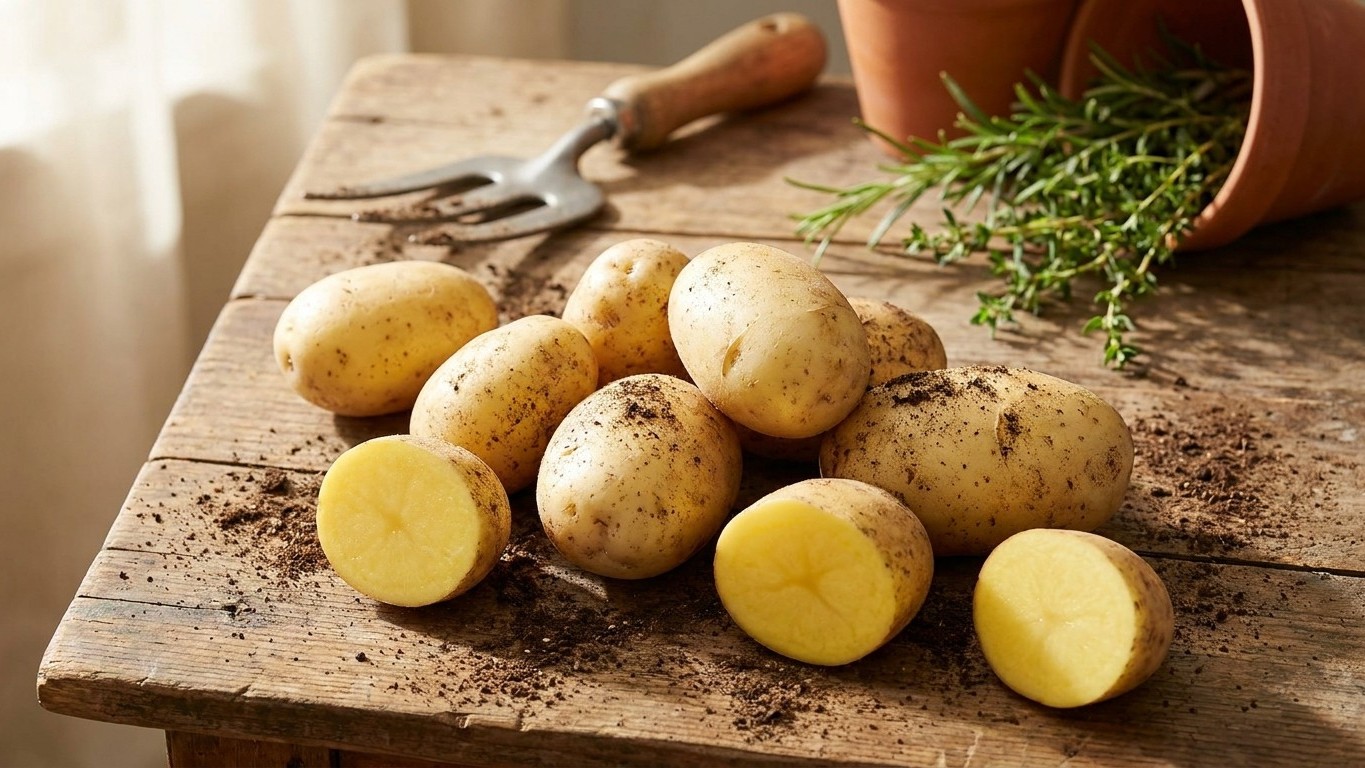

Yellow Finn is a late-season potato with yellow flesh and white skin, published for boiling by University of Maine Cooperative Extension Bulletin #2077. That combination, a late maturity class paired with a boiling use, tells a gardener almost everything needed before ordering seed: when it can go in the ground, what climate it tolerates, and what to do with it once it’s out of the ground.
The short answer
University of Maine Cooperative Extension Bulletin #2077, Growing Potatoes in the Home Garden, written by Steven B. Johnson, lists Yellow Finn with four pieces of information that matter to anyone deciding whether to plant it: flesh color, skin color, season class, and kitchen use. The flesh is yellow. The skin is white. Those are two separate columns in the bulletin, and they don’t always match, so it’s worth saying both rather than assuming one implies the other. A potato can carry yellow flesh under a white, red, or russet skin, and Yellow Finn happens to pair yellow flesh with a white skin.
The season class is late. That single word carries more planning weight than any other detail in the bulletin, because it determines how long the crop needs to sit in the ground before it’s worth digging. A late variety isn’t just “slower” in some vague sense; it’s a different category of crop management, one that assumes a longer, cooler growing window than an early or mid-season type would need.
The published use is boiling. Bulletin #2077 doesn’t describe Yellow Finn’s flesh as waxy or floury, and neither does Utah State University Extension. Those texture words show up constantly in garden catalogs and blog posts, but they aren’t in the university sources behind this page, so this article won’t invent them either. What the bulletin does say, plainly, is that this variety is suited to boiling. That’s a use, not a texture claim, and it’s the detail a cook can actually act on.
One thing the bulletin does not list is a days-to-maturity number for Yellow Finn. Neither does Utah State University Extension. That’s not an oversight on this page; it’s a gap in the published record. A lot of seed catalogs will print a specific day count, but the two extension sources used here don’t, and a season class of “late” is the closest verified stand-in for that information.
Where it suits, and where it does not
Season class only means something once it’s set against a real limit in the soil. Utah State University Extension notes that tuber set and tuber fill stop once soil temperatures climb above 90 F. That threshold is the dividing line between varieties that finish fast and those that need more time. An early-season potato can be planted, sized up, and dug before a hot stretch of summer pushes soil past that ceiling. A late-season variety like Yellow Finn doesn’t have that luxury. It needs a growing window that stays under 90 F in the soil for most of its cycle, not just at planting.
That single fact reshapes where Yellow Finn makes sense. In regions with long, mild growing seasons and summers that don’t routinely bake the topsoil, a late variety can take its time and still finish well. Coastal areas with moderate summer highs, higher-elevation gardens, and northern states where soil temperatures rarely spend weeks above 90 F are the kind of ground this variety is built for. Maine, where Bulletin #2077 comes from, is itself a useful reference point: a state with a climate cool enough that late-season potatoes are a normal part of the home garden lineup, not an outlier choice.
The opposite case is just as clear. In a region where summer soil temperatures cross that 90 F line for extended stretches, an early variety has a real structural advantage: it can be dug and out of the ground before the heat ever becomes a factor. A late variety planted in that same ground is still trying to size up tubers while the soil has already crossed the point where Utah State University Extension says tuber development stops. The plant doesn’t necessarily die, but the crop underneath it stalls.
None of this means Yellow Finn is off-limits in warmer states. It means the timing has to work around the heat rather than through it. Gardeners in hot-summer regions who still want to grow it typically look for the coolest part of their season, whichever end of the calendar that falls on locally, so the tuber-fill window lands before soil temperatures climb past that ceiling. The variety itself doesn’t change; the planting calendar around it does.
In the kitchen
Bulletin #2077 publishes one kitchen use for Yellow Finn: boiling. That’s a narrower, more useful piece of information than it first sounds, because it tells a cook what pot to reach for without making a texture promise the source doesn’t back up. Boiling as a published use points toward whole or halved potatoes cooked in water until tender, the kind of preparation that shows up in potato salad, soups, and simple boiled-potato side dishes finished with butter or herbs.
What this doesn’t mean is that Yellow Finn is ruled out for other cooking methods. The bulletin is documenting a suited use, not issuing a restriction. A potato published for boiling can still be roasted or mashed by a home cook; it just hasn’t been evaluated and listed for those uses in this particular source. The honest way to describe it is that boiling is the one use with a university reference behind it, and anything beyond that is the cook’s own experiment rather than a documented fact.
Yellow flesh tends to hold its color well after cooking, which is part of why boiled preparations show it off. A pot of boiled Yellow Finn, cut into a salad or served plain, keeps a warm yellow tone that white-fleshed varieties don’t have. That’s a visual detail worth mentioning to a cook deciding between varieties for a dish where color matters, like a potato salad meant to stand apart from a plate of pale, white-fleshed potatoes.
The practical takeaway for the kitchen is simple: treat Yellow Finn as a boiling potato first, because that’s the use with a documented source, and build a menu around that starting point. Potato salad, boiled potatoes with butter, and soups that call for chunks of potato simmered until tender are all a natural fit for a variety published specifically for that method.
Growing it
Growing a late-season variety like Yellow Finn is less about a fixed calendar date and more about working backward from the 90 F soil ceiling that Utah State University Extension identifies as the point where tuber set and fill stop. The steps below follow that logic in order.
- Time the planting for a long, cool window. Because Yellow Finn is a late variety, it needs more of the growing season than an early type to size up tubers. Plant as soon as local soil conditions and frost risk allow, so the crop has the longest possible stretch of soil temperatures below that 90 F limit.
- Plant seed pieces at a normal potato depth and spacing. Standard home-garden spacing works for Yellow Finn; nothing in the source material calls for a different planting depth or row width for this variety compared to any other potato.
- Hill the plants as they grow. Mounding soil around the stems as the plants develop keeps developing tubers covered and shaded, which helps buffer soil temperature swings during the warmer stretch of summer that a late variety has to grow through.
- Watch soil temperature through the season, not just air temperature. Since the 90 F threshold that matters is a soil temperature, not an air temperature, a gardener in a hot-summer region benefits from checking the ground itself during the hottest weeks rather than relying on the forecast alone.
- Lift the crop once the growing window closes. Because no days-to-maturity number is published for Yellow Finn, timing the harvest depends on watching the plant, foliage die-back, and local season length rather than counting toward a specific day count.
The through-line in all five steps is the same one that runs through the rest of this page: Yellow Finn is a late-season potato, and every growing decision, from when it goes in the ground to when it comes out, follows from managing that longer cycle around the point where heat stops tuber development.
Common questions
Is Yellow Finn a waxy or a floury potato?
Neither word appears in University of Maine Bulletin #2077 or in Utah State University Extension material. What is published is a kitchen use: boiling. That’s the documented detail to rely on rather than a texture label neither source uses.
How many days does Yellow Finn take to mature?
No specific day count is published by either source used here. What’s published instead is a season class, late, which places Yellow Finn among the longer-season potatoes rather than giving an exact number of days to count toward.
Can Yellow Finn be grown in a hot-summer climate?
It’s harder there than in a cool, long-season region. Utah State University Extension notes that soil temperatures above 90 F stop tuber set and fill, and a late variety needs more time under that ceiling than an early one does. In hot regions, timing the crop for the coolest part of the local season helps work around that limit.
What does the white skin tell a gardener that the yellow flesh doesn’t?
Skin and flesh color are separate traits in the University of Maine bulletin, and they don’t always match. Yellow Finn’s white skin is how the variety is visually identified in the garden and at harvest, while the yellow flesh is what shows up once the potato is cut open and cooked.