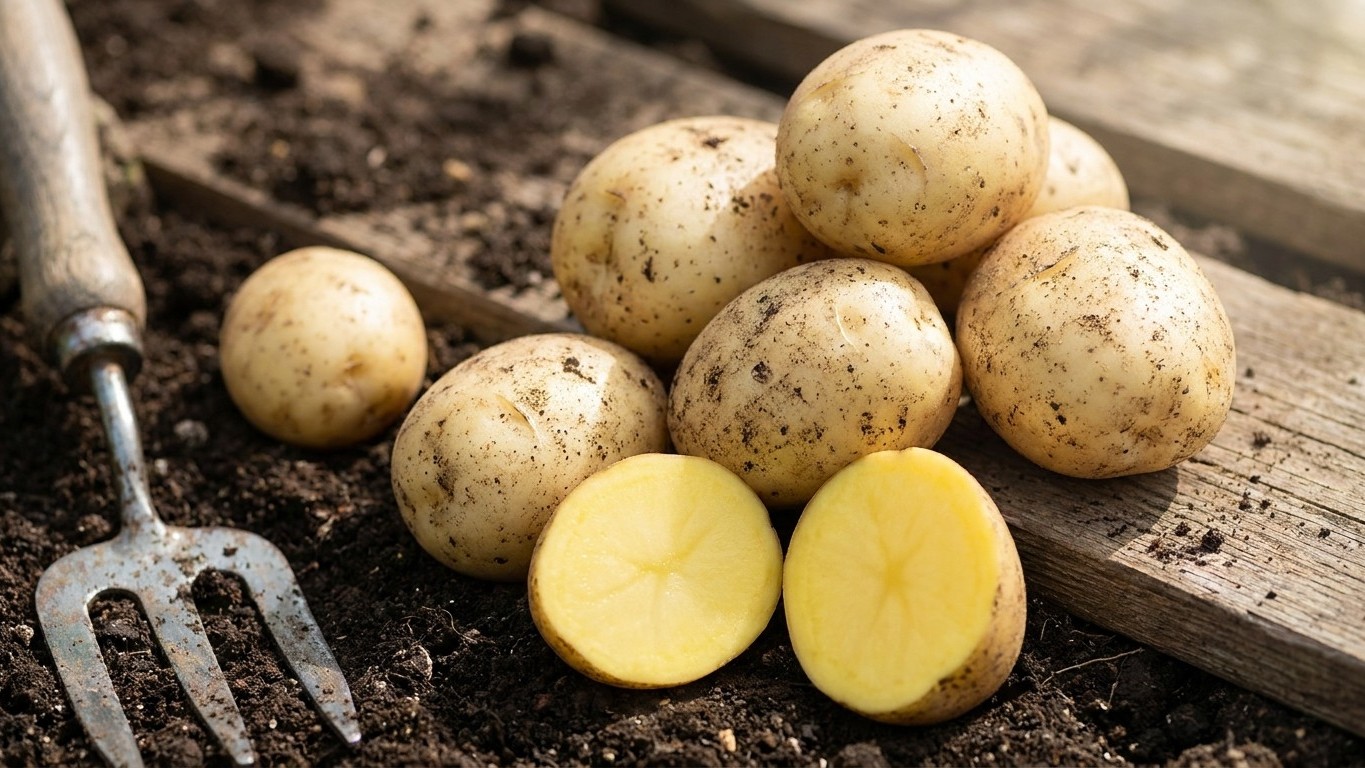

Yukon Gold is a late-season potato with yellow flesh under white skin, bred for two kitchen jobs: baking and boiling. That combination, published by the University of Maine Cooperative Extension in Bulletin #2077, tells a gardener almost everything needed before ordering seed potatoes, including which climate this variety can actually finish a crop in.
The short answer
University of Maine Cooperative Extension Bulletin #2077, written by Steven B. Johnson and titled Growing Potatoes in the Home Garden, lists Yukon Gold with four specific attributes: yellow flesh, white skin, a late season class, and a kitchen use of baking and boiling. Those four facts are the variety’s identity card. They come from an extension bulletin, not a seed catalogue, which matters because catalogue copy tends to blend marketing language with agronomy. The bulletin does neither.
Start with the skin, because that’s what a gardener sees first when the fork comes up under the plant. White skin on Yukon Gold isn’t a minor detail. Flesh color and skin color are separate columns in the source data, and they frequently disagree with each other. Red Norland, for example, carries white flesh under red skin. If a description leans on flesh color alone, calling Yukon Gold “a yellow potato” without naming the skin, a reader who has actually grown potatoes will spot the gap immediately. Yukon Gold is a white-skinned potato with yellow flesh underneath, and both halves of that description need to stay attached.
The season class, late, is the second piece of the identity, and it’s the one gardeners tend to skip past in favor of a maturity date. There isn’t one to skip past here. Neither the University of Maine bulletin nor Utah State University Extension publishes a days-to-maturity figure for this variety, and that’s worth taking seriously rather than filling in with a guess. A days-to-maturity number is exactly the kind of figure a gardener plans a whole season around, counting backward from first frost to a planting date. Without a published number, the honest move is to work from the season class instead, which is what actually determines how the variety behaves in the ground.
Last comes the use, and it’s the most directly practical of the four facts. Baking and boiling means the tuber holds up to both dry heat in an oven and wet heat in a pot, a range that covers a lot of dinner-table ground without pretending to cover everything. It doesn’t say anything about frying, and it doesn’t assign a texture category. What it says is what the extension bulletin actually tested and reported.
Where it suits, and where it does not
Season class is really a statement about geography once you cross it against soil temperature. Utah State University Extension has documented that tuber set and tuber fill stop once soil temperature climbs above 90 degrees Fahrenheit. That ceiling is the hinge the whole growing decision turns on. An early-season variety can be planted, bulk up its tubers, and be dug before a hot stretch of summer pushes soil past that point. A late-season variety doesn’t have that option. It needs the whole stretch of the growing season, from planting through tuber fill, to stay under that 90-degree soil threshold, or the plant simply stops building tubers partway through.
That’s the practical dividing line for Yukon Gold. It belongs to a cooler-summer climate, not a scorching one. Regions where soil temperatures regularly climb past 90 degrees for extended stretches in mid-summer, the lower elevations of the Southwest and the Deep South’s hottest weeks, put a late variety at a real disadvantage, because the tuber-fill window gets cut short right when the plant needs it most. Regions with milder summer soil temperatures, the northern tier of states, higher-elevation gardens, and areas with regular marine or lake-moderated air, give a late variety the runway it needs to actually finish filling out.
None of this means Yukon Gold can’t be grown in a hot-summer state. It means the timing has to work around the heat rather than through it. A gardener in a warm region has two real options: plant early enough in spring that the bulk of tuber fill happens before the hottest weeks arrive, or plant a second flush timed for a cooler stretch later in the season where the climate allows it. Either way, the goal is keeping soil temperature under that 90-degree ceiling during the window when the plant is actively filling tubers, not just during germination.
Where a gardener has a genuine choice of variety and a genuinely hot summer, an early-season variety solves the heat problem more directly, because it’s out of the ground before the soil ever climbs that high. Yukon Gold isn’t that variety. It’s built for a season that stays temperate longer, and choosing it in a climate that can’t offer that is choosing an uphill fight against the thermometer rather than the plant.
In the kitchen
Baking and boiling is a published use, and it points to a specific way this potato earns its place on a plate rather than to a texture claim nobody tested. A baking potato needs to hold together through dry oven heat without collapsing into mush, whether that’s a whole potato wrapped in foil, cut into wedges and roasted, or halved and finished under a broiler. Yukon Gold’s listed use covers that job directly.
Boiling is the second half of the same coin, and it’s a wider category than it sounds. Boiled potatoes show up whole and buttered on a dinner plate, cubed into a pot of soup, or cooked and cooled for a cold potato salad. The published use doesn’t specify which of those applications performs best, only that the variety is suited to being cooked in water as well as in an oven. That’s a meaningfully broader recommendation than a lot of potato varieties get, since some are limited to one camp or the other in extension literature.
What a cook actually does with that information is straightforward. A recipe calling for a potato that can be baked whole, roasted in chunks, or dropped into a pot of simmering water for mashing or a salad is a recipe Yukon Gold is suited to. A recipe built specifically around deep frying, the kind that depends on a very particular starch behavior for crisp french fries, isn’t part of the published use here, and it’s worth not overselling that application on the strength of a bulletin that doesn’t mention it.
The color matters at the stove too, separate from the use case. Yellow flesh brings a naturally buttery look to a finished dish before any butter actually gets added, which is part of why Yukon Gold shows up often in gratins, mashed potato bowls, and roasted potato sides where the color reads on the plate. That’s a visual and culinary fact worth mentioning on its own, distinct from, and layered on top of, the baking-and-boiling use published in the bulletin.
Growing it
Growing a late-season variety successfully comes down to sequencing the season correctly around that 90-degree soil ceiling, and the order of operations matters more than any single step in isolation.
- Plant as early as soil conditions allow. A late variety needs the longest possible runway before summer heat arrives, so seed potatoes go in the ground as soon as the soil can be worked and local frost risk has passed, not later in spring when a shorter-season variety might still have time.
- Hill the plants as they grow. Mounding soil up around the stems as the plant develops keeps developing tubers covered, protects them from sunlight that turns skin green, and gives the root zone more depth to buffer against surface heat as summer progresses.
- Water consistently through the tuber-fill stage. Because a late variety spends more of the season actively filling tubers, even soil moisture during that stretch matters more here than it would for a quick early crop that’s dug before conditions get demanding.
- Monitor soil temperature as summer peaks. Tuber fill halts above 90 degrees Fahrenheit in the soil, so a gardener in a warmer region should track conditions during the hottest weeks and expect growth to pause, resuming once temperatures ease.
- Lift the crop once foliage dies back. A late variety is left in the ground longer than an early one, and digging happens once the top growth yellows and collapses on its own, signaling the plant has finished the season rather than being cut short by a calendar guess.
That sequence is what a late season class actually asks of a gardener: an early start, steady care through the middle of summer, and patience at the end rather than an early harvest date. It’s a longer commitment than an early variety demands, and it only pays off in a climate where the soil has a real chance of staying under that 90-degree ceiling for most of the growing window.
Common questions
Is Yukon Gold a good potato for a hot climate?
Not ideally. As a late-season variety, it needs a longer stretch of the growing season to stay under the 90-degree soil threshold that halts tuber fill, according to Utah State University Extension. A climate with prolonged, intense summer heat works against that requirement, while a cooler or shorter-summer region gives it the time it needs.
Can Yukon Gold be fried?
The published use from the University of Maine Cooperative Extension lists baking and boiling, not frying. That doesn’t mean frying is impossible, only that it isn’t the use case documented in the extension bulletin, so no claim about frying performance can be attributed to that source.
How many days does Yukon Gold take to mature?
Neither the University of Maine bulletin nor Utah State University Extension publishes a days-to-maturity number for this variety. What is published is the season class, late, which is the more reliable way to plan since it accounts for climate rather than a fixed calendar count.
Why do skin color and flesh color get listed separately?
Because they don’t always match. The extension data treats them as two independent traits, and varieties like Red Norland (white flesh, red skin) show why relying on flesh color alone to describe or identify a potato can mislead anyone who has actually grown the variety in question.