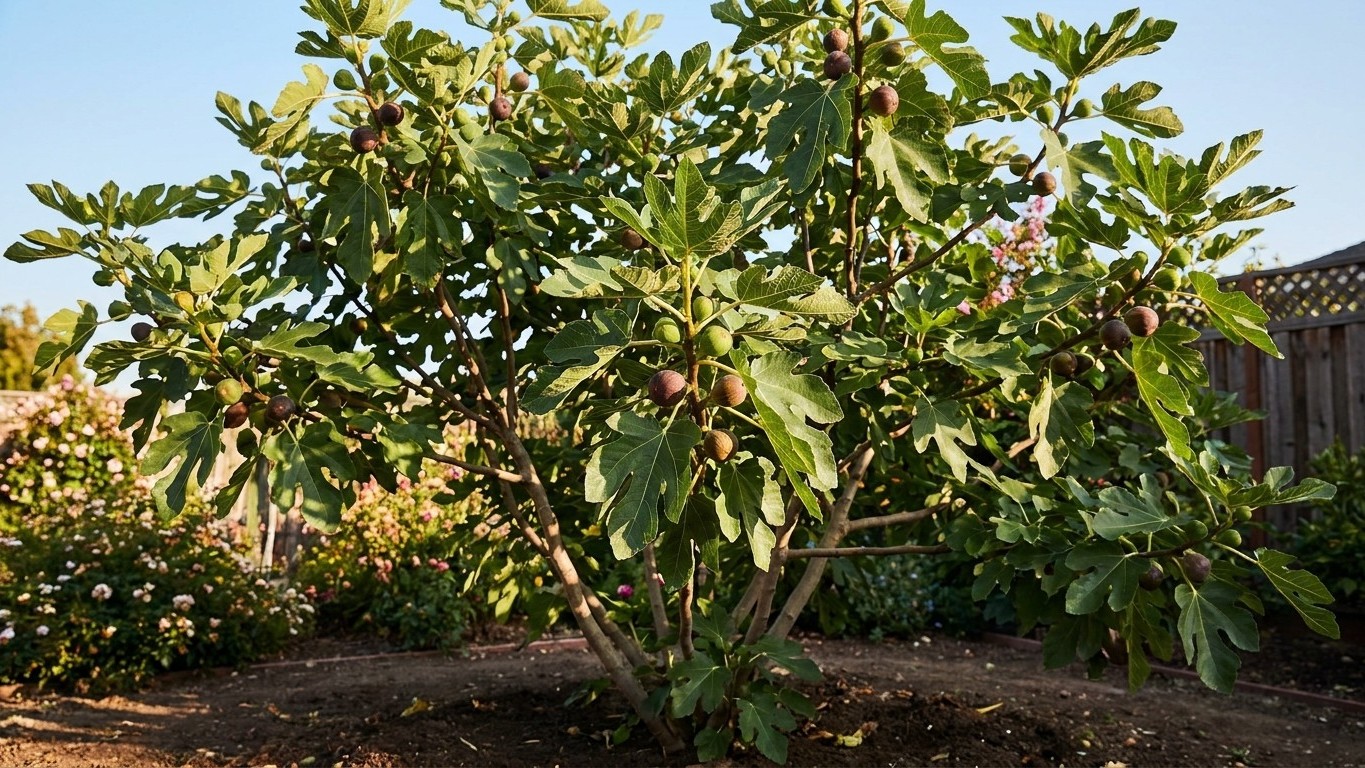

Ficus carica, the common fig, is a deciduous tree or multi-stemmed shrub hardy in USDA zones 7a through 9b. It wants full sun to partial shade, high-organic, well-drained to consistently moist soil in the acid-to-neutral range, and room to spread anywhere from 6 to 24 feet depending on how it’s trained. It flowers in spring and sets fruit without pollination, ripening into syconia in late summer or fall that get eaten fresh, cooked, dried, or preserved. Pollination needs for cropping and years to first harvest still depend on the specific plant you buy, so confirm both before you commit.
Where it will and will not survive
The number that matters here is 7a-9b. That’s the USDA hardiness range for Ficus carica, and the honest way to use it is backward: it tells you where the plant will not make it, more reliably than it tells you where it will thrive. Below the bottom of that range, winter cold kills the wood outright, or often enough, kills it back to the ground even if the roots survive. Above the top of it, the plant may live, but it’s being asked to cope with heat and humidity loads it wasn’t bred for, and long-term vigor tends to suffer even where survival doesn’t.
A hardiness range is a survival threshold, not a comfort zone. A fig planted at 9b will likely stay alive, but “alive at the edge of a range” and “cropping well” are two different outcomes, and this range alone can’t promise the second one. The same logic runs the other direction at 7a: the plant can survive there, through a typical winter, but a harder-than-typical one can still take it back to the root system, and recovery from that costs a season or more of fruiting wood.
What this page can’t do, and won’t pretend to do, is tell you whether your particular property falls inside 7a-9b. Hardiness zones are drawn county by county, and they shift with elevation, with proximity to large bodies of water, and with the microclimate created by a south-facing wall or a low spot where cold air pools overnight. A number pulled from memory about “generally warm” or “generally cold” parts of the country isn’t a substitute for that county-level data, and guessing wrong here is exactly how a fig ends up planted where it has no real chance.
The more useful move is to look up your own zone before you buy or plant anything, using a hardiness zone guide that carries the actual zone data for your state and county rather than a regional generalization. Once you know your zone, holding it up against 7a-9b answers the survival question cleanly: inside the range, the plant can live there long-term, with the comfort caveats above still applying at either edge; outside it, in either direction, you’re planting into conditions this species wasn’t built to handle, and no amount of siting or mulching changes that math.
What it is called, and why that matters here
The common name in use for Ficus carica is Common Fig. That’s the name most people reach for, and it’s the one this plant is sold under nearly everywhere. But it’s worth being clear about what that name is and isn’t. Sources that catalog plants by common name typically list them alphabetically, without any attempt to rank one name as official over another, and Common Fig is no exception. It’s a widely used label, not a botanical designation, which is exactly why this page is titled by the Latin binomial instead: Ficus carica is the one name that doesn’t change depending on which reference you’re holding.
There’s a real source of confusion worth naming here, and it isn’t really about Ficus carica itself so much as the genus it belongs to. Ficus is a large genus, and several of its other members are sold and grown widely as houseplants and street trees under their own “fig” names, entirely unrelated in use, hardiness, or fruiting habit to the tree covered on this page. Someone shopping for a fig tree to plant outdoors for fruit, and someone shopping for an indoor ornamental fig, can both end up at a nursery tag that just says “fig,” and the two plants behave nothing alike in terms of cold tolerance or cropping. That overlap in common usage is a real trap, and naming it plainly is more useful than pretending the word “fig” always means one thing.
None of this makes Common Fig a wrong name. It’s simply an imprecise one, in the way most common names are, because they were never designed to be unique identifiers in the first place. When you’re buying a plant for a specific outcome, cropping fruit in a known hardiness zone, the botanical name is the one detail that travels reliably from label to label, catalog to catalog, and that’s the practical reason it anchors this page rather than the common name.
The site it needs to actually crop
Getting a fig to survive and getting one to crop well are not the same test, and the growing conditions below split fairly cleanly along that line. Light and space bear directly on whether fruit ever forms and ripens; soil texture, pH, and drainage bear more on the health and vigor of the plant itself, which then supports whatever cropping the light and space allow.
| Condition | What the source lists | What it mainly affects |
|---|---|---|
| Light | Full sun (6+ hours direct) or partial shade (2-6 hours direct) | Yield: less light means a plant that lives but fruits lightly or not at all |
| Soil texture | High organic matter | General vigor and root health |
| Soil pH | Acid (below 6.0) or neutral (6.0-8.0) | General vigor; the source does not separate this out for fruiting specifically |
| Drainage | Good drainage, moist | Survival: poor drainage is the kind of condition that threatens the plant outright |
Full sun is the condition to prioritize if fruit is the goal. Partial shade is listed as tolerated, and the plant will likely live through it, but nothing in these facts says a shaded fig crops as heavily as one in six or more hours of direct sun, and it would be a stretch to promise otherwise. Drainage sits closer to the survival end of the spectrum: “good drainage, moist” describes soil that stays damp without staying waterlogged, and a fig planted somewhere that holds standing water after rain is dealing with a root problem, not a yield problem.
Space at maturity is listed as 6 to 12 feet, or 12 to 24 feet, depending on habit and how the plant is trained, whether it’s kept as a compact multi-stemmed shrub or allowed to grow into a rounded, spreading tree form. That’s a wide spread either way, and it’s the single figure most likely to be underestimated at planting time. A fig set ten feet from a fence or a wall, expecting the smaller end of that range, can still end up crowding structure if it’s the habit that reaches toward 24 feet. Reaching the fruit itself is a separate, practical consequence of that same number: a fig allowed to grow tall and unpruned puts a share of its crop out of easy hand-picking range, while one kept lower and wider tends to keep more of it within reach.
When it crops, and whether it needs a partner
Bloom time for Ficus carica is listed simply as spring. That’s a season, not a calendar date, and it shifts earlier or later depending on where you are and how high up. What a spring bloom period predicts, wherever you garden, is frost exposure: a plant that flowers early in the season is the one a late cold snap catches mid-bloom, while one that flowers later in the same season tends to sidestep that risk simply by timing.
Figs are somewhat unusual among fruiting plants in one respect worth flagging directly from the facts here: the fruit, called a syconium, develops without the need for pollination. That’s a real detail about how the fruit itself forms, not a claim about how the whole cropping picture works for every fig you might buy.
That distinction matters, because this page does not carry pollination-requirement data or an age-at-first-crop figure for Ficus carica, and neither should be assumed. Fruiting plants vary enormously on both counts even within a single genus, some are entirely self-sufficient, some need a second, compatible plant nearby to set any fruit at all, and some take several years of growth before they bear anything worth harvesting. Guessing at either one, based on what a related plant does or what seems intuitive, is exactly how a reader ends up with a tree that never produces what they expected.
The two questions worth asking directly, before buying: does this specific plant need a pollinator partner, and how many years of growth should I expect before it bears fruit. A nursery or supplier selling a named fig selection should be able to answer both, and getting those answers before planting is worth more than any general assumption about how figs are supposed to behave.
What the fruit is, and what it is for
The fruit itself, described in botanical terms, is a syconium, a ripened receptacle rather than a true ovary-based fruit, that forms in late summer or fall on new wood, occasionally with a second, smaller spring fruiting also on new wood. It runs 2 to 4 inches long, and its color varies by cultivar, meaning two figs of the same species can look quite different depending on which selection you’re growing. As already noted, fruit develops without a pollination requirement.
On use, the source states plainly that fruits are highly edible fresh, cooked, used in preserves, or dried, which covers most of the ways fresh fruit typically reaches a table: eaten straight off the tree, baked or cooked into other dishes, cooked down into preserves, or dried for storage. That range of uses is one of the more versatile among tree fruits, since fresh, cooked, preserved, and dried all show up as legitimate options rather than one dominant use crowding out the rest.
Anyone who has eaten a ripe fig knows the flavor and texture, and it’s fair to describe both here as ordinary, well-established facts about the species: the flesh is soft and dense, sweet with a mild, honeyed depth, studded with small edible seeds that add a faint crunch against the smooth interior. The skin, depending on ripeness and variety, ranges from tender enough to eat to slightly tougher and better peeled. That sweetness is why fresh figs are eaten out of hand as often as they’re cooked into anything, and why drying them concentrates that sugar into something closer to a dense, chewy sweet rather than a fresh, juicy bite. What none of this covers is any particular named variety; cultivars of the same species can differ meaningfully in sweetness, skin color, and texture, and no single flavor description applies equally to all of them.
What it resists, and what it does not
Resistance, in any plant listing, means a tendency toward tolerance, not a guarantee of immunity. A plant described as resistant to something can still be affected by it under the wrong conditions; the label just means it holds up better than a plant without that tendency, on average and over time.
That definition matters here because the facts available for Ficus carica in this brief don’t include a resistance list at all, no named pests, diseases, deer pressure, or drought tolerance rating tied to this plant. Rather than filling that gap with anything drawn from general knowledge of figs or of the wider genus, the honest thing to do is name the gap directly: this page cannot tell you what Ficus carica resists or doesn’t, because that data isn’t part of what was sourced for it.
| Category | Status per available facts |
|---|---|
| Plant-level pest or disease resistance | Not included in this brief’s sourced facts |
| Deer or drought tolerance | Not included in this brief’s sourced facts |
| Fruit-specific pests or diseases | Not included in this brief’s sourced facts |
That last row deserves its own note, because it applies to every fruiting plant covered this way, not just this one. A resistance list, even a complete one, generally describes how the plant itself, its leaves, bark, and roots, holds up against pressure. It says nothing about the separate set of pests and diseases that go after the fruit specifically once it’s set and ripening, which can be a real concern even on an otherwise healthy, resistant plant. That’s a genuine gap in what this page can responsibly tell you, and it’s worth checking with a local extension office or a nursery familiar with fig-growing in your specific area before you count on a trouble-free harvest.
Common questions
Can Ficus carica survive a hard winter freeze?
Within its listed range of 7a-9b, yes, though at the coldest edge of that range, a severe winter can still kill the top growth back to the ground even when the root system survives and resprouts.
Does a fig tree need a second plant nearby to produce fruit?
The facts here confirm the fruit itself forms without pollination, but whether a particular fig selection needs a companion plant for other reasons, and how many years it takes to bear, are questions this page can’t answer generically. Ask a supplier before buying.
How much space should be left when planting one?
Plan for 6 to 24 feet at maturity depending on habit and training. Planting closer than that to a fence, wall, or structure risks crowding as the plant reaches its mature spread.
Is the fruit sweet enough to eat straight off the tree?
Yes, ripe figs are commonly eaten fresh, and the source confirms fruits are highly edible fresh, cooked, dried, or made into preserves, with a soft, sweet, honeyed flesh typical of the species.