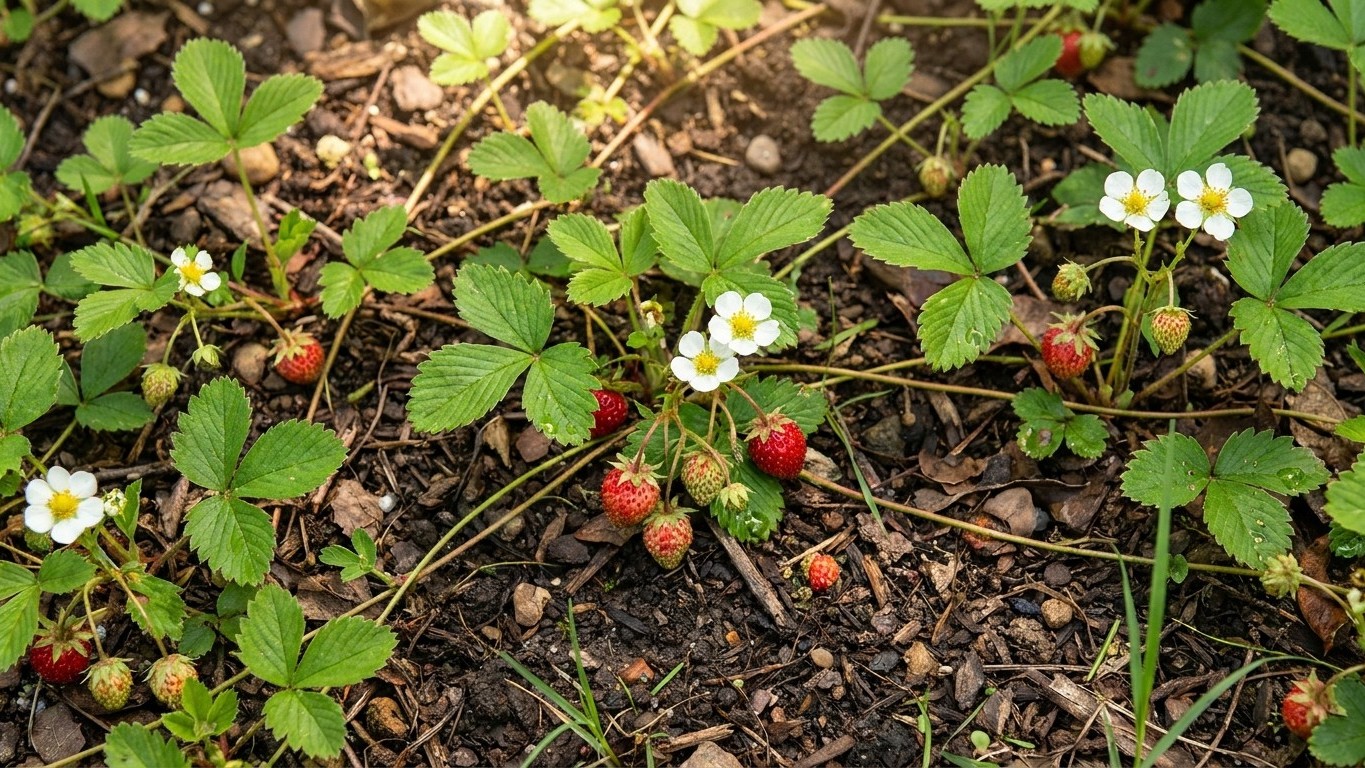

Fragaria virginiana, the wild strawberry, is hardy across USDA zones 5a-9b, tolerates full sun to partial shade, and spreads by creeping runners in loam, clay, or high-organic soil with good to moist drainage. It blooms in spring and produces small, half-inch red strawberries with a sweet-tart flavor, eaten fresh. What decides whether it actually crops for you comes down to sunlight and site, not just survival.
Where it will and will not survive
The USDA hardiness range given for Fragaria virginiana is 5a-9b. That’s a wide spread, but a hardiness range tells you where a plant can survive winter cold, not where it thrives. The honest way to use this number is to work out where it fails rather than guess where it flourishes.
Below 5a, winter temperatures routinely drop into territory this plant’s roots and crowns aren’t built to survive. Above 9b, the problem flips: not enough sustained cold, and often too much heat and humidity for a plant that evolved with a real winter dormancy. Zone lines shift with elevation, proximity to water, and microclimate, so check your specific location rather than assume.
This site keeps a hardiness zone guide broken down by state and county, and that’s the tool to use before buying. If your area lands anywhere inside 5a through 9b, this plant can survive there, a different statement from “this plant will be happy there.” A wild strawberry surviving at the warm edge of 9b is not the same as one growing at ease in a mild zone 6 or 7 spring. Heat stress, humidity, and disease pressure all climb as you move toward the top of a hardiness range, even when the plant technically lives.
One more caution: the data behind this page comes from the North Carolina Extension Gardener Plant Toolbox. The USDA hardiness figure is a national standard, but that source also carries regional growing notes specific to North Carolina that don’t transfer elsewhere. If you’re gardening outside the state, treat the 5a-9b range as the only number that travels with you, and get your local specifics from a guide built for your own region.
What it is called, and why that matters here
Two common names show up for this plant: Scarlett Strawberry and Wild Strawberry. Both are in genuine use, and the source lists them alphabetically rather than ranking one as correct.
“Wild Strawberry” is the more confusing of the two. It’s a generic, descriptive label applied loosely to more than one strawberry species growing outside cultivation, not a name exclusive to Fragaria virginiana. Someone asking a nursery for “wild strawberry” plants could walk away with a different species entirely. “Scarlett Strawberry” is more specific in feel but isn’t a widely standardized trade name either, so it doesn’t resolve the ambiguity on its own.
Neither name is wrong, exactly, they’re both names people use, and that’s the problem: two names in circulation, neither official, at least one shared with plants that aren’t this species. This page is titled by the botanical name, Fragaria virginiana, because a botanical name doesn’t drift depending on region, supplier, or local habit. If you’re buying or confirming this plant, the genus and species is the label to check against, not whichever common name happens to be on a plant tag.
The site it needs to actually crop
Fragaria virginiana tolerates a real range of conditions, but tolerating and cropping well are two different outcomes. Here’s what the source gives for site requirements:
| Condition | What the plant tolerates |
|---|---|
| Light | Full sun (6+ hours direct) or partial shade (2-6 hours direct) |
| Soil texture | Clay, high organic matter, loam/silt |
| Drainage | Good drainage, moist, occasionally dry |
| Growth rate | Medium |
| Maintenance | Medium |
| Habit | Creeping, spreading |
The light range is the clearest example of the survival-versus-yield distinction. This plant will live in partial shade, two to six hours of direct sun a day, a genuine tolerance, not a stretch. But a strawberry plant putting energy into surviving on limited light is not the same plant putting energy into flowers and fruit. Full sun is the setting for cropping; partial shade is the setting for staying alive and spreading as groundcover. The source doesn’t give a yield difference in numbers, but less light typically means less fruit, even where the plant itself is perfectly fine.
Soil and drainage are more forgiving. Clay, loam, and high-organic soils all work, and the plant handles everything from consistently moist ground to spells of dryness, a strength for groundcover use, less of a factor for fruit output.
Space, and reaching the fruit
The source doesn’t give a numeric spacing figure, but it does give the habit: creeping and spreading. This isn’t a plant that stays put in a tidy clump, it sends out runners and colonizes ground over time. The “space at maturity” question isn’t really about a fixed diameter, it’s about how much open ground you’re willing to let it claim. Plant it where spreading is welcome, a slope, a bed edge, an area you want covered, and reaching the fruit later is simply a matter of walking into the patch, since low-growing, spreading strawberries don’t put fruit out of reach the way a tree eventually does.
When it crops, and whether it needs a partner
Bloom time is listed as spring, given as a season rather than a calendar month, and that’s the right way to read it: spring bloom shifts earlier or later depending on your latitude and elevation. The practical takeaway is that this plant flowers early in the growing year relative to many other fruiting species, which means it’s more exposed to late frost. A cold snap after flowers open can damage or kill that season’s blossoms and, with them, that season’s fruit. If frost timing in your area is unpredictable in spring, factor that into siting.
Here’s where this page has to draw a firm line rather than fill a gap with a guess. Two questions matter enormously for whether a fruiting plant like this will actually bear for you, and neither is answered in the data behind this page: whether it needs a second, compatible plant nearby to set fruit, and how many years it takes to reach bearing age. Both vary enormously even within a single genus, some fruiting plants are self-fertile, close relatives sometimes need a cross-pollinating partner, some fruit within a season, others take years. Guessing based on “it’s a strawberry, so it’s probably like other strawberries” is exactly the shortcut that leads to years of waiting for fruit that was never coming.
Before buying, ask a nursery or supplier directly: does this need another plant nearby to set fruit, and roughly how long before it bears. Get a real answer on both before you plant, not an assumption borrowed from a different species in the same family.
What the fruit is, and what it is for
The source describes the fruit plainly: flowers give way to achene-dotted, ovoid fruits, the strawberries themselves, which mature to red and reach about half an inch across, with seeds embedded in pits on the fruit’s surface.
On flavor and use, the source is direct: “Wild strawberries have a sweet tart flavor.” That lines up with what anyone who has eaten a true wild strawberry would recognize, a smaller, more concentrated version of the cultivated strawberry’s sweetness, with a tart edge cultivated varieties are often bred to soften. At half an inch across, these are snacking-sized fruits, eaten fresh off the plant rather than the kind of bulk harvest you’d plan a batch of jam around. The source doesn’t specify cooking, drying, or baking uses, so the honest use case here is fresh eating.
Worth being precise: the botanical description confirms size, color, shape, and timing. It does not, on its own, tell you anything about taste, that comes only from the separate edibility note. Conflating the two is how flavor claims end up attached to plants that were only ever described visually.
What it resists, and what it does not
Resistance is a tendency, not a guarantee, a plant listed as resistant to a stress generally holds up better than average against it, not immune. That distinction matters most with the two resistances actually listed for Fragaria virginiana: drought and erosion.
| Challenge | What resistance means | What you’d see |
|---|---|---|
| Drought | Established plants tolerate dry spells better than average | Foliage holds up through short dry periods once settled in; new transplants still need regular water |
| Erosion | The creeping, spreading root system helps hold soil in place | Useful as a groundcover on slopes or bare ground prone to washing out |
The drought tolerance applies to established plants, not fresh transplants, which still need consistent watering through their first season. And a resistance list like this says nothing about pests and diseases that go after the fruit itself rather than the leaves or roots. That’s a real gap this page doesn’t have the data to fill, if fruit-specific pest pressure matters to your decision, research it separately.
Common questions
Is Fragaria virginiana the same as store-bought strawberries?
No. It’s the wild species, distinct from the large cultivated strawberries sold commercially, which are bred hybrids. The fruit here is smaller, about half an inch across, with a sweet-tart flavor.
Does it need full sun to produce fruit?
It survives in partial shade, but full sun favors better cropping. Partial shade keeps the plant alive; it’s not the setting associated with heavier fruit production.
Will it take over a garden bed?
Its habit is listed as creeping and spreading, so yes, it colonizes ground over time through runners, an asset for groundcover use and a drawback if you want it contained.
Can I grow it if I’m right at the edge of zone 9b?
The plant can survive there, since 9b is within the given range, but the top of a hardiness range is about survival, not comfort. Confirm your exact zone using a dedicated hardiness zone guide before planting.