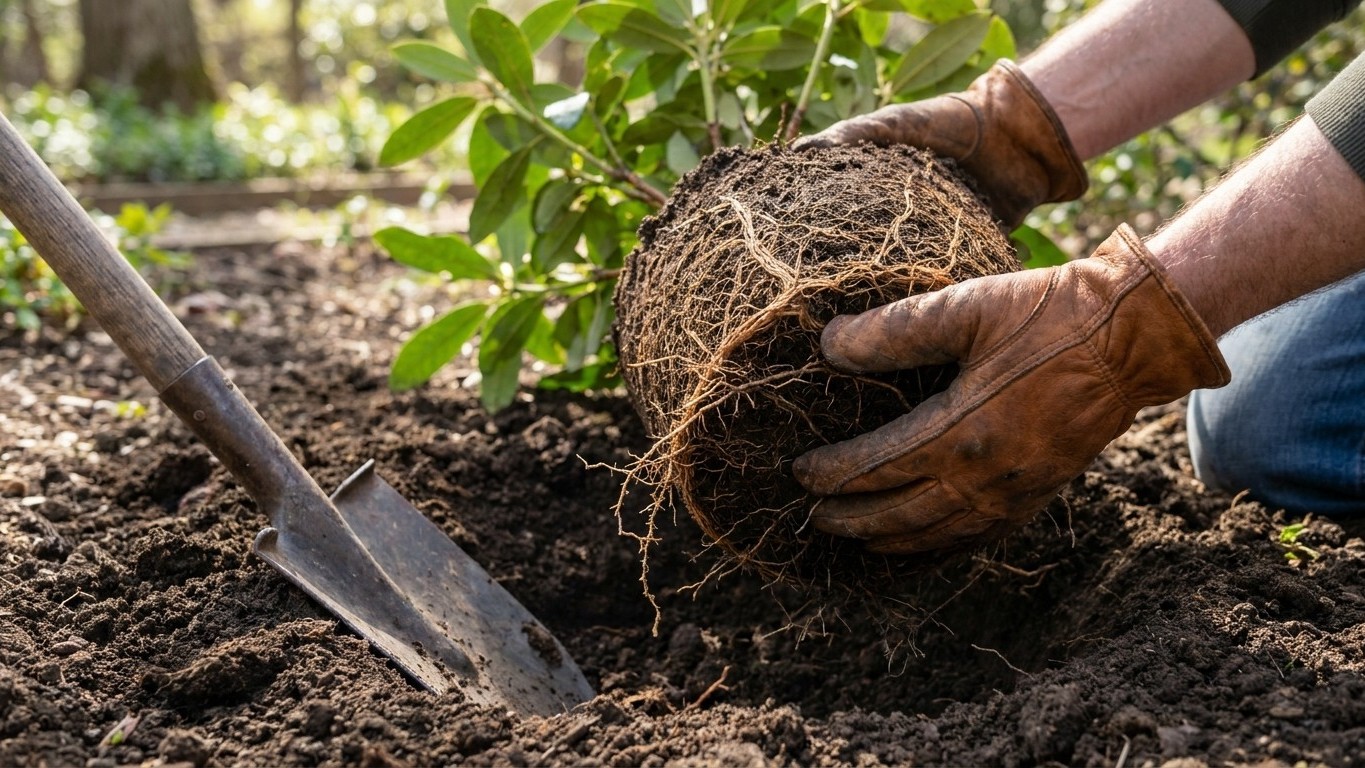

Moving an established shrub means digging the new hole first, cutting the cleanest possible root ball while the plant is dormant, resetting it at the same depth it grew before, and watering it like a new plant for a full year afterward. Small, young, fibrous-rooted shrubs usually survive this well. Large, old, or taprooted specimens often don’t, and for those, buying new stock is usually the better outcome.
You are leaving most of the roots behind
A shrub’s root system reaches well past the edge of its canopy, spreading sideways far more than it goes down. Most of the fine feeder roots, the ones actually pulling in water and nutrients, sit in the outer, upper layer of soil. No shovel captures that whole system. A root ball a person can lift and carry represents a small slice of what was actually feeding that plant a day earlier.
That gap is why transplant shock exists. The top of the plant still wants to support the same canopy it had before the move, using a fraction of the plumbing that used to supply it. The plant spends its first season trying to grow enough new roots to catch up to the demand its top growth places on it. Until that happens, it’s running a deficit.
This is also why size matters so much in whether a move succeeds. A young shrub has a compact, still-developing root system, so a larger share fits inside a diggable root ball, and the deficit after transplanting is smaller. An old, well-established shrub has spent a decade or more building a root system sized for its current canopy, and a shovel only reaches the inner portion of that. The bigger and older the plant, the worse the ratio, and the longer and shakier the recovery.
Why watering becomes the whole job
Because the root system is undersized for the plant it has to support, the single biggest thing an owner can do afterward is keep water available exactly where the remaining roots are, consistently, without letting that zone dry out or stay soggy. Fertilizer doesn’t fix a root deficit, and pruning the top doesn’t either. Water does, because it buys the plant time to grow the roots it’s missing.
When to move it
The right window for moving a shrub isn’t a date on a calendar, it’s a condition: the plant should be dormant or close to it, and the soil should be workable rather than frozen solid or waterlogged. Moving it while it’s resting gives the truncated root system a head start on rebuilding before it’s asked to support foliage, flowers, or summer heat.
Because dormancy timing shifts by region, the actual dates to work around come from local frost information rather than a generic month. The frost dates listed on your state’s page are what should set your calendar here. A state that stays cold well into spring has a longer, later dormant window; a state with a short, mild winter has a narrower, earlier one. There isn’t one national answer.
What makes a bad moment to move a shrub
Two conditions consistently produce trouble:
- Full leaf during summer heat: the plant is already under maximum demand from its canopy, and cutting its roots at that moment stacks a fresh injury on top of the heaviest workload of its year.
- Frozen ground: it’s not just hard to dig. A root ball pulled from frozen soil tends to shatter along ice lines instead of holding together, destroying exactly the roots the move depends on.
Between those two extremes sits the dormant window your state’s frost dates point to: soil workable enough to dig a clean, intact root ball, air cool enough that the plant isn’t fighting heat and leaf demand at the same time.
The move itself
Once the timing lines up, the sequence of the move matters almost as much as when it happens. Skipping a step, or doing them out of order, is where otherwise healthy shrubs end up struggling months later.
- Water the shrub deeply a few days beforehand. Roots hold together better, and are less likely to snap during digging, when the soil around them is evenly moist rather than dry and crumbly.
- Prepare the new hole before touching the old one. A root ball out of the ground is a plant on the clock, and every extra minute exposed to air and sun works against it. NC State Extension describes an ideal planting hole as “only as deep as the root ball and at least two to three times wider, with roughened sides sloping in toward the bottom.” The depth is a limit, not a target, since a hole dug too deep lets the plant settle below grade. The width is a minimum, since loosened soil beyond the root ball gives new roots somewhere easy to spread into. The roughened, sloping sides matter because smooth walls left by a shovel in clay soil act like the inside of a pot, and roots that hit that wall tend to circle instead of pushing outward.
- Cut a clean root ball rather than tearing one loose. A sharp spade worked in a steady circle severs roots cleanly, which heals faster than ragged, torn ends. Move as much intact root as the plant and the job allow; more roots kept together and undamaged beats fewer.
- Keep the root ball together, shaded, and damp in transit. A tarp or burlap wrap holding the soil against the roots, kept out of direct sun and wind, prevents fine feeder roots from drying out before they reach the new hole.
- Plant at the same depth, using the root flare as the guide. The point where the trunk widens into roots should sit right at soil level, exactly as it did in the old spot. Planted too deep, that flare gets buried and starts the plant toward rot and poor root growth.
- Water deeply immediately after planting. This settles soil around the roots, closes air pockets, and gives the shrub its first real drink in its new home.
The year after
Aftercare is where transplants are actually won or lost, more than the digging or the timing. The first season is entirely about supporting a root system smaller than the canopy it has to feed.
Watering deeply and infrequently beats a quick daily sprinkle, since it encourages roots to grow down and out searching for moisture rather than staying shallow. For a full guide to how much and how often through a first season, the watering guide on this site covers it in more detail.
Mulch does real work here, but only within a specific range. NC State Extension notes that “a 2-inch to 3-inch layer of mulch suppresses most annual weed seeds and makes it easy to hand-pull any that do germinate,” and separately, for trees, that a “3-inch layer of mulch” reduces water loss and keeps soil moisture and temperature steady around the roots. More is not better: piling mulch deeper than that range is how a flat ring turns into a mounded volcano against the trunk. Just as important is keeping mulch pulled back from the plant itself: “Pull mulch 6 inches away from the base of plants to prevent bark decay and vole damage.” Trapped moisture against the trunk invites rot, and in winter, rodents tunneling under a mulch blanket can girdle bark unnoticed until spring. The base of the trunk or main stems should be plainly visible, not buried under mulch.
Skip fertilizer in that first season. A newly transplanted shrub can’t supply a growth spurt above ground when its root system is still catching up below it, and pushing top growth it can’t support just widens the deficit. For the same reason, resist the old advice to prune the top “to balance the roots”, that removes exactly the leaves the plant needs to rebuild the roots it’s missing.
If the shrub needed staking to stay upright after the move, that staking has a shelf life. NC State Extension advises removing “all staking within one year after planting or growth may be reduced,” and adds that for shrubs and trees planted in fall, “it may be possible to remove stakes…by midspring.” One year is a ceiling, not a target. A plant that stands mostly still through its first year isn’t failing, it’s spending its energy where it’s needed, underground.
Common questions
How do I know if a shrub is too large to transplant successfully?
Size at maturity and root habit vary by species, and that information lives on each plant’s own page on this site rather than here. As a general rule, older and larger shrubs have a much smaller share of their total root system inside a diggable root ball, which makes recovery slower and less certain the bigger the plant has grown.
Can I transplant a shrub while it still has some leaves on it?
It’s far riskier than moving one that’s fully dormant. A shrub in leaf is actively demanding water and nutrients from roots that are about to be cut back sharply, and doing that during summer heat compounds the stress. Waiting for the dormant window indicated by your state’s frost dates gives far better odds.
Do root stimulants or transplant sprays actually help a moved shrub recover?
There’s no solid evidence backing specific products in that category, and none is named or recommended here for that reason. The steps with documented effect are the mechanical ones: an intact root ball, correct planting depth, appropriate mulch depth, and consistent deep watering through the first year.
Should I remove the burlap or wrapping around the root ball before planting?
The root ball should go into the new hole with as little disturbance to its roots as possible, and any wrapping used only to hold soil together during the short move should be pulled away at planting time rather than left buried, since it can interfere with roots spreading into the surrounding soil.