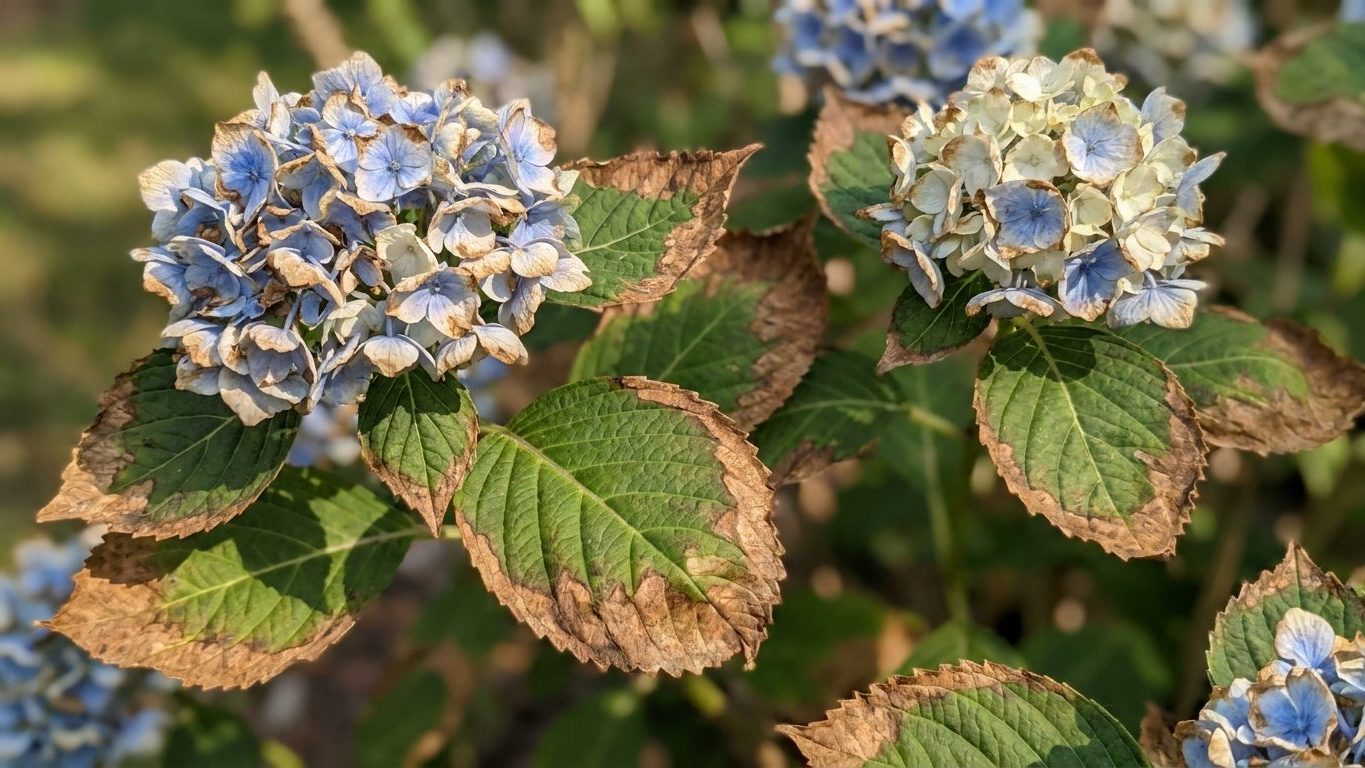

Brown edges on hydrangea leaves and flowers usually point to one of three things: environmental scorch from heat, wind, or inconsistent watering; salt or fertilizer burn; or a fungal leaf spot disease. On flowers, especially panicle types, browning at the edges is often just the bloom aging naturally as summer turns to fall, not a problem at all.
Why this matters
Brown edges are a symptom, not a diagnosis, and treating the wrong cause wastes a season. Spray a fungicide on a plant that’s simply scorched from afternoon sun and nothing improves, because the leaf tissue was never infected. Water more on a plant already sitting in soggy clay and you push it toward root problems that show up as browning on a delay, weeks after the real damage was done.
Misreading the signal also affects next year’s flowers. Bigleaf, oakleaf, mountain, and climbing hydrangeas all set their flower buds on the previous summer’s wood. If browning triggers a reflex prune at the wrong point in the plant’s cycle, you can cut off buds that were already formed and lose an entire season of bloom. And if you’re cutting back damaged growth on a bigleaf plant, know that its bark, leaves, flowers, and stems are documented as toxic in large quantities to people, cats, dogs, and horses, so debris shouldn’t sit where pets browse.
When to do it
Check for scorch during stretches of high heat, dry wind, or after a lapse in watering, since shallow-rooted types like bigleaf and panicle hydrangeas dry out fast without mulch. If browning shows up on new spring growth specifically, suspect a late cold snap rather than disease. If it shows up on older, interior leaves after a stretch of wet, humid weather, that pattern fits fungal leaf spot instead.
On flowers, timing tells you almost everything. Panicle hydrangea blooms shift from white through pink and tan as they age on the plant, and that color change often includes browning at the petal edges late in the season, which is normal senescence, not a defect. Bigleaf and mountain hydrangea flowers browning early, before they’ve had a chance to fully open, is a different story and worth investigating rather than dismissing.
Watch after any fertilizer application too. Burn from over-application or from feeding during a dry spell tends to appear within one to two weeks, as a crisp, uniform margin browning across many leaves at once rather than isolated spots.
How to do it
Start by reading the pattern, not just the color. A uniform, crisp brown margin on many leaves across the whole plant, with no spots inside the leaf, almost always means scorch, salt buildup, or fertilizer burn. Distinct brown or tan spots with defined edges, sometimes ringed, scattered irregularly across leaves of different ages, point to leaf spot disease. Whole branches wilting and browning together suggest bacterial wilt. A powdery white coating alongside browning tissue is powdery mildew. On panicle hydrangea specifically, streaked or mottled discoloration can be rust, and buds that brown and fail to open are consistent with bud blight.
| Pattern observed | Likely cause | What to do |
|---|---|---|
| Uniform crisp margin, many leaves | Scorch, salt, or fertilizer burn | Adjust watering and feeding; check sun exposure |
| Distinct ringed spots, scattered | Leaf spot | Remove and dispose of affected leaves, improve airflow |
| Whole branches wilting and browning | Bacterial wilt | Prune out affected wood, sanitize tools |
| White powdery film plus browning | Powdery mildew | Increase spacing and airflow, water at soil level |
| Streaked/mottled foliage (paniculata) | Rust | Remove affected leaves, avoid overhead watering |
Once you’ve matched a pattern, act on the cause rather than the leaf. For scorch and salt burn, water deeply and less often rather than a quick daily sprinkle, since both bigleaf and panicle hydrangeas are shallow-rooted and benefit from a two- to three-inch mulch layer that buffers soil moisture and temperature. If fertilizer burn is likely, stop feeding for the rest of the season and, if the plant is in a container, flush the soil with plain water to move salts past the root zone.
For leaf spot, rust, or bud blight, remove the affected foliage and bag or trash it rather than composting it, since fungal spores can survive and spread from a home compost pile. Water at the base of the plant instead of overhead, ideally in the morning so any leaf surface that does get wet has time to dry before evening. Space plants and prune out crowded interior growth to improve airflow, which is the single biggest factor in whether fungal disease returns the following year.
If you need to prune out damaged wood on a bigleaf, oakleaf, mountain, or climbing hydrangea, do it with the plant’s own timing in mind, not the calendar, since these types carry next year’s flower buds on the current wood. Panicle and smooth hydrangeas are more forgiving because they flower on new growth each season, so removing damaged stems doesn’t cost you next year’s blooms in the same way.
What goes wrong
The most common mistake is treating every brown edge as disease and reaching for a fungicide when the real cause is environmental. Fungicides do nothing for scorch or salt burn, and repeated unnecessary spraying doesn’t help the plant recover any faster.
The mistake that looks like extra care but isn’t: watering more in response to browning. If the actual problem is a shallow root system sitting in poorly drained soil, additional water compounds the stress instead of relieving it. Check drainage and soil moisture at root depth before assuming the plant is thirsty.
Another frequent error is panicking over aging panicle flowers. Those blooms are supposed to shift color and pick up brown tones as the season winds down, and cutting them off early because they look “off” just means losing weeks of interest in the landscape for nothing. On the color-and-feeding side, a well-meaning switch to a high-phosphorus fertilizer to “boost blooms” locks up available aluminum in the soil, which pushes blue bigleaf or mountain flowers toward pink, a color shift that gets misread as a health problem when it’s really a feeding decision.
Kitchen remedies deserve a plain answer here too: adding coffee grounds or citrus peel is widely believed to acidify soil enough to change flower color, but the pH shift from grounds alone is small, and what actually moves color is available aluminum, which reliable acidification releases. If browning or color change is the concern, a soil test tells you more in one step than months of adding grounds to the mulch.
Doing it differently
Container-grown hydrangeas dry out and accumulate fertilizer salts faster than those in the ground, so browning tied to watering or feeding shows up sooner and needs a quicker fix, usually a plain-water flush through the pot’s drainage holes. Raised beds with a sandy or amended mix drain well but can also dry out fast in heat, so mulch and moisture checks matter more than they would in dense clay.
Greenhouse or heavily sheltered growing tends to raise humidity around the foliage, which favors leaf spot and powdery mildew more than scorch, so airflow and spacing become the priority over sun protection.
Variety matters as much as growing method. Panicle hydrangea is the only type in the genus that takes full sun well, so scorch from sun exposure is far less likely on it than on bigleaf, which needs dappled or partial shade and afternoon sun protection to avoid margin burn in the first place. Oakleaf hydrangea turns a wine-red in autumn as part of its normal fall color, and that shift shouldn’t be confused with disease-related browning on other types growing nearby.
Common questions
Is brown edging on hydrangea flowers always a sign of a problem?
No. On panicle hydrangea especially, blooms naturally shift from white to pink to tan as the season progresses, and browning at the petal edges is part of that aging, not damage.
Can I compost hydrangea leaves with brown spots?
It’s better not to. If the spots come from leaf spot or rust, the fungal material can survive in a home compost pile and spread back into the garden. Bag and trash affected leaves instead.
Will more water fix brown, crispy leaf edges?
Only if underwatering is the actual cause. If the soil is already wet at root depth, adding more water worsens root stress rather than helping, so check moisture before increasing irrigation.
Does pruning off brown foliage hurt next year’s blooms?
It can, on bigleaf, oakleaf, mountain, and climbing hydrangeas, since they set flower buds on the current wood for the following year. Panicle and smooth hydrangeas flower on new growth, so removing damaged stems doesn’t carry the same risk.