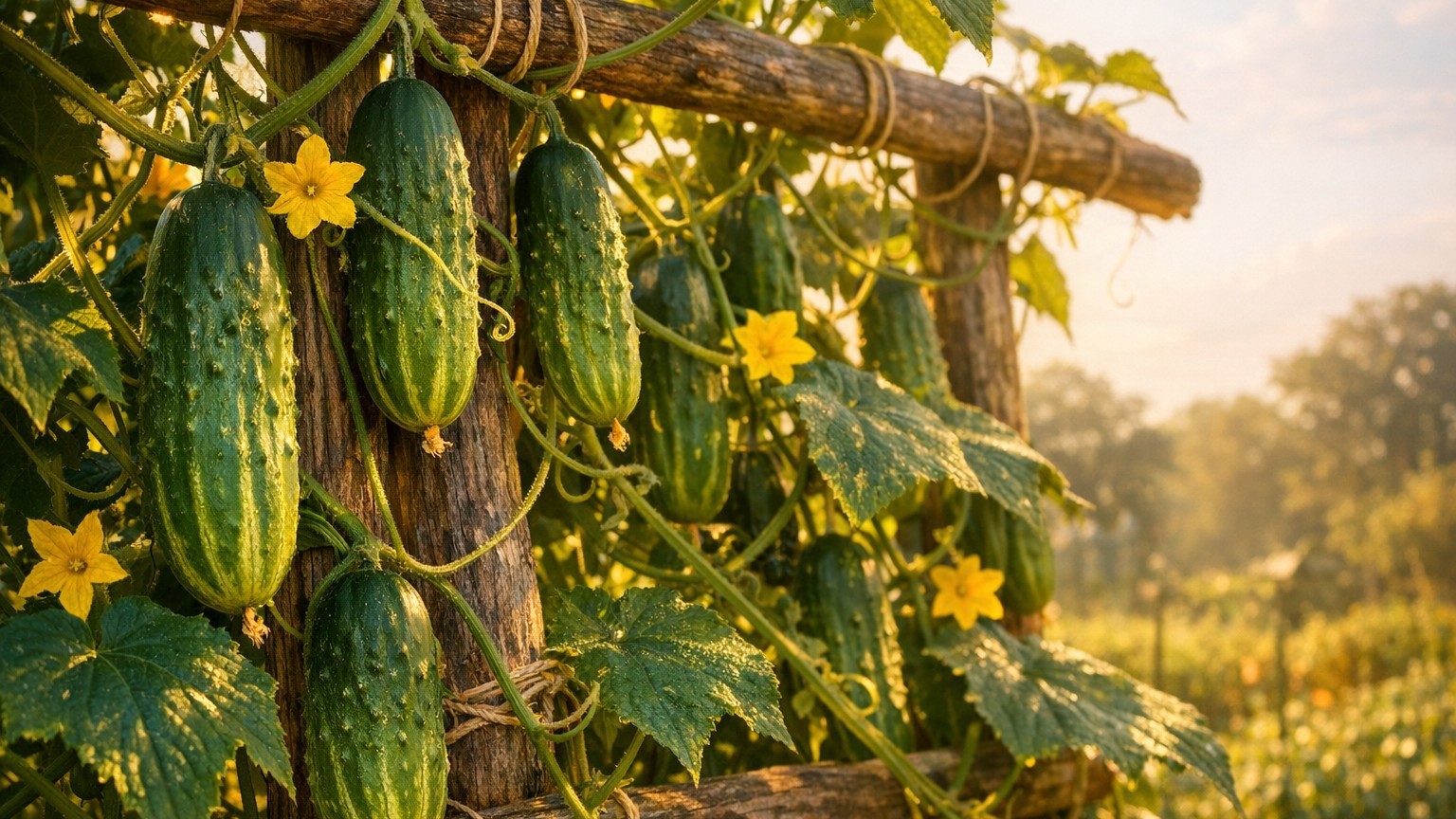

Alabama’s long, hot growing season favors heat-tolerant, disease-resistant cucumber types over anything bred for cooler, drier climates. Pickling and slicing types with strong resistance to foliar disease do best on a trellis, where airflow cuts down the humidity that ruins so many vines here. Parthenocarpic and burpless types are worth a look for gardeners fighting inconsistent pollination in the hottest stretch of summer.
The short answer for Alabama
Start with the calendar. At the reference station used for these normals, the last spring frost falls between March 19 and April 3, and the first fall frost arrives between November 2 and November 16. That’s a frost-free window stretching well past seven months in a typical year, longer than most cucumber types need to produce a full harvest. Season length is not the limiting factor here. Heat and humidity are.
The same station logs an average of 58.5 days a year at or above 90°F. That’s the number that should drive variety choice, not the frost dates. A cucumber vine stalls its fruit set once daytime heat climbs into that range for days on end, and flowers can drop before they’re pollinated. That pushes the decision toward types bred or trialled for heat tolerance and toward parthenocarpic varieties, which set fruit without relying on bee visits during the exact week pollinators may be scarce.
Summer rainfall adds the second pressure. June, July and August bring about 12.1 inches combined, with August the driest of the three at 3.55 inches. That’s not a drought, but it’s rain that tends to fall in heavy, humid bursts rather than steady soaks, and the humidity between storms is what feeds powdery mildew and downy mildew on cucumber foliage. This is where variety selection matters as much as the calendar: types carrying resistance to those two diseases, and to bacterial wilt spread by cucumber beetles, hold their leaves and their yield far longer into a humid Alabama summer than types with no resistance bred in.
Put those three facts together and the decision by type looks like this: choose a disease-resistant slicing or pickling type, grow it vertically on a trellis or cage rather than sprawled on the ground, and consider a parthenocarpic or burpless type if heat-driven pollination gaps have been a problem in past seasons. Bush types suit containers and small raised beds where trellising isn’t practical, but they sit closer to the soil and closer to the humidity that breeds disease, so they need a bit more vigilance. For the specific cultivars trialled and recommended county by county, that call belongs to the Alabama Cooperative Extension System, not to a page written at the state level.
What will not work here

Long-season European greenhouse cucumber types, the kind bred for low humidity and controlled airflow, struggle outdoors in Alabama almost every year. They weren’t selected against downy mildew or bacterial wilt, and a summer with 58.5 days above 90°F paired with humid, storm-driven rainfall is exactly the environment they were never asked to tolerate. A gardener who orders one because it looked productive in a seed catalog photographed in a cooler climate is usually disappointed by July.
Watering on a weekly schedule fails here too, and the rainfall numbers explain why. Averaging 12.1 inches across June through August sounds like plenty, but that rain arrives as thunderstorms that dump an inch or more in an hour, run off a clay slope or a compacted bed, and leave the root zone dry again within two or three days once the heat resumes. A cucumber vine under 90°F-plus heat loses moisture fast through its broad leaves, and a once-a-week watering habit built for a milder climate leaves the plant stressed between storms, which is exactly when blossom drop and bitter fruit show up.
Planting cucumbers close together directly on bare soil, a common shortcut in cooler, drier regions, invites trouble in Alabama’s humid summer. Vines sprawled on the ground trap moisture at leaf level overnight, and that trapped humidity is the single biggest driver of the powdery and downy mildew that shortens the productive life of a cucumber patch here. Vertical growing on a trellis, cage, or fence isn’t a cosmetic choice in this state. It’s the difference between a vine that produces into September and one that collapses by late July.
Treating the frost-free window as one long, uninterrupted harvest is another miscalculation. Cucumber beetle pressure and the bacterial wilt they spread tend to build through the season, and a single spring planting often shows visible decline by the height of summer even where disease resistance was bred in. A garden that plans on one planting to carry seven months of frost-free weather is planning around the calendar and ignoring the pest and disease pressure that actually determines how long a stand of cucumbers keeps producing.
What changes across Alabama
Alabama spans USDA Plant Hardiness Zones 7a to 9a, and that range on its own tells you there is no single cucumber calendar for the whole state. A zone spread that wide, built from the average annual extreme minimum temperature, reflects real differences in winter cold, and those differences track closely with differences in spring warm-up, summer heat load, and the length of the disease-pressure season a cucumber vine has to survive.
| Region | General zone position | What shifts for cucumber growers |
|---|---|---|
| North Alabama (near the reference station) | Toward 7a | Cooler nights, a later soil warm-up in spring, frost dates closest to the March 19–April 3 and November 2–16 figures cited here |
| Central Alabama | Mid-range, roughly 8a | Earlier spring warm-up, a longer stretch of 90°F-plus days than the north, more pressure to trellis for airflow |
| South Alabama, Gulf Coast counties | Toward 9a | Frost risk drops off earliest in spring and returns latest in fall, but humidity and heat load run highest, favoring disease resistance above all else |
A gardener in the state’s higher elevations, in the northeastern counties where the terrain climbs toward the Appalachian foothills, should expect the spring frost to linger later than the reference dates and the fall frost to arrive earlier, sometimes by a week or two beyond what the airport station shows. That’s a real shift in the sowing window, not a rounding error, and it argues for holding off transplants a bit longer than a gardener in the warmer river valleys or along the Gulf Coast would need to.
None of this replaces a local check. The zone range given here describes the whole state, not any one reader’s own yard, and the only way to know which end of that 7a to 9a spread applies to a specific piece of ground is to look it up rather than guess from a regional description.
Where to check this for your own county
The Alabama Cooperative Extension System, at aces.edu, publishes county-level guidance that this state-wide page cannot replace. Every county extension office serving Alabama works from local trial data and local soil and disease pressure, and that’s the level at which a cucumber recommendation actually becomes reliable.
Two things are worth pulling up specifically once there. First, the local planting calendar for the county in question, which will reflect the real frost pattern for that spot rather than the airport-station figures used as the state reference here. Second, the list of cucumber varieties actually trialled in Alabama conditions, including which ones showed the strongest resistance to downy mildew, powdery mildew, and bacterial wilt in university test plots. Extension trial data carries far more weight than a seed catalog description, because it’s tested against the same heat load and humidity a home garden in that county will face.
A county recommendation beats a state one every time, and that’s not a knock against this page. It’s simply what a page written at the state level can and can’t do. This article can tell a reader in Alabama that heat load and humidity matter more than season length, and that disease resistance and vertical growing solve most of the state’s cucumber problems. It can’t tell a reader in a specific county which named variety performed best in that county’s own test plots last season. That answer lives with the local extension office, updated with fresh trial results as new varieties come through.
Checking this against your own garden
Every figure on this page is a normal, an average built from thirty years of data at one weather station. A reader’s own garden will run ahead of or behind those normals depending on soil, slope, and shelter, and three simple observations settle the question better than any date on a calendar.
- Soil warmth by feel: cucumber seed germinates poorly in cold soil no matter what the calendar says. Pressing a hand into the planting bed and feeling it consistently warm, not just sun-warmed on the surface but warm an inch or two down, is a better signal than counting days from the frost date.
- The first flush of male flowers: cucumber vines typically open a run of male flowers before the first females appear, and that’s normal, not a sign of a problem. Watching for the females, which show a tiny swollen cucumber shape behind the petals, is what actually tells a gardener that fruit set is beginning.
- The first true leaves: the rounded seed leaves that emerge first aren’t the plant’s real foliage. Watching for the first set of jagged, vine-shaped true leaves shows whether the plant is settling in well for the local conditions or struggling against a cold snap or waterlogged soil that the calendar alone wouldn’t reveal.
Taken together, these three signs tell a gardener more about their own microclimate, their own soil, their own patch of shade or exposure, than any state-wide frost date or heat normal ever could. The numbers in this article describe Alabama in general. The plant in front of a reader describes their own yard.