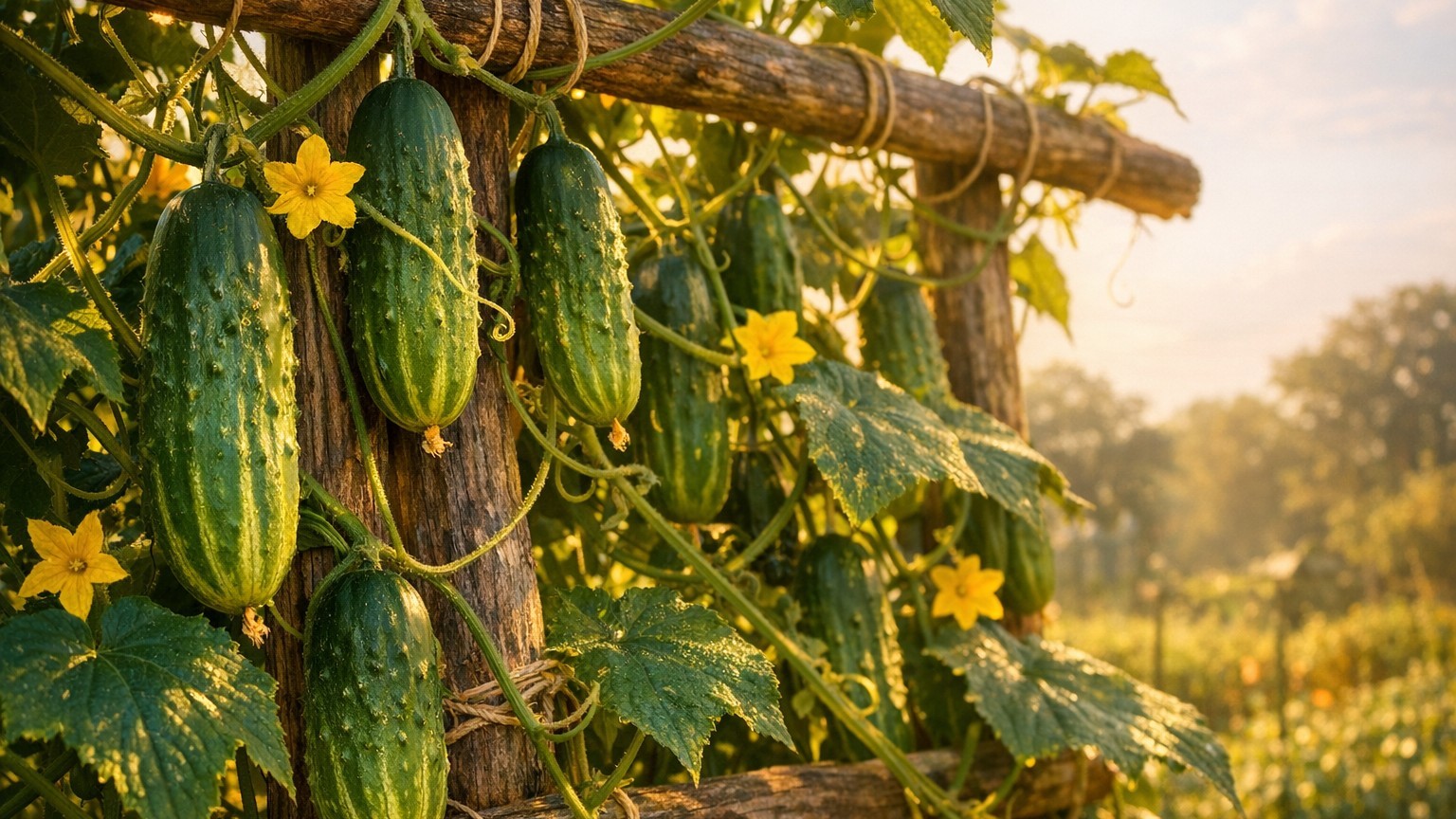

Short-season pickling types and compact bush or parthenocarpic greenhouse cucumbers are the realistic choices for Alaska. The state’s frost-free window averages about 143 days at its mildest station, and even there summer never reaches 90°F, so cucumbers need a head start indoors, a cover over them outside, or a spot under glass to produce anything worth picking.
The short answer for Alaska
Start from the numbers, because they decide everything else. At the reference station used for these normals, the last spring freeze falls between May 3 and May 12, and the first fall freeze arrives between September 22 and October 1. That gives roughly 143 frost-free days in an average year, and this is Anchorage, one of the mildest inhabited parts of the state. The Interior and points north run shorter, sometimes far shorter.
Cucumbers are tropical in origin. They stop growing below about 50°F and die outright at frost. A 143-day window sounds workable until you notice the second number: zero days a year reach 90°F at this same station. Cucumbers like warm soil and warm air to germinate and set fruit quickly; Alaska offers a long season of mild, cool days rather than a short season of hot ones. The plant gets time but not heat.
That combination points toward three practical types rather than any single named variety. Fast-maturing pickling cucumbers tend to finish sooner than large slicing types, which matters when every week of the season counts. Bush cucumbers stay compact enough to grow in a raised bed, a large container, or a cold frame that can be moved or covered on a cold night. Parthenocarpic cucumbers, which set fruit without pollination, are worth knowing about because they were bred for greenhouse production in short-season, low-light climates not unlike much of Alaska, and they remove the uncertainty of whether pollinators will find the flowers in a cool, short summer.
None of these are variety names this page can hand you. What a gardener actually plants should come from a trial list for their own district, not a generic national seed rack. The University of Alaska Fairbanks Cooperative Extension Service tracks which pickling, bush, and greenhouse types have actually produced in Alaska conditions, and that list changes as breeders release new short-season stock. The type comes from the climate; the specific seed packet comes from the extension trial.
What ties all three types together is that they are almost always started indoors under lights four to six weeks before the last frost date, then transplanted out after the risk of frost has passed, or grown the whole season under some form of cover. Very few Alaska gardeners direct-seed cucumbers into open ground and expect a crop.
What will not work here

Long-season vining slicing cucumbers bred for hot, humid states are the clearest mismatch. Many of the large slicers sold in national catalogs were selected for regions with weeks of 90°F-plus heat driving rapid growth. Alaska supplies none of that heat load, ever, at the reference station used here. A vine that needs a hot July to size up its fruit will spend the whole Alaska summer sulking in cool soil, and the first fall freeze, arriving as early as September 22, can close the season before the plant has caught up.
Direct-seeding into open ground without any cover is the second failure. With the last spring freeze landing anywhere from May 3 to May 12, a seed sown at the earliest safe date still faces cool soil for weeks afterward. Cucumbers germinate slowly in cold soil and can rot before they sprout. Gardeners who wait for guaranteed warmth before direct-seeding are often sowing into June, and June is already the driest month of summer here, averaging just 1.02 inches of rain against 1.82 in July and 2.93 in August. A seedbed that dries out in a low-rain month with no heat to trigger fast germination is a rough start twice over.
Relying on outdoor pollinators for a non-parthenocarpic vining type is a third weak point. Cool, short summers mean fewer active pollinator-days than warmer states get, and a cucumber that depends on bees moving pollen from male to female flowers can end up with blossoms that never set fruit, especially early and late in the season when temperatures dip.
Dense, sprawling growth on bare ground is the fourth mismatch, and it runs the opposite direction from what gardeners in hot, dry states worry about. August here brings the wettest month of summer, nearly 3 inches on average, and fruit or foliage sitting on damp ground for that long invites rot and fungal disease. Trellising or growing in raised beds keeps leaves and fruit off wet soil and improves airflow, which matters more in a cool, damp August than in a hot, dry one.
Finally, skipping season extension altogether does not work. Whether it is a cold frame, a row cover, a high tunnel, or a small greenhouse, some form of protection is what turns a marginal 143-day window into a working one, because it buys extra warm hours on either end of the season that the open air simply does not provide.
What changes across Alaska
Alaska is not one climate wearing one name. The USDA Plant Hardiness Zone Map places the state across zones 1a to 8a, the widest spread of any territory in the country, built from average annual extreme minimum winter temperatures. That range alone tells you there is no single planting answer for Alaska; a coastal garden and an Interior garden are not really the same growing project.
South and coast versus Interior and north
The frost dates and heat figures used above come from a station representing one of the milder, more populated parts of the state. Southcentral and parts of the Southeast panhandle sit toward the warmer end of Alaska’s zone range, with maritime air moderating both winter lows and summer highs. The Interior, by contrast, runs colder winters and often a shorter frost-free stretch, even though long summer daylight there can push plant growth hard during the weeks it does have. Farther north and at higher elevations, the season compresses further still, and greenhouse or high-tunnel growing stops being optional and becomes close to the only realistic path to a harvest.
A gardener anywhere in this state should treat the numbers in this article as describing the milder end of Alaska’s spectrum, not their own backyard. If the local zone runs colder than the reference station used here, expect a shorter frost-free window, a later safe transplant date, and an earlier need to bring plants under cover in fall. None of that changes which types of cucumber make sense (fast pickling types, bush habits, parthenocarpic greenhouse types still lead), but it does change how much of the season needs to happen indoors or under protection versus in open beds.
This page will not tell an individual reader which of Alaska’s zones they garden in. The USDA hardiness zone map is built for exactly that lookup, by address or ZIP code, and it takes a minute to check.
Where to check this for your own county
Everything above describes Alaska in general, anchored to one reference station. A state this size, spanning seven hardiness zones, cannot have one planting calendar that fits every garden, and this page has not tried to invent one. The place built to answer that question is the University of Alaska Fairbanks Cooperative Extension Service, at uaf.edu/ces.
Two things are worth looking for once there. First, a local or district-level planting calendar, since Alaska’s extension work is organized around district offices that reflect real local conditions rather than a single statewide date. Second, and more valuable, a list of cucumber varieties actually trialled in Alaska gardens or greenhouses, updated as new short-season and parthenocarpic types come onto the market. That list is where a gardener finds the actual variety names this page deliberately did not invent.
A county or district recommendation beats a state-level one every time, for a simple reason: extension agents test what actually fruits in their district’s soil, daylight, and microclimate, while a page like this one can only work from the broad normals for a single reference station. Treat this article as the wide-angle view: the frost dates, the heat load, the rainfall pattern, the reasoning behind choosing a type of cucumber. Treat the extension office as the close-up: the specific seed packet that has actually produced a harvest two counties over from where you garden.
If a district office does not have a cucumber-specific calendar posted, a call or email to the local extension agent is normal practice, and often faster than searching. Master Gardener volunteer programs run through the same extension system and are another route to district-level, tested advice.
Checking this against your own garden
Dates and averages get a gardener close, but the garden itself has the final word. Three things to watch, using nothing more than hands and eyes, tell you more about your own microclimate than any calendar.
Soil warmth by feel is the first. Push a bare hand a couple of inches into the bed where cucumbers are meant to go. If it still feels cold rather than cool, the soil has not caught up to the calendar yet, whatever the frost date charts say, and transplanting now risks stalled or rotting roots.
The first flush of male flowers is the second signal. Cucumbers typically produce a run of male blossoms before the female flowers, which carry the tiny swelling at their base that becomes the fruit, appear. Seeing males open tells you the plant has settled in and is moving toward fruiting; if females never follow on an open-pollinated type, that is a cue pollinator activity may be too low, and worth a note for next year’s variety choice.
The first true leaves are the third. The rounded seed leaves that appear first are not the real signal; the jagged, characteristically cucumber-shaped leaves that follow show the plant has moved past its most fragile stage. A garden that reaches true leaves earlier than the district average suggests a warmer-than-typical microclimate, maybe a south-facing wall or a sheltered raised bed, worth exploiting with a slightly earlier start next year.