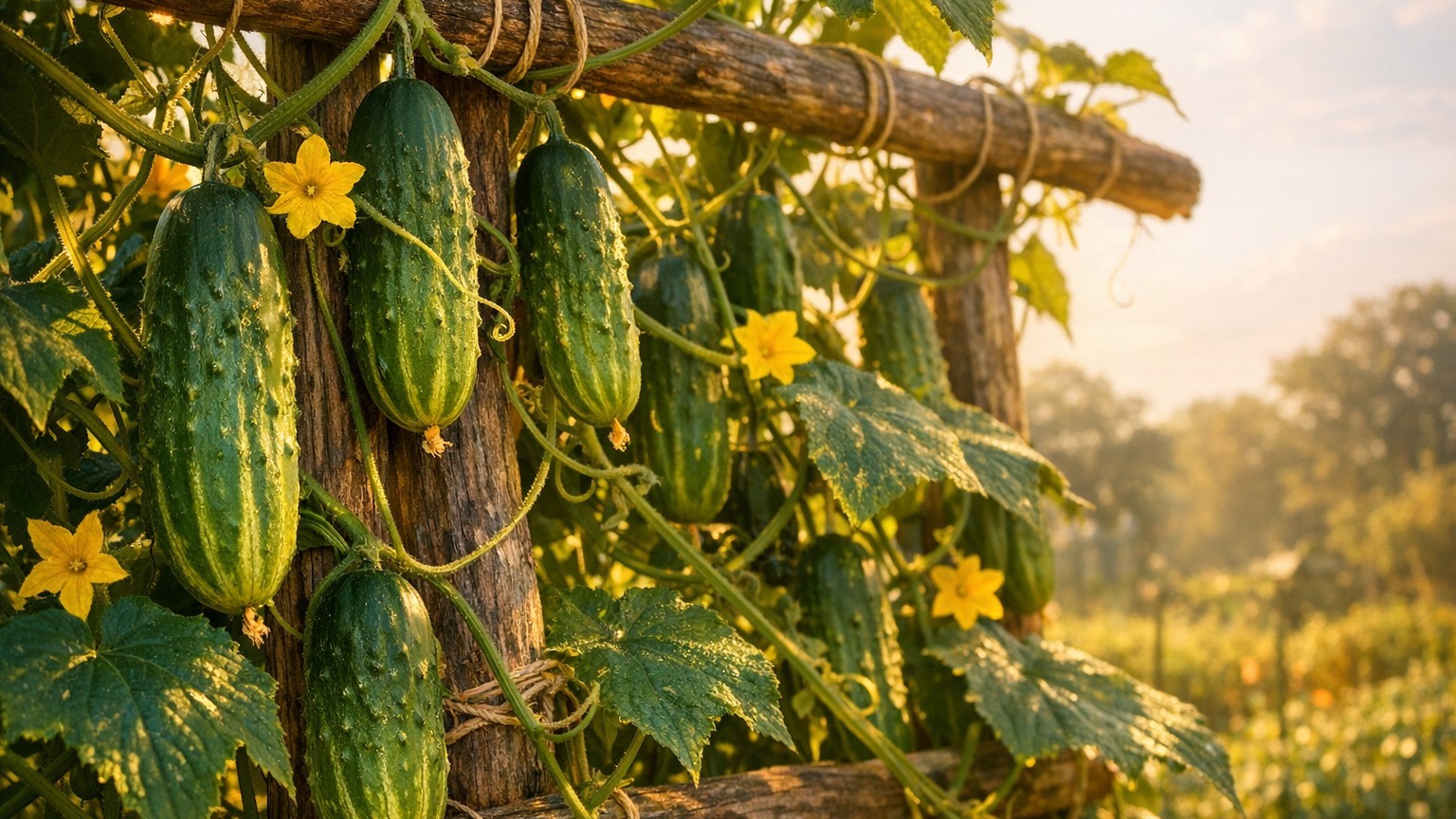

For most of Alberta, bush and pickling-type cucumbers beat long-season vining slicers, because the region’s frost-free window runs a lean course and summer heat rarely climbs high enough to push a slow variety along. Parthenocarpic types grown under row cover or in a cold frame add real insurance against a season that starts and ends earlier than a seed packet assumes.
The short answer for Alberta
Choose compact, fast-to-bear types over anything bred for a long, hot growing season. That’s the decision, and it comes straight from two numbers on the books for this province’s reference station at Calgary: an average last spring frost of May 21 and an average first fall frost of September 16. Count the days between those two dates and you get a season that sounds workable on paper. But both dates are means, not guarantees. In roughly half of all years on record, frost arrives later in spring or earlier in fall than these averages suggest, which means the real planting window a gardener can count on is shorter than the calendar math implies.
Heat is the second constraint, and it cuts against cucumbers even harder than the short season does. The Calgary station records an average of zero days a year at or above 90°F. Cucumbers are warm-season vines that push hardest in genuinely hot weather; without those hot stretches, fruit set slows and vines that need a long run of heat to finish simply run out of time. That combination, a tight frost window plus a summer with almost no heat spikes, points toward specific types rather than specific brand names.
Which type fits which garden
| Type | How it performs here |
|---|---|
| Bush cucumbers | Compact vines that tend to set fruit earlier in the season; a strong fit for containers, raised beds, and gardens working with a tight window |
| Pickling cucumbers | Generally quicker to reach a harvestable size than large slicing types; well suited to a short, cool season |
| Parthenocarpic types | Set fruit without pollination, which makes them a strong match for cold frames or hoop houses used to stretch the season at either end |
| Standard vining slicers | Usually need a longer, warmer run to fill out; a marginal choice outdoors without protection |
| Burpless and long Asian types | Typically bred for long, warm growing regions; the weakest fit for an unprotected Alberta garden |
Check what your local nursery and the provincial extension service have actually trialled before settling on a variety name. This page can point to the type that fits the province’s numbers, but it can’t vouch for a specific cultivar.
What will not work here

Long-maturing vining slicers are the clearest mismatch. They’re built for regions where summer stretches well past what Calgary’s numbers show, and a season bookended by a May 21 average frost and a September 16 average frost simply doesn’t give them the run they need to fill out before the cold returns. Add in the zero days above 90°F, and there’s no heat surge later in summer to make up lost time. A slicer that needs a long, warm stretch to finish will still be setting fruit when frost closes the season.
Seeding directly into cold soil is another common miss. The May 21 average frost date tells you when the air is likely, on average, to stop freezing. It says nothing about soil temperature, and cucumber seed germinates poorly in cold ground regardless of what the air is doing. Gardeners who direct-seed the moment the average frost date passes often end up with weak, rotted seed rather than an earlier harvest.
Watering on autopilot fails too, just not for the reason it fails in a hot climate. Alberta isn’t hot by this station’s record, but it is dry through the growing season: about 8.5 inches of rain fall across June, July, and August combined, and August, the month cucumbers are usually filling out fruit, is the driest of the three at 2.24 inches. A once-a-week watering habit built for a wetter region leaves the root zone dry for long stretches during exactly the month fruit needs steady moisture. The result is the familiar bitter or misshapen cucumber, not from heat stress, but from an uneven water supply during a naturally dry stretch.
Finally, planting without any frost protection at either end of the season ignores what a mean frost date actually is. Because these are averages and not safe dates, a grower who plants out exactly on May 21 and pulls vines exactly on September 16 is working the coin-flip odds, not a guaranteed window.
What changes across Alberta
Alberta is not one climate, and the numbers used above describe conditions at Calgary specifically, not the whole province. Natural Resources Canada places Calgary in Canadian hardiness zone 4a, a rating built from seven separate climate variables rather than the single temperature figure the American system uses. That distinction matters here because Canadian zone 4a is not equivalent to any single USDA zone; NRCan’s own comparison shows that Canadian zone 4a overlaps nine different USDA zones, from 3a to 7a. A number that broad, applied to a single reference city, gives no useful information about a garden three hundred miles north or a thousand feet higher in elevation.
A province the size of Alberta runs from prairie grassland in the south to boreal forest in the north, with foothills and higher elevations changing the picture again along the western edge. A grower farther north or at meaningfully higher altitude than Calgary should expect a shorter frost-free window than the one described here, not the same one. That shift argues even more strongly for the fast-maturing types recommended above, and it argues against assuming this page’s frost dates apply unchanged to a garden well outside the Calgary area.
This page can’t say which zone an individual reader’s own property falls into, and it won’t guess. Natural Resources Canada’s plant hardiness map is the tool built for that question, and it’s worth checking directly rather than assuming a provincial average covers a specific address.
Where to check this for your own county
A provincial answer is a starting point, not a finish line, and Alberta Agriculture and Irrigation is the place a grower should go to close the gap. The department maintains guidance, and it’s worth searching there for two specific things: a planting calendar built for the reader’s own county or region, and a list of varieties that have actually been trialled locally rather than assumed to work based on the province-wide averages used on this page.
That second point matters more than it sounds. This page reasons from a single reference station’s climate normals, which is the honest, defensible way to write about a province this large without pretending to know every microclimate inside it. But a county-level recommendation, built from trials run closer to a specific reader’s own soil and elevation, will always beat a provincial one built from a single weather station hundreds of miles away. If Alberta Agriculture and Irrigation publishes a county-specific list of cucumber varieties that have performed well in trials, that list should carry more weight than the type-level guidance offered here.
Extension services also update their calendars and trial results more often than a general reference page can track. Checking the source directly, rather than relying on secondhand summaries, is the difference between planting on last year’s advice and this year’s.
Checking this against your own garden
None of the dates or averages above outrank what a grower can see and feel in their own soil, and three observations settle more than any calendar does.
Soil warmth by hand is the first. Push a bare hand a few inches into the bed where cucumbers are meant to go. Cold, damp soil that feels uncomfortable to the touch is still too cold for good germination, whatever the calendar says about the average frost date having passed. Warm, slightly gritty-feeling soil is a better sign than any date on this page.
The first flush of male flowers is the second cue. Cucumber vines typically produce a run of male blossoms before the female flowers, the ones with a small swelling at the base that will become fruit, appear. A garden showing plenty of male flowers but no females yet is still a week or two from real production, regardless of what a seed packet’s timeline suggests.
The appearance of the first true leaves, the ones that look like miniature cucumber leaves rather than the rounded seed leaves a plant starts with, is the third. Slow, stalled true-leaf growth after germination usually points to soil that’s still too cool or nights that are still running cold, a sign to hold off on removing any row cover rather than following a date on a calendar.