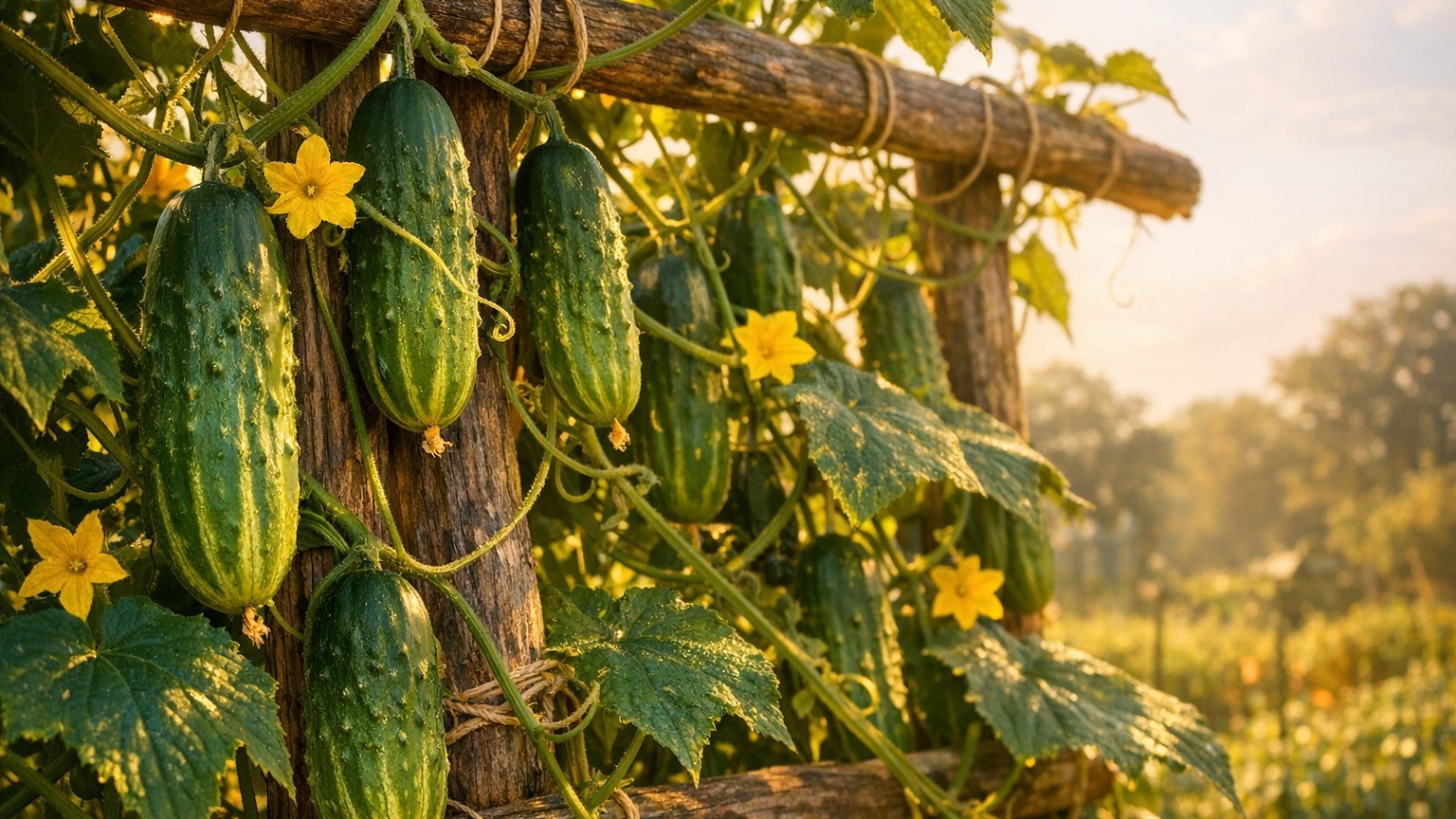

The best cucumber for California depends on where in the state you’re standing. Frost-free coastal and Southern California gardens favor parthenocarpic slicing types and successive pickling sowings across a nearly year-round window, while the Central Valley, Sierra foothills and Northern California interior work a shorter, frost-bound season and lean on heat-tolerant bush types. Check your county’s UC ANR office for the named varieties trialled locally.
The short answer for California
Start with geography, not variety names. California’s frost pattern splits the state in two, and that split decides which type of cucumber makes sense before anyone picks a seed packet. NOAA’s 30-year climate normals for the coastal and Southern California reference station show zero days at or below 32°F across three decades, with the frost-free season logged at 365 days. That’s not a typo: the killing frost that shapes a cucumber calendar across most of the country simply doesn’t apply along the coast and through the southern basins.
That absence of frost turns the question from “when do I plant” into “how do I keep plants producing through heat and drought.” Where the season never really ends, gardeners can run successive sowings of pickling cucumbers every few weeks from spring through fall, staggering harvest rather than betting everything on one planting. Parthenocarpic slicing types, the kind that set fruit without needing bee visits, earn their keep in coastal fog belts where onshore haze can suppress pollinator activity for days at a stretch.
Heat is the other half of the decision, and here the numbers need a caveat. The reference station behind these normals, coastal Los Angeles, logs an average of only 2.4 days a year at or above 90°F, a mild figure that has little to do with what a gardener in Fresno, Bakersfield or the Sacramento Valley actually lives through. This page can only speak for the station its facts come from; inland heat loads run far higher, and a Central Valley gardener should treat that 2.4-day figure as background noise, not a forecast for their own soil. In that inland heat, bush-type cucumbers are the easier bet: less vine to shade, water and monitor, in a garden already working hard just to stay irrigated.
One more mechanism worth naming: California summers are close to rain-free. Combined June, July and August rainfall averages about 0.1 inch at the reference station, with August alone averaging 0.0 inch. That dryness suppresses the fungal and mildew pressure that pushes gardeners in humid states toward strict trellising and wide spacing. Here, vining types on a trellis and vining types left to sprawl can both succeed, since the disease risk that usually drives that choice barely exists in a California summer. Trellising still earns its place for a different reason: it concentrates irrigation water where roots need it and keeps fruit off hot soil.
For the exact cultivar names trialled and recommended near you, check with your county’s University of California Cooperative Extension office rather than a national seed catalog description written for the whole country.
What will not work here

Long-maturing, late-main-season pickling types that need a full frost-free stretch to finish are a poor bet anywhere in California except the coastal and southern zones where that 365-day frost-free normal actually holds. Move into the Central Valley, the Sierra foothills or Northern California’s interior, places that NOAA’s own frost data confirm still freeze in an average year, and a long-season type sown late risks running out of warm days before the first fall frost. The frost-free figure in these facts describes one reference station, not the state, and treating it as a statewide guarantee is the most common mistake a gardener transplanted from a milder climate makes here.
Watering on a once-a-week schedule, an interval that gets away with itself in wetter states, fails in California for a simple reason: there’s almost nothing behind it. Summer rainfall averages roughly 0.1 inch across June, July and August combined, and August alone averages 0.0 inch. Cucumbers are close to 95 percent water by weight and stall or turn bitter under moisture stress, so a plant relying on a weekly soak with no rain to fill the gaps runs on empty for most of that week, especially once inland heat (well above the mild 2.4-day average logged at the coastal reference station) pulls moisture out of the topsoil faster than a weekly schedule can replace it.
Matted, ground-level vining, often justified elsewhere as protection against humidity-driven disease, doesn’t carry the same logic in a state this dry. The problem here isn’t mildew, it’s contact: fruit lying on baked, irrigated soil through a rain-free summer are prone to sunscald on the exposed side and soft rot where they sit against wet drip-line soil. Getting fruit up off the ground, even with a simple trellis or a bed of straw, solves a California-specific problem, not a generic one.
Finally, assuming a single statewide planting calendar will not work, because California isn’t one climate. A calendar built around the frost-free coastal reference station, applied to a mountain valley or high-desert garden in a colder pocket of the state’s 5a-11a hardiness range, sets a gardener up to seed into cold soil, or to lose a late crop to a frost the coastal calendar never accounts for.
What changes across California
California carries six USDA Plant Hardiness Zones within its own borders, from 5a to 11a, according to the USDA Plant Hardiness Zone Map built on 1991-2020 normals. That’s a wider spread than most countries manage, and it means “California” isn’t a useful unit for a planting decision on its own.
| Region type | Where it sits in the state’s 5a-11a range | Frost pattern | What it means for cucumbers |
|---|---|---|---|
| Coastal and Southern California | Toward the warm end, near 11a | Frost-free in an average year (0 days at or below 32°F) | Growing window set by heat and water, not frost; near year-round successive sowings |
| Central Valley and interior foothills | Mid-range zones | Freezes recorded in an average year | Season runs spring to fall, bounded by a real killing frost on both ends |
| Sierra Nevada and higher elevations | Toward the cold end, near 5a | Hard frost typical at both ends of the growing season | Short frost-free window; timing matters more here than variety choice |
Elevation does inside-state work that latitude does on a bigger map elsewhere. A garden at higher elevation in the Sierra foothills can sit in a colder zone than a garden hundreds of miles further north but closer to sea level, which is why zone alone, not distance from the equator, drives so much of the difference here.
Coastal fog is its own variable inside the state’s frost-free zone. Marine influence keeps summer temperatures milder along the immediate coast than the days-above-90 figure alone suggests for a garden even a short drive inland in the same county, part of why one reference station describes frost pattern well but heat load poorly for large stretches of the state.
None of this tells an individual reader which zone sits under their own garden. The only reliable way to place yourself inside that 5a-11a range is the USDA Plant Hardiness Zone Map itself, searchable by ZIP code, a far more precise starting point than any statewide description.
Where to check this for your own county
This page describes California at the state level, and a county-level recommendation from University of California Cooperative Extension (UC ANR) will always beat it. UC ANR is the state’s land-grant extension network, and its county and regional offices publish planting calendars and variety trial results built on local trial gardens, not a single statewide reference station.
Start at ucanr.edu and look for two things: a county or regional planting calendar for cucumbers, and any variety trial list naming cultivars that performed well in that county’s soil and climate. A coastal San Diego County office and an inland Fresno County office are drawing on different trial data, even though both fall under “California,” and the varieties each names will reflect that difference in a way a state-level page can’t.
Master Gardener programs run through UC ANR county offices are also worth searching by name, since many keep their own seasonal cucumber guidance and can answer soil or pest questions a general resource has no way to anticipate. If a county page lists a planting window that differs from the frost-free assumption used here for the coastal and southern reference, trust the county page. That’s the point of going local: it already accounts for the elevation, fog or interior heat that a state-level answer has to average away.
Because so much of California gardens under active water restrictions in dry years, county extension pages are also the place to check current watering guidance for vegetable beds, since a drought designation and local rules can shift mid-season in ways no fixed planting page can track. Some county offices also publish recommended indoor seed-starting dates for gardeners at higher elevation or in the Central Valley, where a head start under grow lights buys back weeks lost to a shorter frost-free window, a level of detail a six-zone statewide range can’t responsibly provide.
Checking this against your own garden
Every figure on this page describes a 30-year normal, not this year, and not your specific yard. Three plant-based signals will tell you more about your own microclimate than any calendar.
Soil warmth by feel. Push a finger a couple inches into the bed before sowing. Cucumber seed sits and rots in cold soil rather than germinating, so ground that still feels cool and slightly clammy in the morning, even after a warm afternoon, is telling you the soil hasn’t caught up with the air yet, common in a coastal fog pocket even inside a technically frost-free zone.
The first flush of male flowers. Cucumbers typically open several male flowers before the first female flower, the one with a tiny swelling at its base, appears. A plant throwing male flowers steadily with no females yet isn’t behind schedule, it’s working through its normal sequence; a plant that drops flowers altogether under a heat spike is signaling stress beyond what it can handle where it’s planted.
The first true leaves. The rounded seed leaves that appear first aren’t the plant settling in; the jagged true leaves that follow are. How quickly true leaves show up after germination is a rough read on whether your particular bed, with its own sun exposure and drainage, is running warmer or cooler than the general regional pattern. A slow appearance in a spot expected to be warm is worth a second look at shade or drainage you might have underestimated.
None of these require anything beyond a look and a finger in the dirt, and together they outrank a printed date, because they’re reporting on the actual bed instead of a 30-year average.