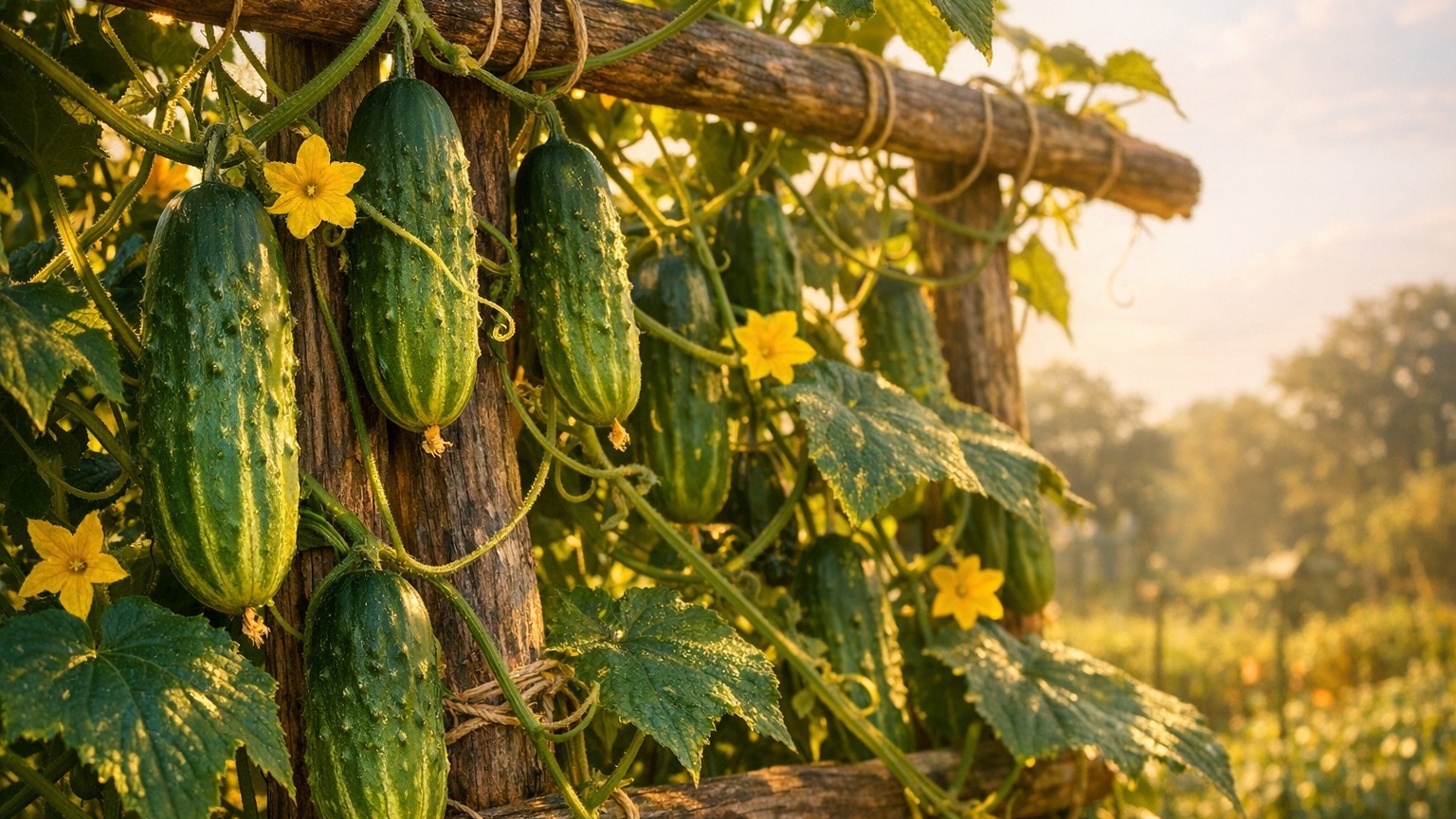

Colorado’s cucumber question comes down to season length and dryness, not soil or sun. A roughly 150-day frost-free window on the Front Range favors fast, compact pickling and bush types, while burpless and standard slicing types do fine wherever the season runs long enough for vines to sprawl. Mountain towns and the western slope shift that answer again, and county-level trial data settles the rest.
The short answer for Colorado
Bush and compact-vine pickling types are the safest bet across most of Colorado, and parthenocarpic (self-fruiting) burpless types are worth the extra label-reading in years when pollinators are scarce during the hottest stretch of summer. Standard vining slicers work too, but mainly where the frost-free window runs on the long side of the state’s range.
Reading the season length
At the Front Range reference station, the last spring frost falls between May 1 and May 11, and the first fall frost arrives between September 30 and October 12 (NOAA NCEI 1991-2020 Climate Normals, station USW00003017). That puts the frost-free window at roughly 141 to 164 days, measured at 5,280 feet on the plains. That’s enough time for nearly any cucumber type to reach full production, provided it goes into warm soil promptly rather than on the calendar date alone. Mountain towns run a shorter version of that same math, sometimes short enough that a July frost is a real risk rather than a rare one, and the western slope runs on its own separate timeline again.
Reading the heat and water load
Denver averages 39.6 days a year at or above 90F (NOAA NCEI Climate Normals 1991-2020), and summer rain totals only about 5.7 inches across June, July and August, with August the driest month at 1.58 inches. That combination, real heat paired with light rainfall, is why parthenocarpic and burpless types earn their keep here: heat stress can knock back the bee activity standard varieties depend on for fruit set, and a plant that sets fruit without pollination keeps producing through a hot, dry stretch that would stall one relying on insects. Bush types also make sense where watering is done by hand or drip line, since a compact plant needs less soil area kept consistently moist.
None of this points to one named variety. It points to a type, and the type that survives best on your own block is the one your county extension office has actually trialled.
What will not work here

Cucumber varieties bred for a long, humid growing season are the first thing to fail at higher elevations within Colorado. A frost-free window that can run as short as 141 days on the plains, and considerably shorter in mountain valleys where July frost is a documented risk, doesn’t leave room for a slow-finishing variety to catch up if a cool spring delays planting by even two weeks.
Weekly watering does not survive this heat
A watering routine built around once-a-week soakings, common advice in wetter states, runs into trouble against 39.6 days a year at or above 90F and barely 5.7 inches of rain across the whole summer. Cucumber fruit is mostly water, and the plant’s shallow root system draws from the top several inches of soil, the same layer that dries fastest under Colorado’s combination of heat, low humidity and near-constant plains wind. A single deep soaking a week can leave the plant short on the hot days in between, and the result shows up as bitter fruit, blossom drop, or fruit that stalls halfway through sizing.
Daily light watering fails for a different reason
Overcorrecting with a quick daily sprinkle causes its own trouble. Light, frequent watering keeps only the top inch of soil moist, training roots to stay shallow instead of reaching down where moisture lasts longer, which leaves the plant more exposed on the next 90-degree day, not less. A deep soak two or three times a week, rather than a daily splash, works with this climate’s rainfall pattern instead of against it.
Bare, exposed ground next to a dry vine
Planting cucumbers on bare, unmulched ground, a technique that gets by in a humid state, behaves differently in Colorado’s dry heat. There isn’t the fungal pressure of a humid Southeast garden to manage, but bare soil around a shallow-rooted plant bakes and cracks fast under close to 40 days a year above 90F, pulling moisture away from the root zone exactly when the plant needs it most. Mulch does more work here against evaporation than against disease, a different job than it performs in a wetter state.
What changes across Colorado
Colorado’s USDA Plant Hardiness Zone spans 3b to 7b (USDA Plant Hardiness Zone Map 2023, based on 1991-2020 normals), a range built on average annual extreme minimum temperature. That’s one of the widest spreads of any state on the map, and it means there is no single cucumber answer for Colorado, only answers that shift with elevation and location.
The high country
Mountain towns at the colder end of that range work with a season measured in weeks, short enough that the state’s own frost data flags July frost as a real possibility. A gardener there gets more out of starting cucumbers as transplants rather than direct-seeding, and choosing the fastest-finishing type available, since there’s little margin to recover from a slow start or a mid-season cold snap.
The Front Range and eastern plains
Denver’s reference-station numbers, a frost-free window of roughly 141 to 164 days and 39.6 days a year above 90F, sit closer to the middle of the state’s zone range. This is where the widest mix of cucumber types, bush, vining, pickling and slicing alike, has enough season and heat to finish reliably, provided the water side is managed against that light summer rainfall.
The western slope
Areas at the warmer end of Colorado’s zone spread, including lower-elevation western slope valleys, run on a separate climate pattern from the Front Range, with different rainfall timing and a longer effective season. A gardener there has room for longer-maturing slicing types that would be a gamble in the mountains, but still needs to watch water closely, since warmer zones in this state tend to pair with drier summers, not wetter ones.
None of this tells an individual reader which zone applies to their own yard. The USDA hardiness zone map, checked by ZIP code, does that job.
Where to check this for your own county
Colorado State University Extension is where this state-level answer needs to be checked, because a county recommendation beats a state one every time, and everything above this point is the state one.
Two things are worth pulling from that resource. The first is the local planting calendar for your own county, which translates the state-level frost dates cited earlier into a working window for a specific elevation and microclimate, rather than the plains-based reference station used in this article. The second is the list of cucumber types local extension agents or master gardener programs have actually trialled in demonstration gardens nearby, which carries more weight than any general recommendation because it’s been tested against your specific combination of soil, elevation and water availability.
This matters more in Colorado than in a state with a tighter hardiness range, because the spread from zone 3b to 7b means a recommendation built around Denver’s numbers can miss badly for a garden 5,000 feet higher or two hundred miles west. A quick call or email to the county office also surfaces detail no published calendar covers, like which years have run unusually late for frost, or which local water rules might affect a plan built around cucumbers’ need for consistent moisture.
Checking this against your own garden
Every date and average cited above describes a reference station or a statewide range, not the particular patch of soil a reader is planting into. Three direct observations settle that difference better than any calendar.
Soil warmth by feel comes first. Cucumber seed sits and rots in cold soil no matter what the calendar says, so pressing a hand into the planting bed a few inches down, before the sun has warmed the surface, gives a better read than the frost date alone. Soil that still feels cool and damp rather than warm and dry is telling the gardener to wait, whatever the reference station’s average predicts that week.
The first flush of male flowers comes before the female flowers that set fruit, and on most cucumber plants that gap runs about a week to ten days. Seeing only male flowers isn’t a problem, it’s the plant’s own signal that fruit set is close, and it’s a more reliable marker than counting days since planting.
The first true leaves, the serrated ones that follow the smooth seed leaves, mark the point where the plant shifts from living off seed reserves to running on its own roots. A slow, pale set of true leaves on a plant that was watered and planted correctly usually points to soil that’s still cooler than it looks, a useful flag for a garden sitting in a shaded or low-lying spot that runs colder than the county average suggests.