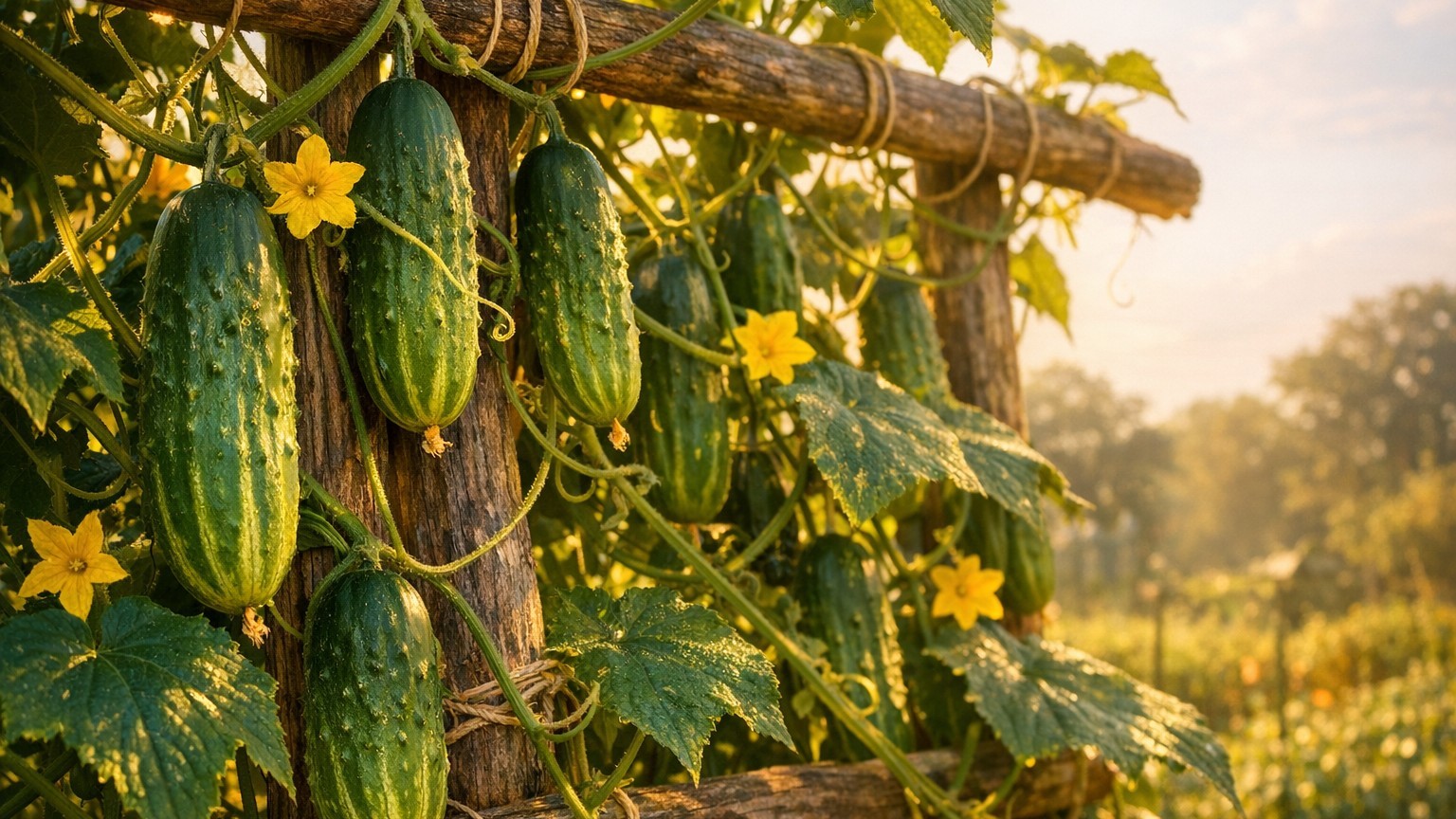

Delaware’s long, humid growing season favors heat-tolerant slicing and pickling cucumbers over anything bred for short, cool summers. Parthenocarpic and burpless types generally outperform old-fashioned vining slicers here because they shrug off the humidity that fuels fungal disease. The right pick still depends on whether you want slicers, picklers, or something compact for a trellis, and your county extension office has the final say on what’s been trialled locally.
The short answer for Delaware
Start with the numbers that actually drive the decision. The reference station at Wilmington sees its last spring freeze between April 3 and April 14, and its first fall freeze between October 26 and November 7. That’s a frost-free window of roughly six and a half months, plenty of time for nearly any cucumber type to mature, set fruit, and produce a second flush if the first one gets cut short by disease or a beetle infestation.
The number that matters more than season length is heat load. Wilmington averages 17.6 days a year at or above 90F. That’s not extreme compared to the Deep South, but it’s enough to stress cool-season crops and to push cucumber vines into rapid, sometimes uneven fruiting. Types bred for heat tolerance, meaning they keep producing and don’t turn bitter or misshapen once soil temperatures climb into the 80s, have a real edge over varieties selected for shorter, milder summers further north.
Slicing, pickling, or trellis: pick by use, not by name
For fresh eating, look for slicing types described as burpless or Asian-style. These tend to have thinner skin and fewer seeds, and they handle the humidity-driven leaf diseases common in Mid-Atlantic summers better than thick-skinned American slicers. For canning and pickling, dedicated pickling types (bred for uniform small fruit and crisp texture) are the standard choice, and many are also parthenocarpic, meaning they set fruit without pollination, which helps on years when bee activity is inconsistent during a wet June.
If garden space is tight, a bush-type cucumber saves real estate without giving up much yield, while vining types trained up a trellis actually do better here than left on the ground, since airflow around the leaves cuts down on the mildew that Delaware’s humid summers practically guarantee. None of this requires a specific brand or cultivar name. It requires matching the type to your space and your kitchen goals, then checking with the Delaware Cooperative Extension for which specific varieties of that type have actually performed well in local trials.
What will not work here

The single biggest failure point in Delaware cucumber patches isn’t cold, it’s humidity meeting poor airflow. Summer rainfall averages about 13.1 inches across June, July, and August, and it doesn’t arrive evenly. June brings 4.67 inches, July 4.41, and August drops to 3.98, often in the form of scattered thunderstorms rather than steady soaking rain. That pattern means leaves get wet, dry slowly in the thick air, and stay wet again by the next storm. Vining types left sprawled on the ground in that cycle are a textbook setup for powdery and downy mildew. Anyone growing here without a trellis or at least generous spacing between plants is fighting an uphill battle against fungal disease all summer.
Weekly watering is another quiet failure mode. With 17.6 days a year above 90F, evaporation demand spikes hard during heat waves, and a single thunderstorm that dumps an inch of rain in twenty minutes mostly runs off instead of soaking in, especially on the sandier soils common in southern Delaware. A garden watered once a week on a fixed schedule will look fine in a mild stretch and then show blossom drop and bitter fruit the moment a heat spell hits. Cucumbers need consistent soil moisture, not a weekly dump, and that’s truer here than in a drier, cooler climate where the same schedule might hold up.
Finally, don’t bother with types bred specifically for short-season northern climates, the ones marketed as fast-maturing for regions with a 90-day summer. Delaware’s frost-free window doesn’t need that trade-off, and those varieties are often bred with less heat tolerance, since their developers never had to worry about 90-degree stretches. Planting far too early is a related mistake: soil needs to be warm, not just frost-free, so sowing right at the earliest possible date in early April, before the soil itself has caught up, usually means poor germination rather than an earlier harvest.
What changes across Delaware
Delaware is a small state, but it isn’t one garden. The USDA Plant Hardiness Zone Map places the state across a 7a to 8a range, and that spread matters more than the state’s size might suggest. Zone 8a, generally the warmer end found closer to the coast and in southern Sussex County, means a milder average extreme minimum winter temperature and typically a longer effective growing season than the 7a conditions found further north and inland, closer to the Wilmington reference station used for the frost dates above.
That difference shows up in two practical ways for cucumber growers. First, timing: a garden in the warmer southern part of the state can often push planting a little earlier in spring and stretch harvest a little later in fall than the Wilmington frost dates suggest, since those dates come from one specific airport station, not a statewide average. Second, heat stress: if the southern zone runs warmer overall, the practical heat load on the plants, and the water demand that comes with it, is likely higher there than the 17.6-day average calculated from the Wilmington station.
There’s no single hardiness zone for Delaware, and there’s no single answer to when to plant or how much water a cucumber patch needs statewide. A gardener in the north should treat the Wilmington frost dates as a reasonably close reference. A gardener further south or right along the coast should expect the frost-free window to run a bit longer in both directions, and should watch soil moisture even more closely given the added heat. Neither reader should try to guess which side of that 7a to 8a line they fall on from this page. That’s a job for the USDA hardiness zone map itself, checked by ZIP code.
Where to check this for your own county
Everything above is a state-level starting point, built from one reference weather station and a statewide hardiness range. It is not a county recommendation, and county recommendations are what actually settle these questions. The University of Delaware’s Cooperative Extension is the resource built for exactly that gap, and it’s worth going straight to it rather than guessing.
Two things are worth asking for specifically once there. First, a local planting calendar for vegetables, ideally one built around your specific county rather than the state as a whole, since as shown above the frost-free window genuinely shifts between the northern and southern parts of Delaware. Second, and more useful for the question this page is actually about, ask for the list of cucumber varieties that extension agents or master gardener programs have trialled in your area. That list will name actual cultivars, tested against actual local disease pressure and actual local soil, something a state-level overview like this one is not positioned to do responsibly.
A county-level recommendation will always beat a state-level one, for the simple reason that it’s measured closer to your own soil and your own microclimate. This page draws on frost dates, heat averages, and rainfall normals gathered at a single reference station and rounded into a statewide picture. Extension offices work at a finer grain, often down to specific demonstration gardens within a county, and that’s the level of detail that actually changes which packet of seed goes in the ground.
Checking this against your own garden
Every date and average on this page is a starting estimate, and your own garden will always have the final word. Three signs are worth tracking by hand, no gadgets required.
- Soil warmth by feel: press a finger a couple of inches into the bed in mid-morning. If it still feels cool and damp rather than mild and slightly dry, the soil hasn’t caught up to the calendar yet, no matter what the frost date says.
- The first flush of male flowers: cucumbers typically send out male blossoms before the female flowers that actually set fruit appear. Seeing plenty of male flowers with few or no females yet is normal early on, but if that stage drags on for weeks in hot weather, heat stress or inconsistent watering is usually the cause.
- The first true leaves: the rounded seed leaves that appear first don’t tell you much, but the jagged true leaves that follow are a better read on vigor. Slow, pale true leaves in a bed that’s supposedly warm and watered on schedule usually point to a soil or drainage issue specific to that spot, not a regional climate problem.
None of these observations require a soil thermometer or a rain gauge, though both help if you already own one. They just require walking the bed a few times a week and comparing what you see against what the state averages predicted. When the two line up, the calendar is doing its job. When they don’t, your own plot is telling you something the averages can’t.